

GDPR-Compliant Donor Data Management: A Practical Guide for International Nonprofits
Managing donor information across different countries has become a delicate and complex task. The regulations are constantly changing, the risk of cyberattacks is mounting, and donors are demanding nothing short of complete anonymity for their personal information. Trust in the nonprofit world, which directly impacts the fundraising results, cannot be compromised at any point. Hence, GDPR-compliant donor data management has become the norm worldwide for organizations handling international donor information. Nonprofits adopting these postures self-protect, build donor trust, and stay aligned with global trends.
The issue of nondisclosure persists for many nonprofits regarding how to handle international data, particularly when donations come from multiple countries. This guide will break it down for you. You will know what GDPR is, its impact on donor management, the reasons for its emergence as a global standard, and the steps your organization can take to implement a clear and secure policy without disrupting your regular workflow.
What Makes GDPR Important for Donor Data?
The global nonprofit sector relies on donor support across continents. GDPR applies immediately when EU donors engage with your website or submit a donation form. This has become a global responsibility for organizations handling transnational donor information; GDPR-compliant donor data management is no longer confined to European nonprofits.
GDPR is all about empowering individuals with their personal data. Nonprofits must ensure they acceptably collect donor information, store it securely, and use it exclusively for the stated and agreed-upon purposes. The donors expect no less than the organization to be serious about their privacy. By adopting the principles of GDPR, you not only comply with the regulations but also strengthen your ties with your supporters.
Why International Nonprofits Need a Unified Data Framework

When donations come from different countries, nonprofits often use many tools—payment gateways, CRM systems, fundraising platforms, and email services. This creates scattered data. Distributed data leads to errors, inconsistent practices, and security vulnerabilities. A common strategy enables your enterprise to apply the same set of regulations across all channels through which donors contact.
GDPR-compliant donor data management is at the heart of this system. It is much simpler to guarantee that all the platforms you use adhere to the same privacy standards if a coherent framework is in place. Such alignment is necessary not only to safeguard the international donor but also to ensure a transparent audit trail whenever regulations require it.
A clear framework also helps your team avoid confusion. Staff members can rely on a standardized process instead of guessing what is allowed and what is not. This reduces risk and improves daily operations.
Core Principles of GDPR for Donor Data
1. Transparency
Nonprofits have a duty to disclose to contributors how their data will be used. Among the uses are receipts for donations, newsletters, event updates, and personal outreach. Transparency is the foundation of trust and helps contributors feel confident in their decision to support your cause.
2. Purpose Limitation
Data collected for one purpose cannot be used for another without the expressed consent. If a donor attends the charity event solely to receive the ticket, the organization cannot automatically add them to the marketing list. This principle is essential to GDPR-compliant management of donor data and protects donors against the misuse of their personal data.
3. Data Minimization
Limit data storage to only what you need. Many charities receive more information than necessary, which increases risk. Minimization reduces risk and keeps your databases clean and accurate.
4. Accuracy and Updates
Donors should have the right to request amendments or to get their information updated. One of the main aspects of data governance and responsible stewardship is keeping data accurate.
5. Storage Limitation
Data must not be held longer than necessary. An accurate retention policy is part of GDPR-compliant donor data management and helps charities dispose of information that is no longer current or relevant.
6. Security and Protection
Encryption, access control, secure storage, and strong authentication are all part of the protection measures. Such security measures not only prevent unauthorized access to the donor’s identities and transaction details but also protect them from public disclosure.
7. Accountability
Nonprofits and charities must continually verify that they comply with privacy laws. This proof can consist of documentation, access logs, data maps, and policies that support everyday operations.
How GDPR Affects Communications with International Donors

Unsolicited messages not only breach GDPR but also cause mistrust. Donors would rather receive notifications that are both meaningful and relevant to them than surprise emails. When donor data management, which is GDPR-compliant, is integrated with consent-based communication, it becomes easier for non-profits not only to maintain strong engagement but also to maintain their credibility.
What Makes Nonprofits Ignore GDPR?
Noncompliance with the GDPR is not a way out. The legal penalties, reputational damage, and donor mistrust are risks that even the smallest nonprofits face. When overseas donors perceive your data use as unclear, they may withhold their support next time. A single incident of security breach or misuse of data could put a big dent in your fundraising efforts for several years to come.
However, by implementing patient-centered, responsible procedures, non-profits mitigate these risks and demonstrate their readiness to comply with global privacy requirements.
The Fundamental Characteristics of a Donor Management Process Compliant With the GDPR
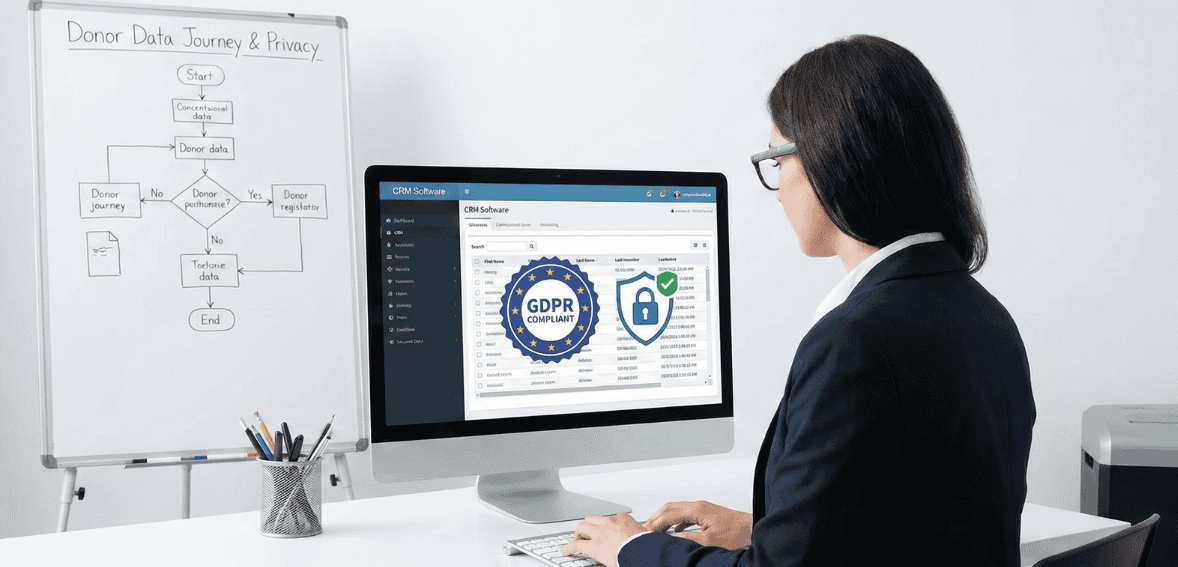
1. Consent-Based Data Collection
The consent requirement must be clear, easy to understand, and free of pressure. Nonprofits should not employ pre-checked boxes or hidden terms. A straightforward consent form not only builds trust but also makes GDPR compliance for donor data management easier from the outset.
2. Secure Digital Storage
The storage of donor data necessitates secure databases. Encryption and access control are both compulsory. This is to ensure that no unauthorized individuals can gain access to the data and that donor information is secured.
3. Data Mapping and Documentation
Nonprofits are required to know the sources of donor data, the places it goes, the people accessing it, and the duration it stays in the system. A documented map assists audits and internal reviews.
4. Managing Donor Rights
Donors are entitled to request updates, have their data deleted, or receive a copy of their information. Organizations are required to offer a straightforward process for such requests.
5. Personnel Training
The staff is a key player in compliance. Periodic training helps ensure that everyone is knowledgeable about the rules and the proper way to apply them. Training also helps build confidence in managing GDPR-compliant donor data across all departments.
6. User-Friendly Privacy Policies
Donors want clear, legible explanations. The use of complex policies leads to misunderstanding. The use of simple language empowers the donors and indicates that their privacy is respected.
Responsible Data Practices to Build Donor Trust
The main pillar of philanthropy is trust. Donors are more likely to give and even to give more if they feel secure and connected to the charity and respected by it. Your organization’s values are reflected in your data management practices. If your nonprofit organization handles donor data in compliance with the GDPR, it can demonstrate that it cares not only about fundraising but also about the confidentiality of donors’ personal data. Such an approach will lead to improved relationships, more donors staying with you, and a stronger image of your organization across the world.
GDPR’s Effects on Nonprofits in the United States
The U.S. nonprofit sector often asks whether GDPR affects its operations. The response is affirmative if their contributors reside in the European Union or if their marketing is aimed at an international audience. GDPR applies to all organizations that process data of EU residents, even if they have no physical presence in Europe.
This characteristic is what makes the management of donor data in accordance with GDPR a worldwide standard. Local regulations are no longer sufficient, and nonprofits must comply with international standards, especially when their fundraising is cross-border.
Challenges Faced by Nonprofits Regarding International Data

1. Fragmented Systems
Many nonprofits use various tools for fundraising, communications, and donor management, which can lead to inconsistencies and confusion.
2. Lack of Team Training
The teams usually do not get the necessary privacy training. Hence, errors occur. Training improves privacy accuracy and lessens the chances of violations occurring.
3. No Clear Consent Policies
Some nonprofits accept donations while lacking clear consent. This practice can give rise to legal problems and loss of trust.
4. Outdated Records
The existence of old or incorrect records increases the risk factor. Nonprofits need structured retention and update processes.
5. Limited Documentation
Organizations without adequate documentation struggle to justify compliance. A structured process fosters consistency.
These challenges make it clear that a robust, well-defined system is necessary.
Why a Structured Privacy System Strengthens Nonprofits
Nonprofits benefit in several ways:
1. Stronger Donor Relationships
Donors value transparency. When they know their data is safe, they feel more confident.
2. Reduced Legal Risk
The use of a standard privacy procedure protects charity organizations from the aforementioned consequences, including reputational damage and fines.
3. Unified International Operations
Teams can manage donor information from any region using the same rules.
4. Enhanced efficiency
Ambiguity impedes decision-making, making it impossible to conduct daily operations without clear guidelines.
5. Better Data Quality
Accurate data leads to better fundraising strategies and more meaningful engagement.
All of these benefits come from the use of GDPR-compliant donor data management as the foundation for your operations.
Best Practices for International Donor Data Management

1. Use Clear Consent Forms
Make your forms easy to understand. Include checkboxes that donors can select voluntarily. Avoid small print and hidden terms.
2. Store Data in Encrypted Systems
Encryption protects donor identities and financial details, and adhering to PCI-DSS payment standards is one of the most important elements of GDPR-compliant donor data management.
3. Limit Access to Authorized Staff
Donor information should only be accessible to specific staff members. This practice, in addition to reducing the likelihood of internal misuse, also enhances security.
4. Regular Review of the Privacy Policy
Laws and regulations are changing. Your organization’s policies should be aligned and reflect the latest requirements.
5. Create a Data Retention Schedule
Cleansing your database should be a regular activity. Old records that serve no purpose must be removed, and only the essential ones retained.
6. Conduct Periodic Audits
Audits are a method of evaluating your strengths and weaknesses. They also assist in demonstrating compliance.
7. Train Your Team Often
Frequent training acts as a constant reminder of privacy roles for everyone.
8. Keep Clear Records
Keep a documentation of your methodology. Good documentation is essential for audits, future planning, and security throughout the life cycle.
Addressing Donor Rights Under GDPR
Donors have several rights under GDPR:
- The right to access their information
- The right to update or correct details
- The right to request deletion
- The right to limit data use
- The right to receive a copy of their data
A smooth, straightforward process enables nonprofits to easily satisfy these rights while keeping donors content. This also enhances GDPR-compliant donor data handling, as it demonstrates that your company respects global privacy regulations.
Get Your Nonprofit Ready for Cross-Border Compliance
International donations by nonprofits require compliance with standard procedures. First, evaluate your current systems. Point out the voids, risks, and possible enhancements.
Your organization can also adopt clear policies that cover global operations. This ensures that every donation, registration, or interaction follows the same privacy rules.
This is where cross-border data compliance solutions become valuable. They help nonprofits manage complex international data regulations with ease.
Maintaining Security Across Global Fundraising Platforms

For a lot of organizations, online platforms, social media, events, and third-party donation systems are significant sources of fundraising. These platforms must comply with global regulations. Many fundraising platforms now come with built-in compliance tools, audit logs, and privacy settings.
You can review platform documentation, privacy manuals, and security attributes to ensure they meet your requirements. Some platforms also provide independent audit reports that prove compliance.
Special Considerations for Multi-Country Donors
International donors often have unique expectations. They interact with your organization through many channels—email, payment forms, websites, and events. They should be able to maintain their privacy wherever they are, and the systems should support that.
Using the right platform that puts security and compliance first is one of the best ways to handle this complexity. A platform ensures that there is accuracy, consistency, and clarity.
This is where international donor data security becomes a key concern. Donors expect top-tier protection across all digital touchpoints.
Industry Standards That Support GDPR
Many organizations working for the benefit of society follow global frameworks to simplify compliance. Among them are:
- ISO 27001 standards for cybersecurity
- SOC 2 requirements for data protection
- PCI-DSS payment security rules
All these standards align with GDPR principles and enhance organizational operations. By adopting these standards, nonprofits not only gain credibility but also create a more trustworthy environment.
This is directly related to the standard of data protection in the non-profit sector, which gives a uniform and professional treatment.
Aligning Fundraising Efforts With Global Regulations

The behavior of the donors is constantly changing. Supporters want to be confident in transparency, privacy, and the responsible handling of their data. Nonprofits will be acting with integrity if they combine their fundraising with compliance rules.
This is where global fundraising data regulations affect the non-profit sector. Stricter privacy laws are being enacted across countries, so nonprofits must be prepared to adapt their operations before issues arise.
Conclusion
Nonprofits’ strength is enhanced by how they handle and protect donor information. By treating donor data with the same care as your mission, you build confidence and trust with your supporters, minimizing risk and driving more donations being made —regardless of geographic location. A review of your organization’s existing processes and tools, along with implementing the appropriate tools, will enable you to effectively manage donor data globally. For privacy-centric solutions designed specifically for the global fundraising community, look to CloudStudioManager.com for platforms that help you stay compliant, secure, and grow.
FAQ
Does GDPR apply to nonprofits in the U.S.?
Definitely, if EU contributors engage with your website or make a donation, your nonprofit organization will be required to comply with GDPR requirements.
Is GDPR only applicable to data storage?
Absolutely not; it is a comprehensive regulation that involves every stage in the processing of donor information, that is, collecting, using, sharing, and storing.
Can a donor request that their data be deleted?
Of course, donors are always entitled to request deletion, changes, or a copy of their data.
What is the safest method to protect donor information?
The application of robust access control measures, encryption, and consistent compliance practices has been credited with securing donor data.
How does responsible donor data management build trust?
The transparent and careful processing of donor information conveys recognition and trust that lasts a long time.