
Best Nonprofit CRM Tools for 2026
Nonprofit teams are being asked to do more with less: raise more, retain more, prove impact more clearly, and report faster—without adding headcount. That’s why the best nonprofit CRM tools for 2026 are no longer just “donor databases.”
The strongest nonprofit CRM tools now sit at the center of fundraising, communications, program delivery, volunteer management, finance handoffs, and analytics.
In 2026, the gap between “good enough contact management” and a true mission system is widening fast. AI-driven personalization, automated data hygiene, flexible integrations, and multi-channel constituent journeys are becoming baseline expectations—especially for organizations competing for recurring gifts and major gifts.
At the same time, leadership is more cautious about data privacy, vendor lock-in, rising subscription costs, and fragile integrations.
This guide breaks down what matters most when choosing nonprofit CRM tools, then walks through the best nonprofit CRM tools for 2026 across different sizes and operating models—plus practical selection steps, implementation advice, and realistic future predictions.
What “Nonprofit CRM” Means in 2026 and What You Should Demand
A modern nonprofit CRM is a constituent relationship system: it tracks every interaction a supporter has with your organization (donations, emails, event attendance, volunteering, peer-to-peer fundraising, memberships, advocacy actions, and sometimes service delivery).
The reason nonprofit CRM tools matter so much in 2026 is simple: most fundraising and engagement problems are data problems in disguise.
If your records are incomplete, duplicated, or disconnected from giving and communications, your team wastes hours doing manual lookups, exporting lists, cleaning spreadsheets, and guessing which message will resonate.
The best nonprofit CRM tools for 2026 reduce that chaos by centralizing data, automating workflows, and helping teams act on insights quickly.
In practice, you should demand five outcomes from your shortlist of nonprofit CRM tools:
- A single constituent profile that shows giving history, engagement, relationships, and preferences.
- Automation for receipting, stewardship, reminders, lapsed donor reactivation, and task assignment.
- Built-in or integrated fundraising (donation forms, recurring giving, event registrations, peer-to-peer).
- Reporting you can trust, including campaign performance and retention metrics.
- A clean integration path with email, accounting, payment processing, your website/CMS, and analytics.
The best nonprofit CRM tools for 2026 also reflect the new reality: many supporters behave like subscribers. They expect personalized communication, easy mobile giving, transparent impact updates, and frictionless recurring options.
That means your CRM must support segmentation, lifecycle journeys, and consistent data hygiene—without requiring a full-time database administrator.
Core modules checklist for nonprofit CRM tools in 2026
When comparing best nonprofit CRM tools for 2026, evaluate whether the CRM can cover your current needs and the next 24 months of growth. A practical checklist includes:
- Constituent management: households, relationships, interaction timelines, custom fields, and tags.
- Gift management: one-time, recurring, pledges, soft credits, tribute gifts, matching gifts, and acknowledgments.
- Digital fundraising: donation forms, text-to-give, peer-to-peer pages, and campaign tracking.
- Events and memberships: registrations, ticketing, check-in, renewals, and benefits tracking.
- Volunteer tracking: roles, shifts, hours, and communications.
- Communications: email automation or tight integrations, templates, and engagement tracking.
- Reporting and dashboards: retention, LYBUNT/SYBUNT, campaign ROI, major gift pipelines, and forecasting.
- Security and permissions: role-based access, audit trails, and data export controls.
Some platforms bundle most of this natively; others rely on integrations. Either is fine—if reliability is high and ownership cost stays predictable. Vendors increasingly position their platforms as unified “giving ecosystems,” combining CRM + fundraising + engagement.
For example, Bloomerang describes its platform as connecting fundraising, donor management, and volunteer engagement.
The best nonprofit CRM tools for 2026 will make the checklist feel simple in daily use. If the tool checks every feature box but requires constant admin babysitting, it’s not a true upgrade.
Data model and governance that actually protect fundraising results
Data governance sounds boring—until it quietly kills revenue. In 2026, nonprofit CRM tools must do more than store contacts. They must help you protect data quality at scale.
Start with the data model. If your organization depends on household giving, employer matching, foundation relationships, or program participants who later become donors, you need a CRM that handles complex relationships cleanly.
If you run advocacy, you need action history and issue-based segmentation. If you rely on grants, you need restricted-fund tracking or at least reliable tags and reporting fields.
Next, consider governance and hygiene:
- Duplicate prevention and merge tools
- Required field logic for gift entry and contact updates
- Standardized naming, addresses, and salutations
- Permission boundaries so sensitive notes don’t leak across teams
- Auditability for finance reconciliation and donor disputes
This is also where AI is becoming practical. Several of the best nonprofit CRM tools for 2026 are leaning into AI to reduce administrative time and improve personalization.
Salesforce, for example, announced purpose-built AI agents for fundraising and related nonprofit work as part of Agentforce Nonprofit (formerly Nonprofit Cloud). Blackbaud also highlighted AI-driven capabilities such as predictive analytics and AI-generated donor acknowledgments in its Raiser’s Edge NXT innovation roadmap.
Your goal isn’t “AI because it’s trendy.” Your goal is fewer missed follow-ups, faster acknowledgments, better segmentation, and more consistent stewardship. The best nonprofit CRM tools for 2026 will treat data governance as a revenue lever, not an IT checkbox.
How to Choose Between Nonprofit CRM Tools Without Regret

Most CRM “regret” comes from two mistakes: choosing based on a demo instead of a workflow, and underestimating how fast costs grow as your database grows. In 2026, you can avoid both by using a decision process built around constituent journeys and total ownership cost.
Start by mapping 6–10 critical journeys. Examples:
- first-time online donor → welcome series → second gift → recurring upgrade
- event attendee → follow-up → donor conversion
- volunteer → engagement → monthly giving
- major donor prospect → cultivation touches → proposal → stewardship
- lapsed donor → win-back campaign
- grant-funded program participant → outcomes reporting
Then test each CRM against those journeys. Ask: “Can we do this with minimal exports, minimal manual work, and clean reporting?” If the answer is “yes, but with 8 integrations and three spreadsheets,” you’ll feel the pain later.
Also weigh your staffing reality. Some nonprofit CRM tools assume you have a database admin, a marketing specialist, and a finance counterpart who can reconcile data weekly. If you’re a lean team, prioritize tools that simplify daily execution.
Finally, consider ecosystem fit. If your team already runs on Microsoft tools, a Dynamics-based path might feel natural—but you must factor product lifecycle changes.
Microsoft’s Fundraising and Engagement solution is scheduled to stop receiving security updates and technical support after December 31, 2026. That is exactly the kind of roadmap detail that should influence your 2026 decision.
Total cost of ownership and pricing traps to watch
The sticker price you see during CRM research is rarely the full cost. For best nonprofit CRM tools for 2026, evaluate total cost across:
- subscription tiers and contact limits
- per-user fees
- fundraising add-ons (forms, events, texting, peer-to-peer)
- implementation and data migration
- training, support, and consulting
- integrations (Zapier, middleware, sync tools)
- payment processing and platform fees (when bundled)
The most common pricing traps in nonprofit CRM tools include:
- contact-based tiers that become expensive once your email list grows
- “affordable base” pricing that requires multiple paid modules
- “bundled” suites where the CRM is fine, but advanced reporting or automation costs more
- “discount year” pricing that steps up later
If your organization is growing, ask vendors for a 3-year projection based on realistic contact counts and module adoption. Don’t guess. A good vendor will help you forecast honestly.
Integrations and ecosystem fit in 2026
Nonprofit tech stacks are becoming more composable, not less. Even the best nonprofit CRM tools for 2026 won’t do everything perfectly. Your job is choosing where you want “native” versus “connected.”
Common integration requirements include:
- accounting software sync (batching, deposits, restricted funds)
- email platform (if not built-in)
- payment processor and online donation forms
- website/CMS forms and identity matching
- event check-in and ticketing
- analytics (GA4, dashboards, BI tools)
- wealth screening / prospect research
- document storage and collaboration tools
When vendors claim “we integrate with everything,” validate how deep the integration is. Is it a true bi-directional sync or a one-way export? Does it preserve campaign attribution and recurring gift metadata? Does it create duplicates?
The best nonprofit CRM tools for 2026 will win on integration reliability and data consistency, not just the number of logos on an “integrations” page.
Salesforce Agentforce Nonprofit (formerly Nonprofit Cloud)
If your organization needs enterprise-grade flexibility, multi-team collaboration, and a platform that can scale across fundraising and programs, Salesforce remains one of the strongest candidates among best nonprofit CRM tools for 2026. Salesforce positions Nonprofit Cloud as purpose-built to bring fundraising, programs, volunteer management, and outcomes together.
What makes Salesforce especially relevant in 2026 is its push toward AI-supported workflows. Salesforce announced Agentforce Nonprofit, describing it as introducing purpose-built AI agents to support fundraising, program management, volunteer coordination, and donor support, with the goal of reducing administrative time.
For nonprofit teams, this matters because the biggest bottleneck is often not strategy—it’s time. If AI agents can reliably draft donor acknowledgments, summarize donor histories, route cases, or prepare next-best actions for fundraisers, your staff gets hours back each week.
Strengths you can expect:
- deep customization and automation potential
- strong data model for relationships and complex fundraising
- powerful reporting and dashboards when configured well
- strong ecosystem of partners and integrations
- room to unify program outcomes and fundraising narratives
Trade-offs to plan for:
- implementation complexity is real
- you may need admin support (internal or partner-based)
- costs can rise as you add apps, storage, or advanced features
- “freedom to customize” can become “freedom to overbuild” without governance
For 2026 planning, Salesforce is best when you have either (a) a larger team with multiple departments, (b) complex revenue streams (major gifts, grants, corporate giving), or (c) a desire to unify outcomes tracking with donor storytelling.
If your organization is smaller and just needs straightforward donor management and event tracking, Salesforce can be more powerful than you need.
Future prediction: the Salesforce direction suggests more “AI agent” capabilities embedded directly into day-to-day nonprofit workflows, reducing reliance on manual segmentation and basic admin tasks. If that roadmap continues, Salesforce will remain a top-tier choice among nonprofit CRM tools for organizations that can support the platform.
Blackbaud Raiser’s Edge NXT
For organizations that live and breathe fundraising—especially those with major gift programs, advancement-style operations, or large donor databases—Blackbaud Raiser’s Edge NXT continues to rank among the best nonprofit CRM tools for 2026. Blackbaud positions Raiser’s Edge NXT as an end-to-end fundraising system with online forms and AI analytics built in.
What stands out in 2026 is Blackbaud’s explicit investment in intelligence and automation. In its product updates, Blackbaud highlighted enhancements such as optimized donation forms, predictive analytics like Prospect Insights, and generative AI-assisted donor acknowledgments.
These features align with a key nonprofit CRM tools trend: stewardship speed and personalization are becoming non-negotiable. Donors increasingly expect quick, warm acknowledgment and relevant follow-up.
Systems that help fundraisers prioritize outreach and automate early stewardship can improve retention and major gift pipeline health.
Where Raiser’s Edge NXT shines:
- robust gift management and fundraising workflows
- strong fit for development teams focused on major gifts
- mature reporting and fundraising analytics culture
- tight connection between fundraising activities and donor history
Where to be careful:
- it may be less ideal if your main need is program/service delivery tracking rather than fundraising
- integrations and data flows should be tested early, especially if your organization has a broad stack
- ensure the system supports your specific engagement channels (texting, peer-to-peer, memberships) in the way you expect
Raiser’s Edge NXT is typically strongest when the fundraising team’s operational needs drive the CRM choice. If the primary mission system is fundraising—and programs reporting can be handled through other tools or light integrations—this is a compelling option.
Future prediction: Blackbaud’s continued focus on AI-driven insights and automated stewardship suggests the platform will keep pushing toward “fundraiser copilots” that help teams decide who to contact next, what to say, and how to prevent donor lapse.
In the landscape of best nonprofit CRM tools for 2026, that direction supports organizations that want fundraising performance to be the system’s main job.
Bloomerang Giving Platform
Bloomerang remains a standout for small to mid-sized organizations that want a donor-centric CRM built around retention and practical day-to-day fundraising. Bloomerang describes its platform as connecting fundraising, donor management (CRM), and volunteer engagement to create a clearer supporter picture.
In real terms, Bloomerang tends to appeal to teams that want a strong donor database without the complexity of enterprise platforms. A key Bloomerang theme is engagement: systems that help you understand which supporters are active, drifting, or ready for an upgrade.
Many organizations evaluating best nonprofit CRM tools for 2026 are focused on recurring giving and retention—because acquiring new donors is expensive and unpredictable. A CRM that makes retention metrics and engagement signals more visible can materially improve revenue stability.
Typical strengths:
- user-friendly donor management for lean teams
- segmentation and engagement-focused workflows
- practical reporting suited to fundraising execution
- good fit for organizations that need CRM + basic engagement in one place
Considerations:
- verify how donation forms, events, and volunteer features match your exact use cases
- confirm integration depth with your email tool, accounting workflows, and website forms
- if you require high customization or complex multi-entity reporting, test carefully
Bloomerang’s relevance in 2026 also includes consolidation trends in nonprofit CRM tools. Bloomerang acquired Kindful (a platform known for integrations and online fundraising tools), which reflects how vendors are building broader ecosystems rather than staying “just a donor database.”
Future prediction: expect Bloomerang to keep expanding into “platform” territory—more built-in fundraising surfaces, stronger volunteer-to-donor journeys, and more automation that helps small teams perform like larger teams.
The best nonprofit CRM tools for 2026 are the ones that reduce tool sprawl without sacrificing clarity, and Bloomerang’s positioning aligns with that direction.
Neon CRM by Neon One
Neon CRM is widely considered one of the most practical all-in-one nonprofit CRM tools for organizations that rely heavily on events, memberships, and recurring engagement programs. Neon One positions Neon CRM as a donor database that combines fundraising, memberships, events, and volunteers in one streamlined platform.
For 2026 decision-making, Neon CRM fits well when your revenue model is built around repeatable engagement: annual memberships, event series, peer-to-peer campaigns, volunteer programs, and a steady cadence of communications.
The operational benefit is consolidation—fewer exports, fewer “which system is correct?” conflicts, and fewer staff hours lost to manual reconciliation.
Where Neon CRM can deliver strong value:
- organizations that run frequent events and need registrations tied to donor history
- membership-based nonprofits with renewals, benefits, and segmentation needs
- teams that want fundraising and engagement workflows under one roof
- staff who need a CRM that feels approachable without heavy admin overhead
Where to validate before committing:
- the exact depth of reporting you need (especially if you have complex board reporting)
- how donation forms and payment flows map to your finance reconciliation process
- whether advanced automation requires add-ons or higher tiers
A major reason Neon CRM stays on “best nonprofit CRM tools for 2026” lists is the operational reality: many nonprofits do not want six separate tools stitched together. They want one system that handles the majority of core workflows reliably, and Neon CRM’s “all-in-one” stance is designed for that.
Future prediction: the growth path for platforms like Neon CRM will likely focus on smarter automation (renewal nudges, lapsed donor sequences, event-driven journeys) and stronger self-serve analytics.
As donor expectations keep rising, CRMs that make consistent, personalized communication easy—especially around events and membership milestones—will keep gaining ground.
Virtuous CRM+ (Responsive Fundraising Platform)
Virtuous has become a serious contender among the best nonprofit CRM tools for 2026 for organizations that want to run “responsive fundraising”—highly personalized donor journeys, strong online giving experiences, and analytics that guide next actions.
Virtuous describes its platform as providing nonprofit CRM, fundraising, volunteer, and marketing tools to create more responsive donor experiences.
Virtuous tends to resonate with teams that think in journeys rather than static lists. Instead of only storing donor data, the system is positioned to help nonprofits decide what to do next with each supporter segment: which message to send, which campaign to invite them into, and how to increase donor lifetime value.
What to like in 2026:
- strong emphasis on personalization and donor experience
- online donation experiences built to reduce friction and grow giving
- integrated analytics and insight-driven segmentation
- growing investment in AI advancements for personalization at scale
What to check:
- how Virtuous will connect to your existing finance processes and accounting sync needs
- whether your team is ready to run journey-based fundraising consistently (it’s a discipline, not just a feature)
- the level of admin effort required to maintain clean automations and segmentation logic
Virtuous publicly highlighted major AI advancements and the direction toward AI-powered search and filtering capabilities within its CRM environment. That signals where high-performing nonprofit CRM tools are headed: less time hunting for data, more time acting on it.
DonorPerfect
DonorPerfect remains a strong, battle-tested option among best nonprofit CRM tools for 2026, particularly for organizations that want an established fundraising hub with practical features and steady usability.
DonorPerfect positions itself as a complete fundraising hub to manage data and campaigns in one place, and it highlights tools that support collaboration and donor engagement.
One reason DonorPerfect continues to show up in nonprofit CRM tools discussions is its pragmatic feature set: a strong donor database, integrated online forms, and workflows that support real fundraising execution. DonorPerfect also emphasizes integrated donation forms designed to streamline operations and maximize donations.
For many nonprofits, donation forms and recurring giving setup are not side features—they are the revenue engine. If your current forms are clunky, poorly branded, or disconnected from your CRM, upgrading can create immediate gains.
Where DonorPerfect fits well:
- small to mid-sized organizations that want reliable donor management
- teams that need integrated online forms and smooth data capture
- organizations that want a fundraising-centric CRM without enterprise complexity
- nonprofits that prioritize consistent execution and solid support resources
Where to validate:
- reporting needs if you require complex program + fundraising combined reporting
- integration approach for email marketing, events, or advanced engagement (depending on your stack)
- long-term scaling cost based on your contact growth and module adoption
DonorPerfect also highlights “leading-edge technology” and AI-supported communications (positioned as a “Fundraiser Bot”), which reflects the broader 2026 shift: nonprofit CRM tools increasingly aim to assist with content creation and repetitive tasks so fundraisers can focus on relationships.
Future prediction: platforms in this category will keep adding AI-powered productivity and more embedded analytics, but the biggest differentiator will remain reliability—clean data capture, predictable reporting, and low-friction workflows that a small team can maintain.
EveryAction by Bonterra (fundraising + advocacy power)
EveryAction is one of the most important nonprofit CRM tools for organizations that combine fundraising with advocacy, organizing, or large-scale digital outreach. Bonterra describes EveryAction as a nonprofit CRM software that helps streamline donor management, fundraising, and advocacy efforts.
This matters because many CRMs handle donations and emails but struggle to unify actions like petitions, emails-to-decision-makers, event organizing, and supporter mobilization into one clean constituent record.
If your organization runs campaigns where donors are also advocates—common for policy, environmental, community, and social justice missions—EveryAction’s positioning can be a strong fit.
Core strengths to expect:
- a database that connects fundraising and advocacy history
- segmentation for multi-channel engagement campaigns
- fit for organizations running frequent digital actions and list growth
- workflows oriented around mobilization and supporter journeys
Key considerations:
- ensure your finance reconciliation and gift reporting needs are fully supported
- confirm how the platform handles major gift pipelines if that’s a growing priority
- validate texting, email deliverability, and attribution reporting in your real scenarios
Bonterra also positions Network for Good (within its portfolio) as providing fundraising software and coaching for growing nonprofits, showing the broader Bonterra ecosystem approach. For 2026, vendor ecosystems matter because nonprofits want fewer vendors and fewer integration failures, but they still need specialized capabilities.
Budget-friendly and flexible nonprofit CRM tools (HubSpot, Zoho, Little Green Light, Keela, Givebutter, CiviCRM)
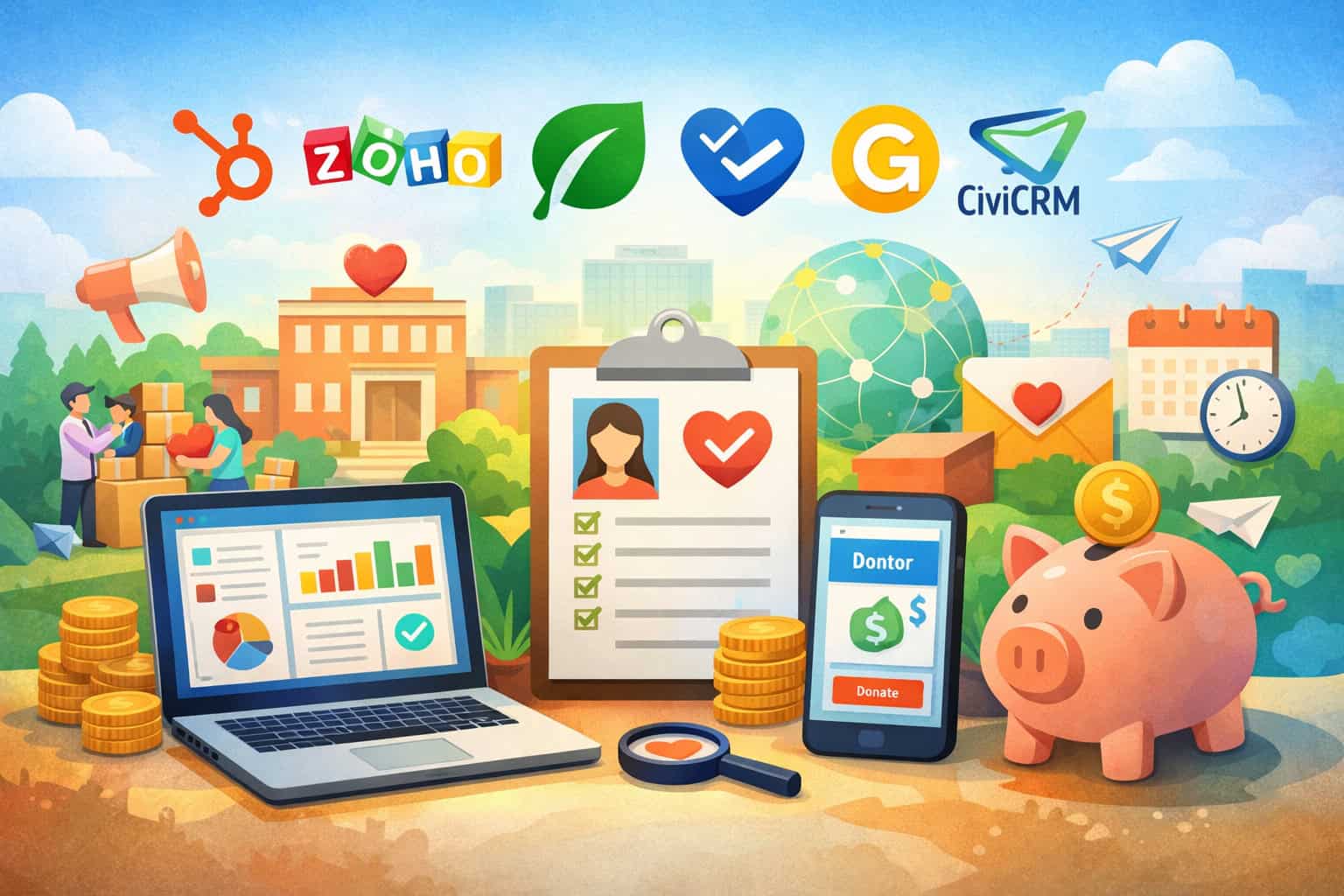
Not every organization needs a heavyweight fundraising platform to succeed in 2026. Some nonprofits need flexibility, affordability, or a fast setup that still supports modern donor journeys. This is where several nonprofit CRM tools can shine—especially when paired with good process.
HubSpot for Nonprofits
HubSpot is not a traditional donor database, but many organizations use it effectively as an engagement-first CRM—especially for marketing automation, inbound lead capture, and lifecycle communications.
HubSpot promotes a nonprofit discount (notably 40%) to make the platform more accessible for qualifying organizations. In 2026, HubSpot can be a strong option if your strategy depends on content, SEO, email journeys, and program enrollment funnels—while donations are handled through a connected giving tool.
Zoho for Nonprofits
Zoho positions its nonprofit offering around CRM plus broader operational tools and credits for eligible organizations. Zoho can be compelling if you want customization without enterprise pricing and you’re comfortable designing your own data model for donors, volunteers, and partners.
Little Green Light
Little Green Light has long been popular for small teams that want a clean donor management system without feature bloat. It positions itself as all-in-one donor management software built to help nonprofits work with ease. In a 2026 context, it’s a strong “core database” choice when you’re willing to connect specialized tools for email, forms, or events.
Keela
Keela emphasizes nonprofit CRM features and integrations to create a single source of truth, highlighting donor management and fundraising workflows. Keela can fit organizations that want modern UX and strong automation without stepping into enterprise complexity.
Givebutter
Givebutter is increasingly significant for budget-conscious organizations because it positions its CRM and donor management as fully integrated with marketing and engagement features, and it promotes a free nonprofit CRM with unlimited contacts.
Givebutter also announced new financial management tools intended to unify donor management, fundraising, and finances in one platform. For many nonprofits, reducing tool sprawl and reconciling fundraising with finance is a major operational win.
CiviCRM (open source)
CiviCRM remains a leading open-source choice, positioning itself as an open-source CRM used by more than 11,000 nonprofits and integrating with common CMS platforms.
In 2026, open-source CRMs are most successful when you have technical capacity or a reliable implementation partner. The upside is control and flexibility; the downside is responsibility for maintenance, hosting, and governance.
How to choose among these flexible nonprofit CRM tools:
- If your organization is marketing-led, HubSpot may be the center, with fundraising connected.
- If you want affordable customization, Zoho is a contender.
- If you want simple donor management, Little Green Light remains a practical core system.
- If you want modern nonprofit-first automation, Keela is worth testing.
- If you want all-in-one fundraising + CRM with low software cost, Givebutter is increasingly relevant.
- If you want open-source control, CiviCRM can be powerful with the right support.
FAQs
Q.1: What are the most important features in nonprofit CRM tools for 2026?
Answer: The most important features in nonprofit CRM tools for 2026 are the ones that protect donor relationships while reducing manual work. Start with a unified constituent profile—one place where staff can see giving history, communications, event attendance, volunteer activity, and notes. Without that, teams operate in fragments, and supporters feel it.
Next, prioritize automation that directly supports revenue: instant or scheduled acknowledgments, recurring giving management, task reminders for follow-up, lapsed donor identification, and segmentation that doesn’t require exporting spreadsheets every week. In 2026, automation isn’t about fancy dashboards—it’s about ensuring no donor falls through the cracks.
Digital fundraising experience is also critical. Donation forms must be mobile-friendly, fast, and branded. The CRM must capture correct attribution (campaign, source, appeal) so reporting is trustworthy. Many of the best nonprofit CRM tools for 2026 emphasize integrated giving experiences because clean attribution improves ROI decisions.
Finally, reporting and governance matter more than ever. Choose nonprofit CRM tools with clear permission controls, audit trails (when needed), and practical dashboards that your leadership will actually use. If you can’t confidently measure retention, recurring growth, campaign performance, and major gift progress, you’re making decisions in the dark.
Q.2: How do small nonprofits choose nonprofit CRM tools without overspending?
Answer: Small teams should choose nonprofit CRM tools based on workflow simplicity, not feature lists. The biggest overspending risk is paying for an enterprise platform that requires consulting, admin time, and multiple add-ons just to do basic tasks. Instead, small nonprofits should focus on three questions:
- Can the team enter gifts, track relationships, and send acknowledgments quickly?
- Can the system run the fundraising tactics the organization actually uses (events, recurring, peer-to-peer)?
- Can reporting be done without advanced technical skills?
Also, evaluate pricing growth. Many nonprofit CRM tools charge based on contact counts or modules. If your email list is growing fast, a “cheap now” platform can become expensive later. Ask vendors for a realistic three-year projection.
Consider modern lower-cost options if you need speed and simplicity. Platforms like Givebutter position themselves around integrated donor management and fundraising with a free CRM approach and unlimited contacts. That can be a strong fit when your goal is to launch quickly and keep software cost predictable.
The best nonprofit CRM tools for 2026 for small nonprofits are the ones that let staff execute consistently every week, not the ones with the most advanced enterprise customization.
Q.3: Should a nonprofit prioritize a CRM with built-in fundraising or best-of-breed integrations?
Answer: In 2026, there’s no universal right answer—only the right answer for your capacity. If your team is lean and you want fewer moving parts, built-in fundraising (forms, events, peer-to-peer) can reduce failure points and improve data consistency.
This is why many vendors are positioning themselves as unified platforms—Bloomerang emphasizes connecting fundraising, CRM, and volunteer engagement.
However, best-of-breed stacks can outperform “all-in-one” systems when you have technical support and disciplined processes.
For example, a marketing-led organization might use HubSpot for automation while connecting a specialized giving tool. HubSpot’s nonprofit program messaging focuses on scaling marketing and engagement with discounted access.
The deciding factor is integration reliability. If integrations break, you lose attribution, create duplicates, and waste staff time. If your organization can’t actively monitor sync health, prioritize fewer systems.
Among the best nonprofit CRM tools for 2026, the winners are the ones that either (a) do the core workflows natively and well, or (b) integrate deeply and reliably enough that staff don’t notice the seams.
Q.4: How is AI changing nonprofit CRM tools in 2026?
Answer: AI is changing nonprofit CRM tools in 2026 in a practical, operational way: reducing administrative time and improving personalization. Rather than “AI as a novelty,” many vendors are focusing on AI that supports day-to-day fundraising and stewardship.
Salesforce announced purpose-built AI agents for nonprofit work—fundraising, program management, volunteer coordination, and donor support—under Agentforce Nonprofit (formerly Nonprofit Cloud).
Blackbaud also highlighted AI-powered enhancements such as predictive analytics and AI-assisted donor acknowledgments within Raiser’s Edge NXT updates. Virtuous has highlighted major AI advancements aimed at helping nonprofits personalize fundraising at scale.
In practical terms, the most useful AI applications in nonprofit CRM tools include: drafting personalized acknowledgment messages, summarizing donor histories before a call, identifying donors most likely to lapse, recommending next-best actions, and improving segmentation through faster search and filtering.
Q.5: What’s the safest CRM decision if our current system is being retired or unsupported?
Answer: If your current system has an end-of-support date, the “safest” CRM decision in 2026 is one that reduces migration risk while giving you a stable long-term roadmap. Start by confirming the retirement timeline and what it means (security updates, support, compliance).
For example, Microsoft’s Fundraising and Engagement solution is expected to lose security updates and technical support after December 31, 2026. That’s not a minor inconvenience—it’s a planning deadline.
From there, choose between two safe paths:
- Platform continuity path: move to a supported solution within the same ecosystem (when viable), minimizing change management.
- Nonprofit-specialist path: migrate to a nonprofit-first CRM with a clear product roadmap and implementation partner support.
Safety also comes from data readiness. Before migration, clean duplicates, standardize fields, and document your must-have reports. A CRM switch doesn’t automatically fix messy data—it can amplify the mess if you migrate blindly.
Finally, prioritize vendors with strong onboarding support, migration tooling, and a track record of helping organizations like yours. The best nonprofit CRM tools for 2026 are not just the ones with the best features—they’re the ones you can implement successfully without losing donor history, attribution, and staff confidence.
Conclusion
Choosing among the best nonprofit CRM tools for 2026 is less about picking the “most powerful” platform and more about choosing the system your team can operate consistently, week after week, while keeping data clean and donor experiences strong.
Enterprise organizations may lean toward platforms like Salesforce (with its AI-agent direction) or fundraising-centric systems like Blackbaud Raiser’s Edge NXT with AI-driven stewardship features. Growth-focused nonprofits often thrive with platforms like Bloomerang or Neon CRM where execution and consolidation reduce friction.
Teams building personalization and donor journeys into their core strategy may find Virtuous particularly aligned. And budget-conscious or fast-moving organizations may succeed with flexible tools like Givebutter, especially as it expands unified fundraising and financial workflows.
The future prediction is clear: nonprofit CRM tools will keep converging into fewer platforms with deeper automation, more embedded analytics, and AI-supported execution. The organizations that benefit most will be the ones that treat their CRM as a fundraising and engagement operating system—not a static database.