

Collaborating With Other Nonprofits: The Most Practical Guide to Nonprofit Collaboration
Collaborating with other nonprofits is one of the fastest ways to expand impact without expanding overhead. When missions overlap, communities rarely benefit from duplicated programs, duplicated outreach, and duplicated admin costs. They benefit when organizations align, coordinate, and deliver services as a connected system.
In today’s funding environment, nonprofit collaboration is no longer a “nice-to-have.” Many grantmakers want evidence of partnerships, shared measurement, and reduced duplication.
At the same time, communities expect seamless services—whether that means a warm handoff from a housing nonprofit to a workforce nonprofit, or coordinated referrals between a food pantry and a mental health provider.
This guide breaks down nonprofit collaboration in a clear, easy-to-execute way. You’ll learn the best collaboration models, how to choose partners, how to protect your mission, how to share resources legally and ethically, and how to build a partnership that lasts beyond a single grant cycle.
You’ll also see future predictions for collaborating with other nonprofits as technology, funders, and community needs evolve.
Why Collaborating With Other Nonprofits Creates Outsized Impact
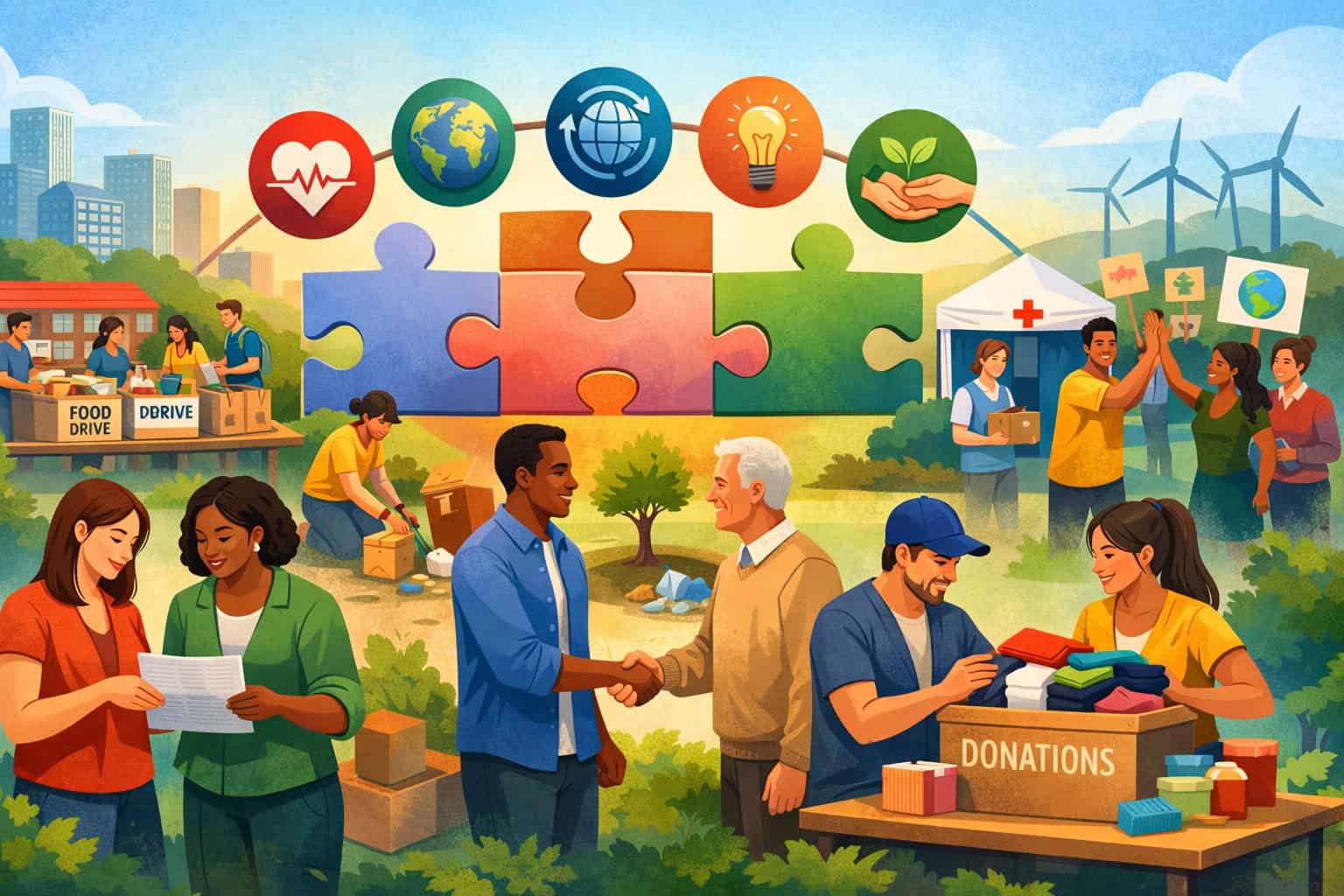
Nonprofit collaboration works because social problems rarely exist in isolation. A family facing eviction may also face job instability, health challenges, food insecurity, and transportation barriers.
If each nonprofit tackles only one piece without coordination, the family is forced to navigate a confusing maze of services. Collaborating with other nonprofits reduces that friction and improves outcomes.
A major advantage of collaborating with other nonprofits is reach. Partnerships allow you to access new neighborhoods, new referral pathways, and new audiences without rebuilding everything from scratch.
When organizations share outreach plans, event calendars, volunteer pipelines, and donor communications, they can scale faster and create stronger community presence.
Nonprofit collaboration also improves credibility. When multiple reputable organizations align around a shared goal—like reducing youth homelessness or improving literacy—stakeholders interpret that as a mature, community-led approach. That credibility matters for local government relationships, major donor confidence, and competitive grant applications.
Another practical benefit is operational efficiency. Collaborating with other nonprofits can reduce costs through shared services, joint purchasing, shared back-office support, shared training, and shared tools. Even small collaborations—like a shared volunteer orientation—can save dozens of staff hours each month.
The most important impact, though, is outcomes. When nonprofit collaboration is designed around client experience, it creates continuity of care, stronger follow-up, and better long-term results. That is the real promise: not collaboration for branding, but collaborating with other nonprofits to deliver measurable change.
Types of Nonprofit Collaboration Models That Actually Work
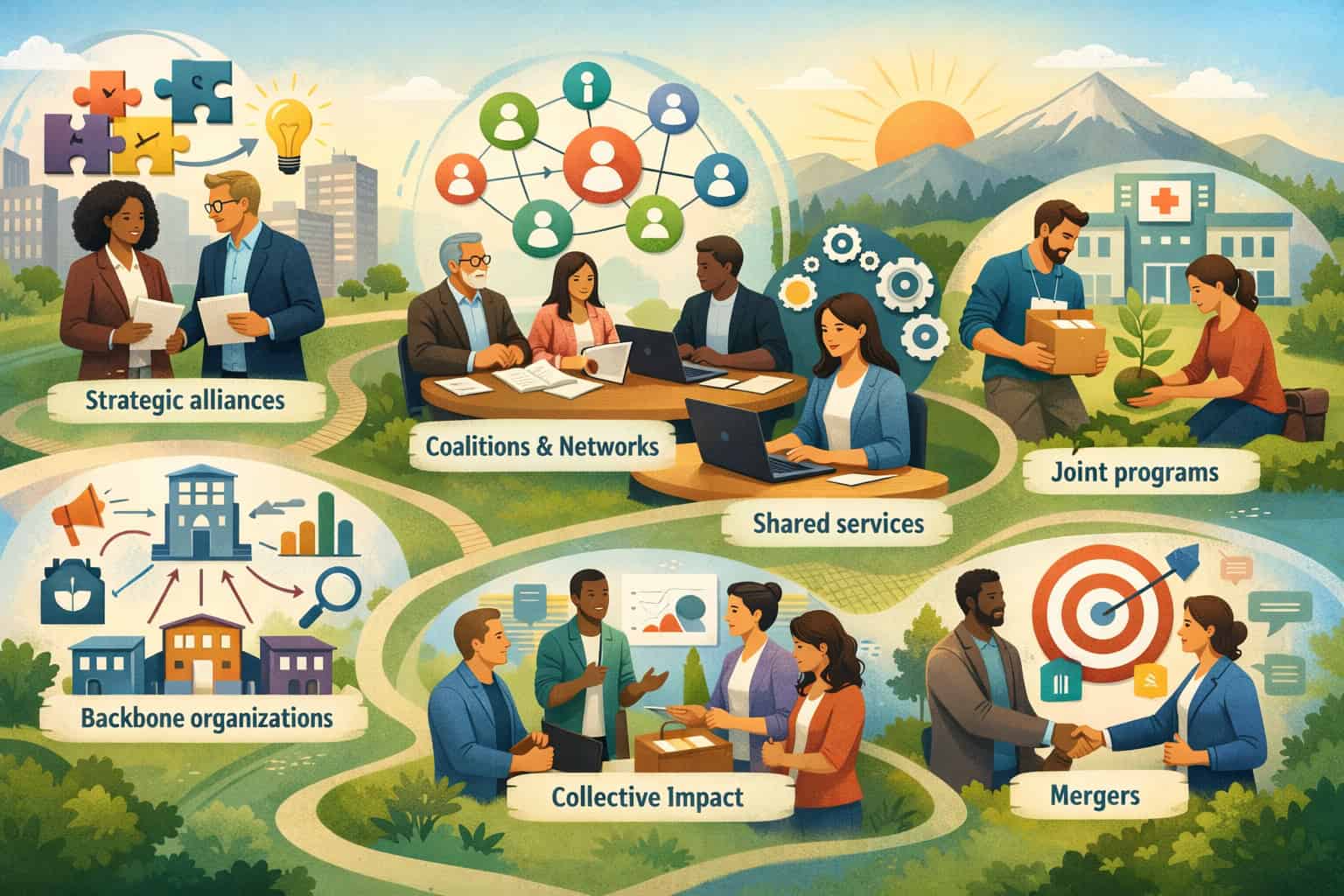
Nonprofit collaboration can be informal or highly structured, and the “best” model depends on your goals, capacity, and risk tolerance. What matters is choosing a model that matches how you want to work together, how long you want the partnership to last, and how you’ll share responsibilities.
Shared Referral Networks and Coordinated Case Management
This is one of the most common forms of collaborating with other nonprofits because it can start quickly and deliver immediate value. Organizations agree on referral standards, shared intake forms (when appropriate), and a clear handoff process. This reduces client drop-off and makes services feel connected.
For a referral network to work, nonprofit collaboration must include service mapping. Partners need to understand who serves which population, eligibility rules, waitlists, geographic boundaries, and language access.
The goal is not to send a referral and hope for the best. The goal is to create a warm handoff—often with follow-up communication and a feedback loop so the referring partner knows if the client received help.
This model is especially useful in social services, crisis response, and community health. It supports collaborating with other nonprofits without merging programs or funding. It also allows partners to test trust and communication before moving into deeper integration.
Joint Programs and Co-Delivered Services
In this model, nonprofit collaboration goes beyond referrals into shared delivery. You might co-host workshops, co-run a mobile clinic day, or operate a joint youth program where each partner provides part of the curriculum. The advantage is a fuller, more holistic program experience for participants.
Joint programs require clearer roles, a shared calendar, agreed staffing, and a plan for participant data. If one partner handles outreach and the other delivers training, both must agree on quality standards and accountability. Collaborating with other nonprofits at this level often requires joint budgeting, shared evaluation, and a written agreement.
This model is powerful when communities need integrated support and funders prefer collaborative program design. It can also unlock new grants that require partnerships, which makes nonprofit collaboration a strategic growth lever.
Resource Sharing and Shared Services
Resource-sharing nonprofit collaboration focuses on efficiency rather than program integration. Examples include shared office space, shared IT support, shared accounting, shared grant writing, shared procurement, and shared training for staff and volunteers.
Collaborating with other nonprofits through shared services can reduce overhead without sacrificing mission independence. It also helps smaller organizations access capabilities they could not afford alone, such as compliance support, HR expertise, or a higher-quality donor database.
This collaboration model works best when partners have compatible work styles and similar quality expectations. Clear service-level agreements are important. A shared services partnership fails quickly if one organization expects white-glove support and another expects “do your best when you can.”
Coalitions, Alliances, and Collective Impact
Coalitions and alliances are collaboration models designed for alignment and influence. They help nonprofits coordinate messaging, share learning, and advocate for policy changes. Collective impact models go further by establishing a shared agenda, shared measurement, continuous communication, and a backbone organization.
Collaborating with other nonprofits through coalitions can strengthen local policy influence and reduce fragmented advocacy. It is especially effective for systems-level issues like affordable housing, public health, education access, and disaster preparedness.
The key here is governance. Nonprofit collaboration at the coalition level needs decision-making rules, membership expectations, and conflict management. Without structure, coalitions become meeting-heavy and outcome-light. With structure, they become powerful engines for community change.
How to Choose the Right Partners for Nonprofit Collaboration
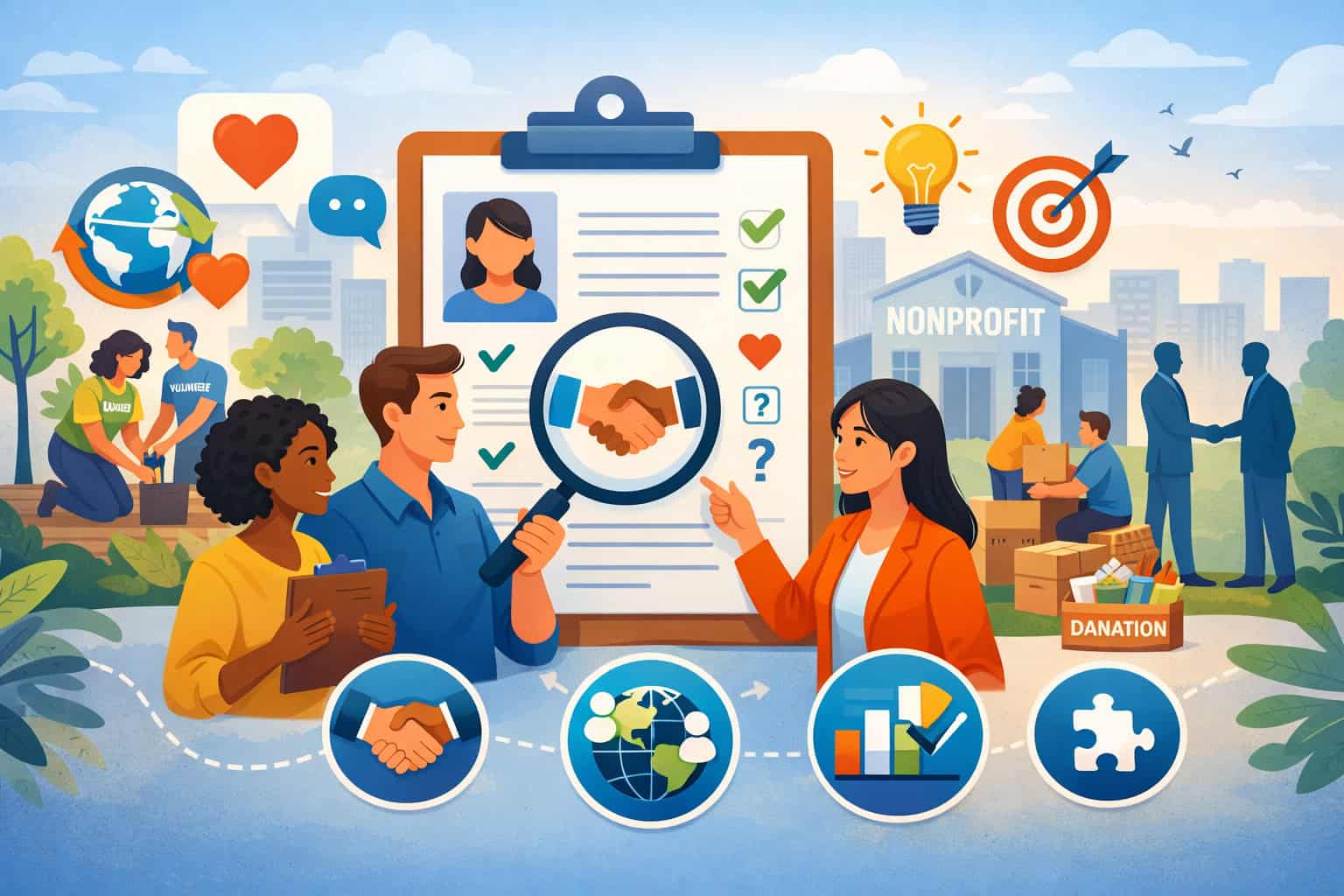
Collaborating with other nonprofits starts with partner selection, and partner selection should be strategic—not only relational. The goal is to find organizations that improve outcomes, strengthen trust in the community, and share compatible values and operating standards.
A practical first step is mission alignment. Your missions do not need to be identical, but they should be complementary. A youth mentoring nonprofit might align well with a tutoring program, a workforce program, or a family support organization.
Nonprofit collaboration works when the partnership helps the community navigate a connected path—not when it creates confusing overlap.
Next, evaluate program quality. Before collaborating with other nonprofits, understand how they deliver services. Look at staff training, participant experience, safety standards, and follow-up processes. If your reputation is connected to a partner’s performance, you need confidence in their quality.
Capacity is another major factor. Some organizations have great intent but inconsistent execution because they are understaffed, underfunded, or overly dependent on one key person. Nonprofit collaboration requires reliability. A partner who cancels frequently or misses deadlines can damage outcomes and strain your team.
Also consider community trust. In many communities, trust is earned over years. Collaborating with other nonprofits that already have strong trust—especially with hard-to-reach populations—can improve engagement. The opposite is also true: partnering with an organization that has community conflict can create reputational risk.
Finally, assess leadership alignment. Strong nonprofit collaboration usually depends on leaders who value transparency, shared credit, and long-term relationships. If one leadership team views partnerships as a way to “capture” resources or control the narrative, trust will erode quickly.
The best partner selection process is a structured conversation: shared goals, target population, program approach, constraints, and expectations. You are not just choosing a partner—you are choosing a working relationship.
Building Trust and Governance for Collaborating With Other Nonprofits

Nonprofit collaboration fails more often from relationship breakdown than from mission mismatch. That’s why governance and trust-building are not “extra work.” They are the work.
Start with a shared purpose. Every collaboration should have a written statement of why the partnership exists and what success looks like. When pressure hits—funding cuts, staffing changes, crises—this shared purpose anchors decisions and reduces reactive conflict.
Next, create decision-making rules. Collaborating with other nonprofits can stall if every decision requires total agreement. Establish which decisions require consensus, which require majority vote, and which can be made by a designated lead. This prevents slow-motion failure caused by indecision.
Communication rhythm matters. Strong nonprofit collaboration includes regular check-ins, shared documentation, and clear points of contact. A simple structure—monthly leadership check-ins, biweekly program coordination calls, and a shared dashboard—can prevent misunderstandings and keep accountability visible.
Conflict management is also essential. Disagreement is normal when collaborating with other nonprofits, especially when resources are tight. The question is whether conflict is handled with clarity and respect. Define how concerns are raised, how disputes are escalated, and how resolutions are documented.
A practical trust-building tactic is “small wins first.” Begin with low-risk joint efforts—co-hosting an event, aligning referral forms, or sharing volunteer training. Successful small wins create confidence and momentum for deeper nonprofit collaboration.
Governance should match the collaboration model. A referral partnership might only need a memorandum of understanding and a shared workflow. A joint program may require a more detailed agreement, joint budgeting, and shared evaluation. A coalition may require bylaws, membership policies, and a steering committee.
Trust is built through reliability, transparency, and consistent communication. When those are in place, collaborating with other nonprofits becomes a stable platform rather than a fragile experiment.
Legal, Compliance, and Data-Sharing Considerations in Nonprofit Collaboration
Collaborating with other nonprofits often involves sharing funds, sharing staff time, sharing participant information, or representing each other publicly. That creates compliance responsibilities that should be addressed early to avoid risk later.
Memorandums of Understanding, Contracts, and Fiscal Sponsorship
Many nonprofit collaboration efforts begin with a memorandum of understanding (MOU). An MOU is useful for clarifying roles, responsibilities, timelines, deliverables, and decision-making without becoming overly complex. However, when money changes hands, contracts are usually more appropriate.
If you are collaborating with other nonprofits on a grant, determine who is the lead applicant, who receives funds, and how subawards will be managed. Subawards typically require reporting, allowable cost standards, and monitoring expectations. Even if funding is not complex, clarity prevents conflict.
Fiscal sponsorship is another collaboration structure, used when one organization receives and manages funds on behalf of another project or emerging nonprofit. This can accelerate program launch, but it requires careful management of restricted funds, reporting duties, and accountability.
Data Privacy, Consent, and Ethical Information Sharing
Nonprofit collaboration often requires sharing participant information to coordinate services. This is where organizations must be cautious. The safest approach is to share only what is necessary and only with clear consent, using secure systems.
Collaborating with other nonprofits should include a shared data policy: what data is collected, why it is collected, where it is stored, who can access it, and how long it is retained. Staff should be trained on confidentiality, especially when handling sensitive situations.
Consider a “minimum necessary” principle. If a referral only needs contact information and a summary of needs, don’t share full case notes. Clear consent forms and client choice should drive data sharing, not convenience.
Branding, Messaging, and Public Representation
Partnerships often create shared messaging. Decide early how logos are used, how joint statements are approved, and how media inquiries are handled. Collaborating with other nonprofits can create PR risk if one partner makes public claims that the other cannot support.
Clarify attribution and credit. Strong nonprofit collaboration does not require one organization to dominate. Shared credit supports partner morale and strengthens community trust. It also prevents one partner from feeling used as a “referral source” without recognition.
When compliance is handled proactively, nonprofit collaboration becomes safer, smoother, and easier to scale. When compliance is ignored, even a well-intended partnership can unravel quickly.
Funding Strategies for Collaborating With Other Nonprofits
Nonprofit collaboration can unlock funding, but it can also create financial complexity. Successful collaborations plan for money early—before a grant opportunity forces rushed decisions.
Start by choosing a funding structure. Some collaborations use a lead organization that holds the budget and subcontracts partners. Others use aligned funding where each partner applies separately but coordinates outcomes.
Coalition models sometimes fund a shared backbone function—like a coordinator, shared data manager, or convening support.
A common mistake is underfunding collaboration time. Collaborating with other nonprofits requires meetings, shared planning, reporting, training, and relationship maintenance. If the budget only covers direct services and ignores coordination, the partnership will strain staff and become unsustainable.
Build budgets that include:
- Partnership management and coordination hours
- Shared evaluation and measurement
- Technology tools for collaboration
- Joint outreach and community engagement
- Training and quality assurance
Also clarify indirect costs. Many nonprofits have different overhead structures and cost policies. A transparent conversation about indirect rates, admin allocation, and reimbursement timelines prevents resentment later.
Another strategy is collaborative fundraising. Joint campaigns can be powerful when done carefully. For example, a coalition might run a seasonal giving drive where donations support a shared goal, then allocate resources by a pre-agreed method. This works best when partners trust each other and share accountability.
Finally, consider sustainability beyond a single grant. Nonprofit collaboration should not collapse when one founder exits. Strong collaborations diversify funding, build shared value, and create community demand that supports long-term investment.
In the coming years, more funders are likely to prefer nonprofit collaboration that shows measurable system improvements rather than isolated program outputs. Preparing now—through shared measurement and clear partnership structures—can make your organization more competitive.
Operational Playbook for Nonprofit Collaboration: Step-by-Step Execution
Collaborating with other nonprofits becomes far easier when you treat it like a process, not a vibe. A simple playbook helps teams move from ideas to action with fewer misunderstandings.
Step 1: Define the Collaboration Goal and Scope
Decide what problem you are solving together. Be specific. “Reduce youth homelessness” is broad; “reduce time-to-placement for youth ages 18–24 by creating a shared referral and rapid response workflow” is clearer.
Define scope: population, geography, services included, and what is not included. Nonprofit collaboration fails when expectations expand silently. A written scope prevents mission drift and protects staff capacity.
Step 2: Map Services and Identify Gaps
Partners should map the client journey and identify gaps, overlaps, and bottlenecks. This is where collaborating with other nonprofits becomes practical. You stop guessing and start designing around reality: waitlists, eligibility rules, transportation barriers, language needs, and cultural trust factors.
Service mapping also identifies what each partner does best. Strong nonprofit collaboration is not about everyone doing everything. It’s about specialization connected by coordination.
Step 3: Set Roles, Workflows, and Accountability
Assign responsibility for each part of the workflow. Who handles outreach? Who handles intake? Who follows up? Who manages evaluation? Then define timelines. If a referral must be contacted within 48 hours, write that down.
Accountability should be supportive, not punitive. Collaborating with other nonprofits works best when partners feel safe sharing challenges early instead of hiding them until failure becomes visible.
Step 4: Build a Shared Measurement System
You don’t need a perfect dashboard to start, but you do need shared definitions. What counts as “served”? What counts as “completed”? What outcome indicators matter? Shared measurement is the backbone of credible nonprofit collaboration.
Start with a short list of metrics:
- Volume (referrals, enrollments, participation)
- Speed (time to contact, time to service)
- Quality (participant satisfaction, retention)
- Outcomes (housing stability, job placement, literacy gains)
Step 5: Review, Improve, and Scale
Set a review rhythm—monthly or quarterly—to assess what’s working. Collaborating with other nonprofits is an ongoing improvement loop, not a one-time launch. Use feedback from staff and participants to refine workflows, update training, and improve the client experience.
When the playbook is clear, nonprofit collaboration becomes repeatable. Repeatability is what allows partnerships to grow without chaos.
Technology and Tools That Strengthen Collaborating With Other Nonprofits
Nonprofit collaboration becomes easier when information flows smoothly. The right tools reduce friction, prevent duplication, and make reporting less painful. The wrong tools create confusion, security risks, and inconsistent workflows.
A strong foundation starts with secure communication. Partners need a consistent channel for coordination, especially for time-sensitive referrals. Email alone is often too slow and too messy. Many collaborations use secure messaging workflows, shared calendars, and standardized forms to streamline handoffs.
Shared documentation matters, too. Collaborating with other nonprofits requires shared policies, training materials, and process guides. A shared workspace for documents reduces “version control” issues and ensures new staff can onboard quickly.
Data tracking is where many collaborations struggle. A simple shared measurement system can be created using consistent intake forms, agreed data definitions, and periodic reporting. The goal is not to build a complex system that nobody uses. The goal is consistent, accurate, low-burden tracking.
Technology must also support equity. If a tool requires high digital literacy or excludes people with limited access, it can reduce program participation. Nonprofit collaboration should improve access, not add barriers.
Looking ahead, nonprofit collaboration will likely be shaped by:
- More use of automation for referrals and follow-ups
- More emphasis on shared outcomes dashboards
- More demand for secure, consent-based data sharing
- Increased use of AI for resource navigation and triage (with ethical safeguards)
The future of collaborating with other nonprofits will reward organizations that can prove outcomes, protect privacy, and deliver coordinated services with minimal friction. Technology will not replace relationships, but it will amplify them when used responsibly.
Future Predictions: Where Nonprofit Collaboration Is Headed Next
Collaborating with other nonprofits is evolving from informal partnerships into measurable networks. Several trends are likely to shape how collaboration works over the next few years.
First, shared measurement will become a baseline expectation. Funders and community stakeholders increasingly want proof that nonprofit collaboration reduces duplication and improves outcomes.
Organizations that can show connected impact—like reduced emergency room use, improved graduation rates, or increased housing stability—will have a competitive advantage.
Second, cross-sector partnerships will expand. Nonprofit collaboration will increasingly include schools, clinics, libraries, workforce agencies, and local government partners. Nonprofits that build strong collaboration skills now will be better positioned to lead multi-partner initiatives later.
Third, community-led collaboration will grow. Communities are pushing for partnerships that center lived experience, cultural trust, and accessible services. Collaborating with other nonprofits will be evaluated not only by outputs, but by whether people feel respected, heard, and supported.
Fourth, technology-driven coordination will become more common, but it will come with stronger privacy expectations. Consent-based data sharing and ethical safeguards will be essential. Collaborations that treat privacy casually will face reputational risk and potential compliance problems.
Finally, nonprofit collaboration will become more specialized. Instead of every organization trying to be everything, strong networks will form where each partner plays a defined role and the system is designed around the participant journey.
That is how collaborating with other nonprofits becomes a true community infrastructure—not a temporary project.
FAQs
Q.1: How do we start nonprofit collaboration if we’ve never partnered before?
Answer: The best way to start collaborating with other nonprofits is to begin small, choose one clear goal, and build trust through consistent execution. Instead of launching a large joint program immediately, start with a collaboration that improves participant experience quickly—like a shared referral workflow or a co-hosted resource event.
Begin by identifying a community need that overlaps naturally with another organization’s mission. Then reach out with a specific proposal: what you want to achieve, what you can contribute, and what support you need from the potential partner. This approach is more effective than a vague invitation to “partner sometime.”
Once you agree to collaborate, set expectations early: who is responsible for what, what timelines apply, and how communication will happen. Document this in a simple MOU. Schedule regular check-ins, even if they are brief. Consistency builds trust faster than big promises.
Finally, evaluate the results together. Nonprofit collaboration strengthens when partners can reflect honestly on what worked, what didn’t, and what should change. Over time, small wins create momentum for deeper collaboration, joint funding, and shared measurement.
Q.2: What if a partner nonprofit doesn’t follow through?
Answer: Nonprofit collaboration depends on reliability. When a partner does not follow through, address it quickly and respectfully. Start with curiosity. Staffing shortages, funding stress, and leadership transitions can disrupt execution. A direct conversation can clarify whether the issue is temporary or structural.
Review the agreement and the goals. If the partnership includes response timelines (like contacting referrals within 48 hours), ask what support is needed to meet that standard.
Sometimes collaborating with other nonprofits requires adjusting workflows to fit real capacity—such as changing referral volumes, shifting responsibilities, or adding a shared coordinator role.
If the pattern continues, protect participants and your organization’s reputation. Document issues, reduce risk, and consider scaling back the collaboration to a lower-stakes model. For example, move from joint service delivery to a limited referral relationship until reliability improves.
If the collaboration cannot meet community needs, it may be healthier to end it professionally. Nonprofit collaboration should improve outcomes, not drain staff and confuse participants. Ending a partnership respectfully, with clear communication and transition support, is sometimes the most responsible choice.
Q.3: How can nonprofit collaboration work when missions overlap and competition exists?
Answer: Overlapping missions do not automatically prevent collaborating with other nonprofits, but competition can create tension. The key is designing nonprofit collaboration around shared outcomes rather than organizational branding.
Communities benefit most when organizations coordinate services and reduce duplication, even if they operate in similar spaces.
Start by clarifying what each organization does uniquely well. Overlap might exist in general mission language, but programs may differ in approach, population, or geographic reach. A collaboration can be built around specialization, where each partner focuses on strengths.
Transparency about funding is also important. If both organizations apply for similar grants, agree on how to avoid undermining each other. Some partners coordinate grant calendars, share letters of support, or create joint proposals for specific opportunities while maintaining independence elsewhere.
Shared credit and consistent messaging reduce fear. When nonprofit collaboration is framed as community infrastructure, not as one organization “owning” the solution, competition tends to soften.
Over time, trust and proven outcomes often matter more than territory—especially when stakeholders see that collaboration improves the client experience.
Q.4: Do we need a formal agreement to collaborate with other nonprofits?
Answer: Not every collaboration needs a complex contract, but most nonprofit collaboration benefits from some written clarity. Even a simple MOU can prevent misunderstandings. It should cover goals, roles, timelines, communication expectations, data sharing boundaries, and how decisions are made.
If money changes hands, a more formal agreement is usually necessary. Subawards, shared staffing, or shared procurement require clarity on allowable costs, reporting, and accountability. Collaborating with other nonprofits on funded projects without clear financial terms can create disputes later.
Data sharing also increases the need for written agreements. If partners share participant information, you should have a clear consent-based process, secure handling expectations, and a plan for privacy incidents. Written policies protect participants and protect organizations.
Formal agreements do not reduce trust; they protect trust. When expectations are visible and agreed, partnerships can focus on impact rather than conflict. The strongest nonprofit collaboration combines good relationships with good documentation.
Q.5: What are the most common reasons nonprofit collaboration fails, and how can we prevent them?
Answer: Nonprofit collaboration often fails for predictable reasons: unclear goals, unclear roles, underfunded coordination, inconsistent communication, leadership misalignment, and unresolved conflict. The good news is that each of these can be prevented with basic partnership hygiene.
Prevent failure by defining a clear collaboration purpose and scope, including what the partnership will not do. Set specific roles and workflows, and assign points of contact. Build a regular communication rhythm and document decisions.
Underfunding is a major hidden issue. Collaborating with other nonprofits requires time for coordination, evaluation, and relationship management. Budget for those needs whenever possible. If no funding exists, start with a small scope that matches capacity.
Finally, normalize conflict management. Create a shared process for raising concerns early, escalating issues, and resolving disagreements. Partnerships that can address problems quickly are far more resilient than partnerships that avoid hard conversations until frustration explodes.
When nonprofit collaboration is treated as a structured practice—supported by governance, trust, and shared measurement—it becomes durable and scalable.
Conclusion
Collaborating with other nonprofits is one of the most effective ways to expand community impact while staying financially sustainable. It helps organizations reduce duplication, coordinate services, share resources, and deliver a better participant experience. Done well, nonprofit collaboration strengthens outcomes, credibility, and funding competitiveness.
The partnerships that last are not built on vague goodwill. They are built on clear goals, aligned leadership, trust, consistent communication, and practical agreements. They start with small wins, then grow into deeper collaboration models—joint programs, shared services, coalitions, and shared measurement systems.
As expectations evolve, nonprofit collaboration will likely become even more important. Funders and communities increasingly want connected solutions, measurable outcomes, ethical data practices, and efficient operations. Organizations that develop strong collaboration skills now will be positioned to lead larger initiatives and deliver stronger results.