

Federal vs State vs Foundation Grants: What’s the Difference?
Understanding the difference between federal vs state vs foundation grants is one of the most important strategic decisions you’ll make as a grant seeker.
Each type of grant comes from a different kind of funder, uses different rules, and requires a different level of capacity from your organization. If you treat them as interchangeable, you risk wasting time on opportunities you’re not ready for or that don’t match your mission.
Federal grants often come with the largest dollar amounts and the strictest rules. State grants tend to be more targeted, closer to the ground, and sometimes easier to manage but still highly competitive. Foundation grants are more flexible, relationship-driven, and vary widely in size and expectations.
At the same time, all three types of grants are changing fast: digital portals, new transparency requirements, trust-based philanthropy, and shifting economic conditions are reshaping how money flows to nonprofits, governments, and in some cases businesses.
In this in-depth guide, you’ll learn what makes federal, state, and foundation grants different, how to match your organization to the right grant type, what the latest trends mean for your strategy, and how to prepare for the future of grant funding.
By the end, you should be able to look at any opportunity and quickly decide whether it’s a good fit—and what it will really take to win and manage it.
Why Understanding Grant Types Matters for Your Funding Strategy

If you’re new to grants, it’s easy to assume that “a grant is a grant.” In reality, choosing between federal grants, state grants, and foundation grants is like choosing between different business models. Each one shapes your cash flow, your staffing needs, your compliance burden, and even your program design.
Federal grants usually require formal policies, detailed budgets, audits, and strong financial systems. State grants may require fewer layers of bureaucracy but still expect clear outcomes tied to local priorities.
Foundation grants might tolerate more experimentation and narrative storytelling but rely heavily on relationships, credibility, and alignment with a funder’s mission.
If you misunderstand these differences, you might aim too high too soon—like a small startup nonprofit chasing a multi-million-dollar federal grant it can’t yet manage.
Or you might aim too low, relying only on small foundation grants when you actually need federal or state funding streams to sustain long-term programs. Many organizations find that the best path is a balanced portfolio that mixes federal vs state vs foundation grants to reduce risk.
Understanding grant types also matters for long-term planning. Government grants are deeply shaped by national and state budgets, legislation, and political priorities. Foundation grants are more influenced by markets, donor interests, and philanthropic trends.
Watching both systems closely will help you anticipate where funding will grow, where it may shrink, and how to position yourself before everyone else sees the opportunity.
Overview of Federal, State, and Foundation Grants
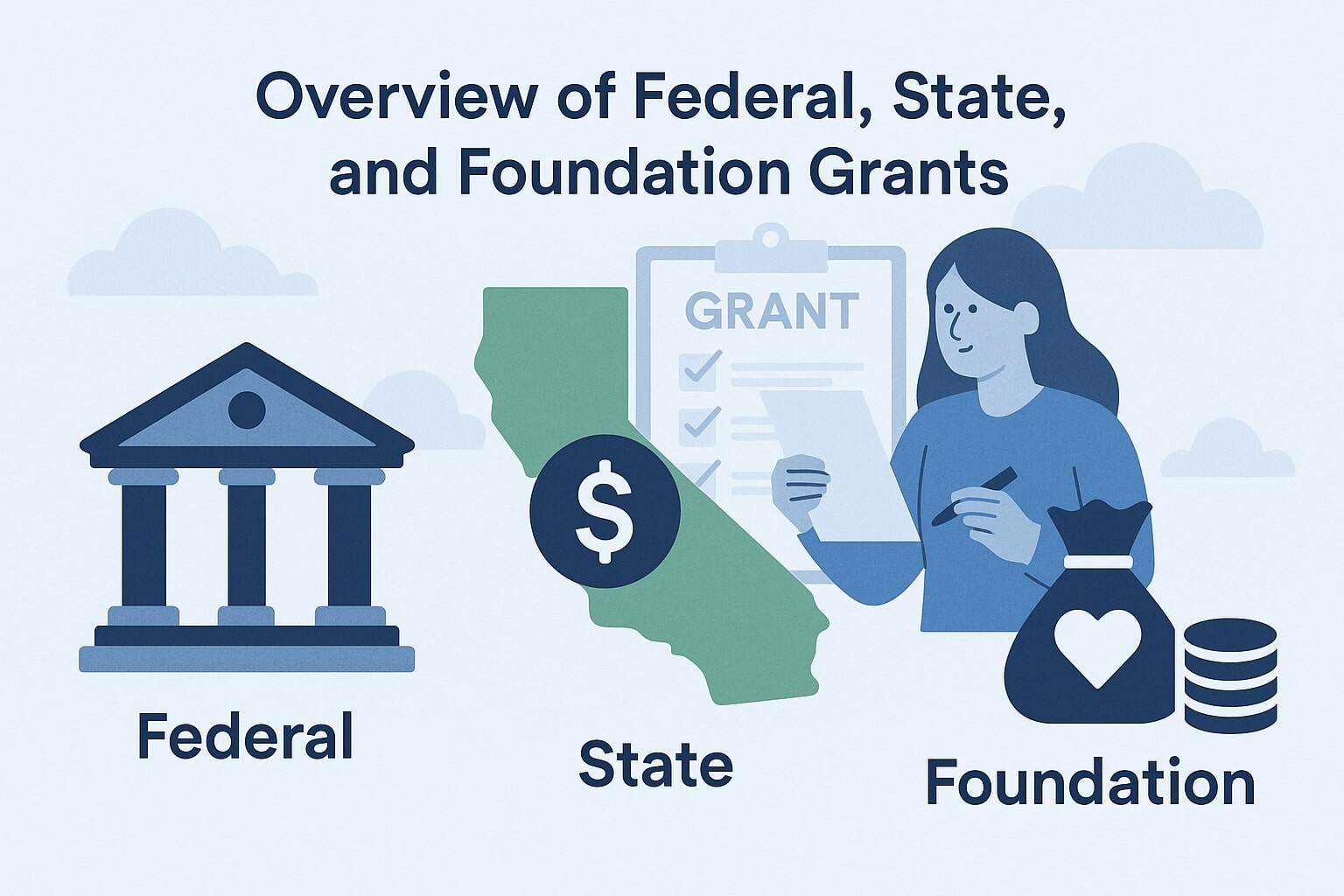
At the highest level, grants fall into two big categories: government grants and private or philanthropic grants. Government grants are offered by public agencies—federal departments, state agencies, and sometimes local governments.
Foundation grants are offered by private, public, or corporate foundations that use charitable dollars to support their chosen causes.
Federal grants are funded through the federal budget and implemented by departments like Health and Human Services, Education, Agriculture, Justice, Transportation, and others.
They usually target large-scale national priorities such as health care, education, infrastructure, research, and social services. Many federal grants are actually passed through to states or localities, which then re-grant funds to community-level organizations.
State grants are funded from state budgets, often blending state revenue and incoming federal funds. They tend to focus on regional needs—workforce development, local infrastructure, environmental projects, public health, and specific community initiatives.
Because state agencies are closer to local conditions, their grant programs may feel more tailored and may emphasize partnerships with local governments, nonprofits, and small businesses.
Foundation grants come from philanthropic institutions—private foundations funded by individuals or families, corporate foundations linked to companies, and public foundations or community foundations that raise money from many donors.
These grants often support nonprofits, schools, and sometimes fiscally sponsored projects. Foundation grants can be highly flexible, especially when offered as general operating support, and are heavily influenced by philanthropic trends such as equity, climate, or community power-building.
Understanding where the money originates and who controls the decision-making is the first step to mastering federal vs state vs foundation grants.
What Are Federal Grants? Definition, Purpose, and Funding Priorities
Federal grants are financial assistance awards from federal agencies intended to support projects that advance public purposes authorized by law, not to acquire goods or services for the government itself.
They’re governed by federal statutes and regulations (like 2 CFR 200, the Uniform Guidance) that set rules for cost allowability, procurement, audits, and reporting.
In fiscal year 2024, the federal government provided an estimated $1.1 trillion in grants to state and local governments alone, covering areas like health care, transportation, income security, education, job training, social services, community development, and environmental protection.
This doesn’t even include federal grants that go directly to nonprofits, universities, or tribal entities. That scale is exactly why federal grants are attractive—but also why they’re heavily regulated.
Federal grants typically support:
- Large, evidence-based programs with national impact
- Research and innovation (e.g., NIH, NSF, SBIR/STTR programs)
- Safety-net services such as Medicaid administration, housing, and nutrition assistance
- Infrastructure and capital projects like broadband, transportation, and water systems
- Education and workforce initiatives, including major student aid programs
Most competitive federal grant opportunities are posted on Grants.gov, the central portal where federal agencies publish funding notices and where eligible organizations can search and apply. To apply, organizations usually must:
- Register in SAM.gov (System for Award Management) to obtain a Unique Entity ID and be eligible to receive federal funds.
- Set up a Grants.gov account and workspace.
- Demonstrate capacity to manage funds, comply with federal rules, and deliver measurable outcomes.
Because federal grants sit at the top of the funding hierarchy, they drive many downstream state and local grant programs—and they require serious planning and infrastructure before you apply.
Types of Federal Grants: Formula, Competitive, Block, and Pass-Through
When comparing federal vs state vs foundation grants, one key difference is the formal categories used in federal funding. Federal grants are often grouped into several common types, each with its own dynamics:
- Formula grants
- Allocated to states or eligible entities using a formula set in law (such as population, poverty rate, or specific risk factors).
- Recipients don’t “compete” in the usual sense; they receive funds if they meet eligibility and submit required plans.
- Examples include many education and public health programs that allocate money to states, which then subgrant to local organizations.
- Project or competitive grants
- Awarded based on a scored application in response to a Notice of Funding Opportunity (NOFO) on Grants.gov.
- Applicants compete nationally or regionally, and only those with the highest scores receive awards.
- Common in research (NIH, NSF), innovation (SBIR/STTR), and community projects.
- Block grants
- Provide a large amount of funding to states or local governments with flexible guidelines, allowing them to design programs within broad federal objectives.
- States then decide how to re-grant or use funds for local priorities.
- Pass-through grants and subawards
- Federal funding is “passed through” to states or intermediaries that then issue subgrants to local governments or nonprofits.
- If you receive a subaward from a state agency under a federal program, you still inherit many federal compliance obligations, even though you never contract directly with a federal agency.
Knowing which type you’re dealing with—formula, competitive, block, or pass-through—helps you understand both your chances and your compliance burden.
A competitive project grant from a federal agency usually demands more complex proposal development, while a subgrant under a formula program might focus more on executing a pre-defined model with strict reporting.
Pros and Cons of Federal Grants for Your Organization
Federal grants can be transformational—but they’re not for everyone at every stage. When you compare federal vs state vs foundation grants, you’ll see that federal awards are the most intensive in terms of compliance and capacity.
Pros of federal grants
- Large, multi-year funding: Federal grants can fund major expansions, infrastructure, or large-scale research that no foundation or state program could match.
- Prestige and validation: Winning a federal grant signals that your programs or research meet national standards of evidence, which can attract additional funders.
- Clear, published rules: While complex, federal regulations and NOFOs are highly detailed. If you follow the instructions precisely, you know how your application will be judged.
- Alignment with big policy goals: Federal grants plug you into national policy agendas, opening doors to partnerships and long-term influence.
Cons of federal grants
- Intense competition: National competitions may fund only a small fraction of applicants, especially in popular programs. You need strong data, evaluation plans, and often prior experience.
- High compliance burden: Requirements around allowable costs, procurement, time and effort reporting, subrecipient monitoring, and audits are demanding. Smaller organizations may struggle without robust financial systems.
- Slow timelines: From NOFO posting to award to reimbursement, the process can take many months, which may strain cash flow for organizations without reserves.
- Less flexibility: Federal grants often tightly define activities, outputs, and outcomes. Deviating from the approved plan usually requires prior written approval.
For many organizations, the smartest strategy is to build capacity using state grants and foundation grants first, and then grow into direct federal funding once systems, staffing, and experience are strong enough.
What Are State Grants? Definition, Purpose, and Funding Priorities
State grants are financial awards provided by state governments to support initiatives that address the specific needs and priorities of that state. They’re funded by state budgets, sometimes combined with federal dollars, and administered by state agencies such as departments of health, education, economic development, or environmental quality.
State grants generally aim to:
- Adapt broad federal priorities to local conditions (for example, tailoring public health programs or workforce initiatives to regional industries).
- Address state-specific issues—such as rural broadband expansion, wildfire prevention, drought response, or regional economic development.
- Support community-based organizations that are too small or too local to receive direct federal grants but are critical to on-the-ground impact.
Because states sit between the federal level and local communities, they play a powerful intermediary role. In some cases, state agencies design entirely state-funded grant programs; in many others, they administer federal funds as pass-through grants, distributing them to local governments, school districts, tribal governments, and nonprofits.
For applicants, state grants can feel more accessible. The agencies are closer, the staff may be easier to reach, and technical assistance may be more hands-on. But state grants still involve competition, reporting, and oversight—especially when federal dollars are involved.
As federal funding to states shifts over time, state grant programs may also expand or shrink, so staying connected to state budget and policy discussions is critical.
How State Grants Differ From Federal Grants in Practice
When you look closely at federal vs state vs foundation grants, state grants occupy a middle ground between heavily standardized federal awards and highly varied foundation grants. In practice, key differences between federal and state grants include scope, flexibility, and relationships.
Scope and scale:
- Federal grants often target large, national initiatives or cutting-edge research.
- State grants target specific communities, industries, or issues within state borders. Awards may be smaller but more numerous and more closely connected to regional priorities.
Flexibility and tailoring:
- State agencies typically have more discretion to design programs that respond to local conditions. That might mean special grant programs for rural communities, disaster-affected areas, or emerging industries.
- Application requirements, scoring criteria, and reporting can be more flexible, especially in state-funded programs that don’t import the full federal rule set.
Relationships and access:
- It’s often easier to build ongoing relationships with state program officers than with federal program staff. State agencies may be more available for pre-application calls, webinars, and technical assistance.
- State legislators can influence grant priorities and may champion funding for particular issue areas or regions, creating opportunities if your work aligns with policy interests.
Compliance and oversight:
- When state grants use federal funds, organizations must comply with both state rules and federal Uniform Guidance.
- When grants are primarily state-funded, rules may be simpler, but you still need solid financial controls, performance data, and documentation.
For many organizations, state grants are a practical stepping stone: they build experience with public funding, but in a slightly less intimidating environment than direct federal competition.
Advantages and Limitations of State Grants
Choosing between federal vs state vs foundation grants often comes down to trade-offs in size, complexity, and fit. State grants have distinct advantages and limitations you should weigh carefully.
Advantages of state grants:
- Closer alignment with local needs: State agencies understand regional economic conditions, demographics, and political realities. Their grant programs often reflect those realities, making it easier to show relevance.
- More accessible relationships: Program officers may know grantees personally, visit sites more often, and provide informal feedback or coaching.
- Moderate award size: While typically smaller than large federal grants, state grants can still be substantial enough to fund real growth without overwhelming an organization.
- Pipeline to larger opportunities: Success with state grants—strong performance, clean monitoring visits, and timely reporting—builds your track record for future federal or foundation funding.
Limitations of state grants:
- Funding volatility: State budgets are sensitive to economic cycles and political negotiations. Grant programs may expand during strong revenue years and shrink during downturns.
- Uneven quality and transparency: Some state programs have excellent guidance and clear scoring rubrics; others may be less transparent, with more discretionary decisions.
- Complex layering of rules: When a state administers federal funds, your grant may come with a patchwork of state and federal requirements that are hard to untangle.
- Geographic limits: By design, state grants restrict your activities to that state’s borders. Multi-state organizations may need multiple grants to serve all regions.
If you’re building your grant capacity, state grants are often a smart “sweet spot”—challenging enough to build your systems but close enough to your community to feel responsive and relevant.
What Are Foundation Grants? Public, Private, and Corporate Foundations
Foundation grants are awards made by philanthropic institutions rather than government agencies. These include:
- Private foundations, typically funded by a single source such as an individual, family, or corporation, and often governed by that donor’s long-term philanthropic intent.
- Public foundations, like community foundations, which raise money from many donors and then re-grant it to nonprofits serving local or thematic priorities.
- Corporate foundations, which may be funded by a company’s profits and often align with business interests, employees’ volunteer priorities, or brand positioning.
Unlike government grants, foundation grants are not driven by legislative appropriations, but by philanthropic strategies and endowment performance.
Private foundations are regulated primarily through tax law and are required to pay out a minimum percentage of their assets each year in qualifying charitable distributions. They also must file an annual Form 990-PF, which publicly discloses their assets, grants, and activities.
Foundation grants typically support:
- Nonprofits with 501(c)(3) status, or fiscally sponsored projects under a 501(c)(3) umbrella
- General operating support, project grants, or capital campaigns
- Specific thematic areas such as education, climate, arts, racial equity, health, or community development
Foundation grantmaking is big business: private foundations collectively report more than $100 billion in charitable spending each year through their Form 990-PF filings, and that figure has grown along with the overall philanthropic sector.
For grantees, foundations can be more flexible and relational than government agencies, but the landscape is fragmented. Instead of a centralized portal like Grants.gov, you’ll navigate hundreds or thousands of distinct funders, each with its own online system, deadlines, and preferred formats.
How Foundation Grants Work: Endowments, 990-PF, and Grant Cycles
To truly understand foundation grants vs federal and state grants, it helps to look under the hood at how foundations manage money.
Most private foundations are built around an endowment—a pool of invested assets. The foundation invests this money, and each year it must distribute a minimum share (generally 5% of its assets) in qualifying charitable activities, mostly grants.
Market performance strongly influences how much a foundation has available and how aggressively it can fund initiatives.
Key elements of foundation operations include:
- Strategy and priorities: Boards and staff set focus areas (for example, early childhood education, homelessness prevention, arts access). These priorities may shift more quickly than government programs and can reflect emerging issues or donor interests.
- Grant cycles: Many foundations run one or more cycles per year, with published deadlines for letters of inquiry (LOIs) and full proposals. Some accept rolling applications.
- Due diligence: Foundations review applications, budgets, audits, and program materials. Some conduct site visits or reference checks, especially for large or multi-year grants.
- Reporting and renewal: Grantees submit narrative and financial reports. Strong performance can lead to renewal or expansion; weak performance may end the relationship.
Private foundations must file Form 990-PF annually with the IRS, providing transparency on:
- Total assets and investments
- Grants made during the year and to whom
- Administrative expenses and key staff compensation
- Compliance with payout requirements and rules against self-dealing
For savvy grant seekers, 990-PF filings are a gold mine. They reveal what a foundation actually funds, typical grant sizes, and whether they repeatedly support the same organizations. That information helps you decide if a particular foundation is truly a prospect or just a “suspect.”
Benefits and Trade-Offs of Foundation Grants
When you weigh federal vs state vs foundation grants, foundations often stand out as the most flexible and relationship-driven option. However, foundation funding also has limits and risks.
Benefits of foundation grants:
- Flexibility: Many foundations offer general operating support, capacity-building grants, or unrestricted funds that let you strengthen infrastructure, not just programs.
- Innovation and risk-taking: Foundations can fund pilots, advocacy, or experimental models that government funders might consider too risky or unproven.
- Faster decisions: Smaller foundations, in particular, can move quickly, sometimes making decisions in weeks instead of months.
- Relational capital: Strong relationships with foundation program officers can lead to multi-year support, introductions to other funders, and strategic advice.
Trade-offs of foundation grants:
- Limited scale: With some major exceptions, foundation grants are often smaller than large federal or state awards. You may need many foundation grants to support a big program.
- Concentration risk: Overreliance on a handful of foundations is dangerous. If a funder changes strategy, leadership, or endowment performance declines, your funding can drop quickly.
- Opaque processes: Some foundations rarely accept unsolicited applications or operate through invitation and networks, making access challenging for newer organizations.
- Trend sensitivity: Philanthropy responds to trends—racial equity, climate, youth mental health, AI, and more. If your work falls out of fashion, it may be harder to compete.
The most resilient organizations treat foundation grants as one pillar of a broader strategy that also includes government grants, individual giving, and earned revenue, not as their sole lifeline.
Federal vs State vs Foundation Grants: Key Differences at a Glance
Although every program is unique, you can think of federal vs state vs foundation grants along a few consistent dimensions: scale, control, flexibility, and predictability.
- Source of funds
- Federal grants: National budget, appropriated by Congress and implemented by federal agencies.
- State grants: State budgets and federal pass-through funds, controlled by governors, legislatures, and state agencies.
- Foundation grants: Endowments and charitable contributions controlled by boards and donors.
- Scale and scope
- Federal grants: Largest average award sizes, national or multi-state impact.
- State grants: Medium award sizes, strictly regional impact.
- Foundation grants: Highly variable, from small micro-grants to very large multi-year awards.
- Flexibility
- Federal: Heavily rule-bound; strict categories of allowable costs and activities.
- State: Moderate flexibility, especially when state-funded; more rigid when re-granting federal funds.
- Foundations: Often most flexible, especially with general operating or trust-based grants.
- Decision-making and relationships
- Federal: Decisions by expert panels and agency staff under formal scoring criteria; relationships matter but are constrained.
- State: Decisions by state staff, advisory committees, or boards; relationships and local reputation are important.
- Foundations: Decisions by program officers and boards; relationships, storytelling, and alignment with values are critical.
- Transparency and predictability
- Federal and state: High transparency in rules, scoring, and award lists; predictability tied to budget cycles and politics.
- Foundations: Transparency varies widely; some publish clear strategies and deadlines, others operate more quietly with invitation-only processes.
Seeing these patterns helps you quickly classify a grant opportunity and decide what kind of strategy, staffing, and timeline it will require.
Eligibility, Competition, and Typical Award Size
When comparing federal vs state vs foundation grants, three practical questions always come up: Who can apply? How hard is it to win? How big is a typical award?
Eligibility
- Federal grants typically require applicants to be organizations—nonprofits, units of government, tribes, educational institutions, or businesses for certain R&D programs. They rarely fund individuals directly, except in specific research fellowships or student aid.
- State grants often mirror federal eligibility rules but may include additional categories, like regional collaboratives or specific local government entities.
- Foundation grants mostly go to 501(c)(3) nonprofits or fiscally sponsored projects. Some corporate foundations also support schools, municipalities, or small businesses under CSR programs.
Competition
- Federal competition is intense. National or large-region competitions may fund only a small percentage of high-scoring proposals.
- State competition varies by program but is usually lower than federal competition because the applicant pool is smaller and more localized.
- Foundation competition is high in aggregate, but heavily relationship-driven. If you’re well aligned and known to the funder, your chances may be significantly better than national averages.
Typical award size
- Federal grants can range from six figures to nine figures, especially in infrastructure and major research or demonstration projects.
- State grants often sit in the five- to seven-figure range per year, depending on the program and the state budget.
- Foundation grants range widely—from micro-grants of a few thousand dollars to multi-year, multi-million-dollar commitments for large institutions.
As your organization grows, you can deliberately move up the ladder: start with small foundation or local grants, then mid-sized state grants, and eventually select federal opportunities that match your demonstrated capacity and track record.
Application Processes, Timelines, and Reporting Requirements
Another major difference among federal vs state vs foundation grants is the amount of time and infrastructure required to apply and report.
Federal grants:
- Application process: You must register in SAM.gov and Grants.gov, then complete a structured application that includes standard forms, detailed budgets, logic models, evaluation plans, and sometimes multi-partner memoranda of understanding.
- Timelines: NOFOs may be posted months before deadlines. Award decisions can take several months; actual funding can start even later. Planning is essential.
- Reporting: Expect strict quarterly or semi-annual program and financial reports, performance metrics, and possibly federal audits or site visits.
State grants:
- Application process: Similar structure to federal grants but usually shorter and more focused on state priorities. Some programs use online portals with standardized forms; others still rely on PDFs and email.
- Timelines: Often faster than federal processes, though still tied to state fiscal calendars.
- Reporting: Typically includes mid-year and end-of-year reports with program and financial data. When grants use federal funds, reporting may echo federal requirements.
Foundation grants:
- Application process: Can range from a brief online form or LOI to a full narrative proposal and budget. Many foundations simplify applications for returning grantees.
- Timelines: Decisions may come within weeks for small grants or a few months for larger cycles. Some foundations align their cycles with board meetings.
- Reporting: Reporting is often more flexible and narrative, though large foundations increasingly use standardized outcomes and dashboards.
From a capacity standpoint, your internal grant calendar should reflect these differences. Reserve more time and senior staff attention for federal grants, while building repeatable processes for state and foundation applications.
How to Choose Between Federal, State, and Foundation Grants
Choosing between federal vs state vs foundation grants is less about which is “best” and more about which is the best fit for your current stage, strategy, and risk tolerance.
Key questions to ask include:
- What is the size and maturity of your organization?
New or very small organizations may struggle with federal grants but thrive with small foundation or local/state awards. - What kind of infrastructure do you have?
Do you have an experienced finance team, indirect cost rate, procurement policies, and audit history? These are almost non-negotiable for federal grants. - What are your funding needs?
Are you trying to pilot an idea, scale a program, build infrastructure, or sustain long-term services? Different grant types align better with each goal. - How much risk can you tolerate?
Because federal grants are all-or-nothing and highly competitive, investing months of staff time may or may not pay off. Foundation and state grants might carry lower application risk relative to effort. - Where are your relationships strongest?
If you already have champions at a state agency or local community foundation, it may be smarter to deepen those relationships before expanding to new federal programs.
In practice, many organizations pursue a mixed strategy: they use foundation grants to pilot and innovate, state grants to expand locally, and federal grants to scale proven models or support infrastructure that benefits multiple partners.
Matching Grant Type to Your Organizational Stage and Capacity
One practical way to approach federal vs state vs foundation grants is to match them to your organizational life cycle: startup, growth, and scale.
Startup or early stage:
- Focus on foundation grants, local government grants, and small state opportunities.
- Emphasize unrestricted or flexible program grants that let you refine your model, build basic systems, and gather proof of concept.
- Build relationships with community foundations and local donors who can provide introductions and credibility.
Growth stage:
- Add larger state grants that help you expand to new regions, serve more people, or create specialized programs.
- Start exploring federal subawards as a subrecipient under a city, county, or state before applying directly as a prime.
- Strengthen your financial policies, data systems, and evaluation capacity to handle more complex requirements.
Scale and institutional stage:
- Evaluate direct federal grant opportunities that match your established expertise—especially if you already manage large state grants or have been a successful federal subrecipient.
- Pursue multi-year foundation partnerships and large strategic grants that complement government funding and support long-term innovation.
- Consider hiring dedicated grant management staff, including compliance and evaluation roles, to protect your reputation and performance.
At every stage, ask whether each new grant opportunity will stretch you just enough to grow without breaking your systems. The right grants build capacity along the way, not just plug short-term budget gaps.
Building a Diversified Grant Portfolio
Just as investors diversify portfolios to manage risk, organizations should diversify their mix of federal, state, and foundation grants. A well-balanced grant portfolio can help you survive political changes, market downturns, and shifting philanthropic trends.
Principles for diversification include:
- Mix by source: Aim for a blend of government grants (federal, state, local), foundation grants, corporate grants, and possibly fee-for-service revenue.
- Mix by size and term: Combine large multi-year awards with smaller one-year grants and recurring core support, so you’re not overly dependent on a single big win.
- Mix by purpose: Seek a balance of program-restricted funds and flexible operating or capacity-building grants.
- Mix by risk: Some grants will be high-risk/high-reward (like competitive federal programs); others, such as renewal foundation grants, may be more predictable.
Practical steps to build this portfolio:
- Map all current and potential funding sources by amount, term, restrictions, and renewal likelihood.
- Identify gaps—such as overreliance on one foundation or one government program—and target new types of grants to fill them.
- Use foundation grants to invest in data systems, evaluation, and staff capacity that make you more competitive for state and federal grants later.
- Treat each major win as an opportunity to level up your infrastructure, not just your programming.
In the long run, a diversified portfolio helps you stay mission-focused, even as any single funder’s priorities evolve.
Trends and Future Outlook for Federal, State, and Foundation Grants
Grantmaking doesn’t stand still. Economic shifts, political changes, demographic trends, and technological advances all shape the future of federal vs state vs foundation grants.
On the government side, federal grants to state and local governments already account for a large share of public spending and are likely to remain critical for health care, infrastructure, and social programs.
Federal agencies continue to refine digital portals like Grants.gov and to modernize data and oversight systems, even as they occasionally face disruptions or centralization experiments that can delay postings and awards.
At the same time, philanthropy is in flux. Reports such as 11 Trends in Philanthropy for 2024 and forecasts like The Philanthropy Outlook 2024 & 2025 highlight growing interest in trust-based philanthropy, equity, participatory grantmaking, and collaboration across sectors.
Foundation and donor-advised fund giving remains strong, even as donors adjust to stock-market performance and potential changes in tax policy.
Looking ahead, you can expect:
- Continued use of data dashboards and outcome metrics in both government and foundation grantmaking.
- Greater emphasis on equity, community leadership, and lived experience, especially in foundations and some state programs.
- More integration between philanthropic and government funding to tackle complex challenges such as climate resilience, housing, and health equity.
- Increasing expectations that grantees demonstrate not just outputs but systemic impact, coalition-building, and policy influence.
Organizations that invest now in data, partnerships, and community voice will be better positioned to thrive across all three grant types.
Emerging Trends in Government Grants: Digital, Policy, and Compliance
Specifically for federal and state grants, several trends are shaping the landscape:
- Digital transformation and centralized portals: Federal agencies rely heavily on Grants.gov to publish NOFOs and receive applications, and many states are building similar portals or upgrading legacy systems.
While temporary control shifts and policy experiments can cause delays, the long-term trajectory is toward more transparent, standardized digital processes. - Heightened compliance expectations: The federal Uniform Guidance continues to shape how states and subrecipients manage grants, emphasizing internal controls, risk assessments, and subrecipient monitoring.
This means organizations must invest in financial systems, audits, and documentation even for subgrants. - Data and performance-driven funding: Agencies increasingly expect evidence-based models, performance metrics, and continuous improvement. That trend is especially strong in health, education, and workforce programs, and is likely to grow with better data integration.
- Policy-sensitive funding shifts: Changes in federal or state administrations can quickly reshape priorities—redirecting grants toward or away from areas like climate, reproductive health, immigration, or policing.
Organizations need scenario plans for shifts in public funding and should avoid depending on a single politicized program.
Over the next five to ten years, expect more real-time grant monitoring, stronger emphasis on cybersecurity and data protection, and growing use of shared evaluation frameworks across agencies.
Emerging Trends in Foundation and Philanthropic Grants
On the philanthropic side of foundation grants vs government grants, several key trends are worth watching:
- Trust-based philanthropy and unrestricted funding: Many foundations are moving from tightly restricted project grants toward multi-year general operating support, especially for organizations led by and serving historically marginalized communities.
- Participatory and community-led grantmaking: Some funders are involving community members, activists, or people with lived experience in decision-making panels, shifting power away from traditional board-only models.
- Collaboration and pooled funds: Foundations increasingly coordinate through pooled funds and collaboratives to tackle big issues like climate resilience, racial justice, and housing. This can create larger, more strategic grant opportunities but may also raise the bar for evidence and scale.
- Technology, AI, and data: Funders are experimenting with using data and technology to scan for high-impact organizations, reduce reporting burden, and track field-level outcomes. At the same time, they’re scrutinizing grantees’ data practices and cybersecurity.
- Regulatory and tax-policy questions: Debate continues around payout requirements, donor-advised funds, and how philanthropic capital should be deployed in times of crisis. Any major policy shifts could affect how foundations design and time their grants.
For grant seekers, the implication is clear: strong relationships, transparency, equity-centered practices, and credible data will matter even more in the coming years.
Practical Steps to Get Ready for Any Type of Grant
Regardless of whether you’re targeting federal, state, or foundation grants, a few core capacities will dramatically increase your chances of success:
- Clarify your strategy and theory of change: Funders expect a clear narrative: who you serve, what you do, why it works, and how you know. A concise theory of change or logic model makes every application stronger.
- Strengthen financial systems and controls: Invest in reliable bookkeeping, budgeting, and reporting tools. Even foundation funders look for clean financials and evidence that you can manage restricted funds responsibly.
- Build a data and evaluation culture: Start simple: define key outcome indicators, track them consistently, and use them to improve programs. Over time, partner with evaluators to document impact more rigorously, especially if you aim for federal or large state grants.
- Create reusable proposal components: Maintain updated organizational descriptions, staff bios, logic models, and standard attachments (e.g., audits, 501(c)(3) letter, board list, policies). This “proposal library” saves huge time across multiple applications.
- Register where needed and stay current
- For federal grants, keep your SAM.gov registration active and entity information up to date; renewal is required annually and is free.
- Stay familiar with Grants.gov searches and applicant registration steps so you’re not starting from scratch when a perfect NOFO appears.
- Cultivate relationships: Reach out to program officers at state agencies and foundations, attend webinars and info sessions, and follow up with thoughtful questions. Relationships don’t guarantee funding, but they improve alignment and feedback.
By investing in these foundations now, you make yourself more competitive across federal vs state vs foundation grants, instead of rebuilding from the ground up for each new opportunity.
FAQs
Q1. Which is easier to get: federal, state, or foundation grants?
Answer: There’s no universal answer, but patterns emerge when you compare federal vs state vs foundation grants. Federal grants are usually the hardest in terms of competition and complexity.
They involve national or large multi-state competitions, detailed NOFOs, and rigorous scoring criteria. You’ll need strong evidence, multi-year plans, and robust financial controls to be competitive.
State grants can be more accessible, especially for organizations with a strong local reputation. The applicant pool is smaller, and program staff may know your work personally.
However, some popular state programs are still extremely competitive, particularly when they distribute federal dollars or support hot topics like broadband or workforce development.
Foundation grants vary the most. For funders that accept unsolicited proposals, competition can be intense because many organizations apply with little pre-work. But when you build relationships and clearly match a foundation’s priorities, your odds can be much better than with anonymous federal competitions.
Some foundations prefer to fund a smaller group of long-term partners rather than constantly rotating grantees, so once you’re “in,” renewals can be easier than first-time awards.
In practice, many organizations start with local and foundation grants to build credibility, then move into state grants, and later pursue federal funding when they have the capacity and track record.
Q2. Can a small nonprofit realistically win a federal grant?
Answer: Yes—but it’s usually not the first step. For smaller nonprofits, jumping straight into highly competitive federal programs can be risky. You may spend huge effort on an application with little chance of success, especially if you lack prior experience with public funding, evaluation, and complex reporting.
A more realistic path is to build a track record through foundation grants and smaller government awards first. Partner with larger organizations or local governments as a subrecipient under federal or state grants.
This lets you gain experience with federal rules, data collection, and audits without bearing the entire burden yourself.
When you do consider applying directly for a federal grant, choose a program that:
- Clearly matches your mission and strengths.
- Values community partnerships you already have.
- Offers technical assistance and has a history of funding organizations your size.
Make sure your board understands the compliance expectations, and consider bringing in a consultant or partnering with an experienced fiscal sponsor or backbone organization.
Over time, as your systems mature, federal grants can become a core part of your funding mix—but they shouldn’t be the first or only pillar.
Q3. Are foundation grants really more flexible than government grants?
Answer: Generally, yes—foundation grants tend to be more flexible than most government grants, but there are important nuances.
Many foundations are moving toward trust-based philanthropy, which means multi-year, unrestricted operating support, streamlined reporting, and more emphasis on relationships and learning than on rigid metrics.
These grants can be transformational because they allow you to pay for leadership, infrastructure, and strategic pivots that restricted project grants often don’t cover.
However, not all foundation grants are flexible. Some funders still restrict funds tightly to specific projects and require detailed line-item budgets and outcome reports.
Very large national foundations may have reporting requirements that rival government grants in complexity. And because foundations are accountable primarily to their boards rather than voters, they can also change strategy quickly, leaving organizations to adapt.
Government grants, by contrast, are bound by law, regulation, and public accountability. They generally allow only certain cost categories, require prior approvals for significant changes, and enforce strict procurement and monitoring rules.
So while foundation funding is usually more flexible, your actual experience will depend on the specific funder, program, and relationship.
Q4. How should I balance federal vs state vs foundation grants in the long term?
Answer: In the long term, aim for a balanced portfolio that reflects your mission, risk tolerance, and growth stage. There’s no perfect formula, but a healthy mix often includes:
- A base of multi-year foundation or community foundation support to provide stability and flexibility.
- A set of state grants that fund core program delivery in your primary service areas.
- Select federal grants (or federal subawards) that help you scale proven models, invest in infrastructure, or participate in national demonstrations.
You’ll adjust that mix over time. In periods of economic uncertainty or changing federal priorities, you may lean more on foundation or individual giving. When major federal initiatives align with your work—such as new infrastructure, health, or education programs—you may temporarily increase your government funding.
The key is to avoid overconcentration in any single grant or funder. Use scenario planning to ask: “What happens if this large grant doesn’t renew?” Then use new opportunities to invest in capacity that strengthens your ability to win and manage diverse funding types.
Conclusion
When you step back, the differences between federal vs state vs foundation grants tell a clear story. Federal grants offer scale, prestige, and deep alignment with national priorities—but demand sophisticated systems, patience, and risk tolerance.
State grants bring funding closer to local realities, blending public accountability with more accessible relationships. Foundation grants provide flexibility, innovation capital, and relational depth that can help you navigate uncertainty and build long-term capacity.
The most successful organizations don’t chase every opportunity. Instead, they:
- Understand who they are and what they do best.
- Match each grant type to their current capacity and strategic goals.
- Build a diversified portfolio that combines government and philanthropic funding.
- Invest continuously in financial, data, and governance infrastructure.
- Cultivate relationships with program officers, community partners, and fellow grantees.
Looking ahead, the grant landscape will continue to evolve, shaped by digital tools, equity movements, economic cycles, and shifting public policy.
If you build strong fundamentals now—clear strategy, solid systems, compelling evidence, and authentic community engagement—you’ll be well positioned to compete for federal, state, and foundation grants and to use them wisely in service of your mission.
Use this guide as a reference, but treat it as the beginning of your strategic thinking. The more intentionally you approach the differences between federal vs state vs foundation grants, the more likely you are not only to win funding—but to turn that funding into durable, meaningful change.