

Free vs Paid Donation Platforms: What’s Best for You?
Choosing between free vs paid donation platforms is not only a pricing decision. The right choice affects how donors give, how your team tracks gifts, how easy it is to grow recurring donations, and how much time staff or volunteers spend on follow-up.
A free platform may look attractive because there is no monthly software fee. But fundraising platform fees, donation processing fees, platform tips, limited reporting, and weaker donor management tools can affect your total cost and donor experience.
A paid online giving platform may cost more upfront, but it may offer stronger branding, automation, reporting, integrations, recurring giving tools, and long-term fundraising control.
The best choice depends on your goals, donation volume, staff capacity, donor relationships, and growth plans.
What Are Free and Paid Donation Platforms?
Donation platforms help organizations accept gifts online through donation pages, payment forms, campaign links, event pages, peer-to-peer fundraising pages, text-to-give tools, and recurring donation options. They make it easier for supporters to give by card, bank transfer, digital wallet, or other supported payment methods.
A free donation platform usually means there is no monthly subscription fee. However, “free” does not always mean zero cost. Most platforms still involve payment processing fees, optional donor tips, platform charges, or limitations on features. Some free fundraising platforms shift costs to donors by asking them to add a tip or cover processing fees during checkout.
Paid donation platforms usually charge a monthly fee, annual fee, platform percentage, or tiered subscription. In return, they often provide stronger nonprofit donation software features, such as donor profiles, campaign tracking, automated receipts, recurring donation management, reporting dashboards, integrations, and branded donation forms.
There are also low-cost platforms that sit between free and fully paid systems. These may offer basic online donation tools at a reduced cost, with paid upgrades for advanced features.
A helpful way to think about the choice is this: free tools help you start accepting donations quickly, while paid tools often help you manage donor relationships more strategically.
Free vs Paid Donation Platforms: Key Differences
When comparing free vs paid donation platforms, look beyond the word “free.” The biggest differences usually appear in donor data, branding, automation, integrations, support, and long-term scalability.
Free platforms are often designed for simplicity. They can be useful for small groups, emergency appeals, school fundraisers, community projects, and new organizations testing online giving. They usually make it easy to create a page, share a link, and start collecting gifts.
Paid platforms are typically built for organizations that need more control. They may support multiple campaigns, recurring donation programs, custom forms, donor segmentation, team permissions, event fundraising, pledge tracking, and deeper reporting.
Here is a practical online donation platforms comparison:
| Category | Free Donation Platforms | Paid Donation Platforms | What to Consider |
| Upfront cost | Usually no monthly fee | Monthly, annual, or tiered fee | Look at total cost, not just subscription price |
| Processing fees | Usually still apply | Usually still apply | Compare card, bank, and wallet fees |
| Platform fees | May be covered by tips or percentage fees | May be fixed or percentage-based | Check who pays the fee |
| Branding | Limited customization | More branded forms and pages | Branding can affect donor trust |
| Donor data | May be basic or limited | More complete donor records | Data access matters for retention |
| Recurring gifts | Basic recurring options | Stronger recurring donation tools | Important for predictable revenue |
| Reporting | Simple exports or dashboards | Advanced reports and analytics | Better reporting supports better decisions |
| Integrations | Limited | More CRM, accounting, email, and website integrations | Reduces manual work |
| Support | Limited or self-service | Email, chat, phone, onboarding, or account support | Support matters during campaigns |
| Scalability | Best for simple needs | Better for growing programs | Choose based on future needs |
Pricing and Transaction Fees
Pricing is where many organizations get surprised. Free fundraising platforms vs paid platforms may charge in different ways, and the cheapest-looking option is not always the lowest-cost option over time.
Common costs include:
- Payment processing fees
- Platform fees
- Monthly software fees
- Annual contracts
- Donor tip prompts
- Chargeback fees
- Text-to-give fees
- Peer-to-peer fundraising fees
- Event ticketing fees
- Integration fees
- Data export or migration costs
Donation processing fees are usually charged on each transaction. These may include a percentage of the donation plus a fixed amount. A platform may also charge an additional platform fee on top of processing.
Some platforms allow donors to cover fees. This can help organizations receive more of each gift, but the donor experience should feel transparent and respectful. Donors should understand what they are covering and be able to opt in clearly.
Features and Fundraising Tools
Free platforms often include the basics: a donation page, payment processing, a shareable link, and simple reporting. That may be enough for a short campaign or a small group with limited needs.
Paid nonprofit fundraising software often includes more advanced tools. These may include donor management tools, campaign tracking, recurring donation platform features, automated receipts, donor notes, team access, pledge forms, event pages, segmentation, and integrations with email or accounting systems.
Features matter because fundraising is not only about collecting money. It is also about building relationships. If you cannot easily see who gave, when they gave, how often they give, and which campaigns they support, it becomes harder to thank donors, invite repeat gifts, and plan future outreach.
A platform with strong donor management tools can help organize giving history, contact details, communication preferences, and campaign activity in one place.
Benefits of Free Donation Platforms

Free donation platforms can be a smart starting point for many organizations. They reduce the barrier to launching an online campaign and allow teams to begin collecting gifts without a large software commitment.
They are especially useful for new organizations, volunteer-led groups, one-time emergency fundraisers, school campaigns, faith-based projects, community drives, and small fundraising experiments. If your main goal is to create a simple donation page quickly, a free tool may be enough.
Free platforms also help organizations test online fundraising before investing in more advanced nonprofit donation software. You can learn how donors respond, which messages work, which channels drive giving, and whether recurring donations are realistic for your audience.
For groups with limited staff, a simple free tool may feel less overwhelming. There may be fewer settings, fewer dashboards, and fewer decisions to make. That simplicity can be helpful when volunteers are managing the campaign.
However, free platforms should still be reviewed carefully. The platform may charge transaction fees, ask donors for tips, limit donor data access, restrict branding, or provide only basic reporting.
Lower Upfront Cost
The clearest benefit of free donation platforms is the lower upfront cost. Many organizations can create a donation page without paying a monthly subscription. This makes online fundraising more accessible for groups that are just starting or working with a tight budget.
Lower upfront cost can be especially helpful when you are unsure how much a campaign will raise. If you are testing a new appeal, launching a small community project, or collecting gifts for a short-term need, a free platform can reduce financial risk.
But lower upfront cost does not mean there are no costs. Payment processing fees usually still apply. Some platforms may also use optional tips, donor-covered fees, or percentage-based charges. These can add up as donation volume grows.
A free platform may also create indirect costs. If your team spends hours reconciling donations, exporting spreadsheets, correcting donor records, or sending manual receipts, the “free” platform may cost more in staff or volunteer time than expected.
Quick Setup for Simple Campaigns
Free platforms are often built for speed. You can create a campaign page, add a description, upload an image, set a goal, and share a donation link quickly. That is useful when timing matters.
For example, a community group may need to launch an emergency appeal. A school club may need a page for a short fundraiser. A small charity may want to test online giving before building a larger system. In these cases, quick setup can be more important than advanced customization.
Simple tools also reduce training needs. Volunteers may be able to manage the page without learning a complex system. This can be helpful when responsibilities change often or when campaigns are run by small committees.
The trade-off is that quick setup may come with fewer options. You may have limited control over branding, email receipts, donor fields, confirmation pages, and reporting. That may be fine for a short campaign, but it can become a problem as your fundraising grows.
Limitations of Free Donation Platforms
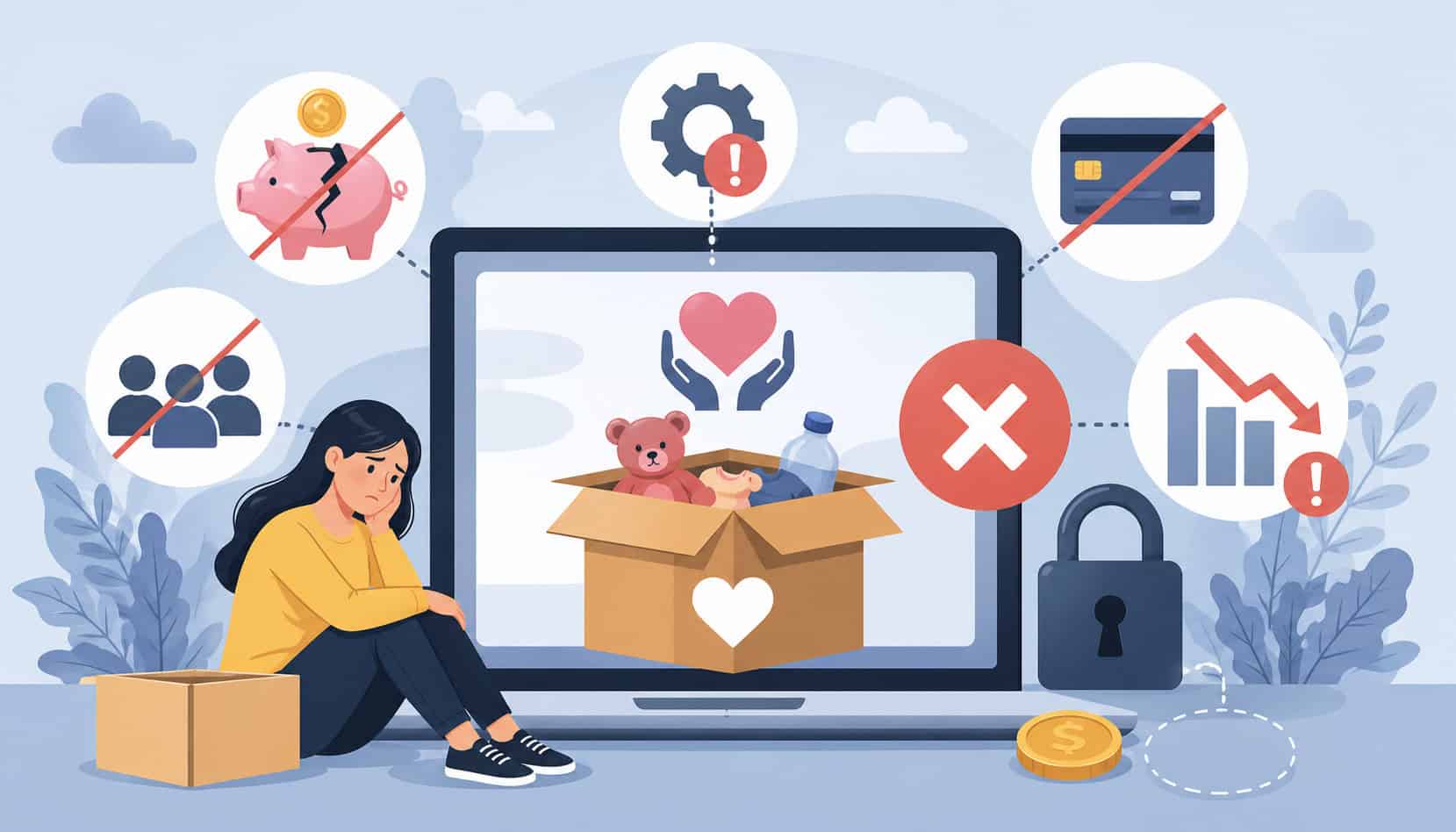
Free donation platforms can be helpful, but they are not always built for long-term fundraising management. Many organizations outgrow them once they need better donor records, stronger branding, recurring gift management, or detailed reporting.
A common limitation is restricted branding. Your donation page may include the platform’s logo, platform-controlled messaging, or a checkout experience that feels separate from your organization. This can reduce trust, especially for first-time donors.
Another issue is donor data access. Some platforms provide only basic donor details, while others limit exports or control parts of the donor relationship. If your organization cannot easily access donor history, communication preferences, and campaign activity, it becomes harder to build relationships.
Reporting may also be limited. Free platforms may show total donations and basic exports, but not deeper insights like donor retention, recurring gift trends, campaign comparisons, average gift size, or lapsed donor activity.
Support can be another challenge. Free tools may rely on help centers, chatbots, or community forums. During a major campaign, slow support can create stress if donations fail, receipts do not send, or reports do not match.
Free platforms may also offer fewer integrations. If your team uses email marketing, accounting software, a website CMS, or a separate CRM, limited integration can lead to duplicate data entry.
Benefits of Paid Donation Platforms

Paid donation platforms are often better suited for organizations that view fundraising as an ongoing relationship-building effort, not just a way to collect one-time gifts.
A paid online giving platform may offer more control over donation forms, branding, donor records, reporting, automation, user permissions, and integrations. These features can help teams save time, improve donor trust, and make better fundraising decisions.
Paid platforms can be especially useful for organizations running multiple campaigns at once. For example, you may need separate pages for annual giving, emergency appeals, events, memorial gifts, school programs, church ministries, or capital campaigns. A stronger platform can help organize these efforts without losing track of donor activity.
Recurring giving is another major advantage. A strong recurring donation platform can help donors give monthly, update payment methods, receive automated receipts, and stay connected over time. This supports more predictable fundraising.
Paid nonprofit fundraising software may also include better reporting. Instead of manually combining spreadsheets, teams can review campaign performance, donor trends, payment activity, and recurring gift data in one place.
Better Donor Management and Reporting
One of the biggest reasons organizations choose paid platforms is better donor management. Fundraising depends on relationships, and relationships depend on good records.
Paid donor management tools can help track donor history, gift frequency, campaign source, communication preferences, notes, recurring donation status, and engagement patterns. This makes it easier to thank donors personally and plan future outreach.
Reporting is equally important. A stronger platform can help answer questions like:
- Which campaign brought in the most first-time donors?
- How many donors gave more than once?
- Which donors started recurring gifts?
- What is the average gift amount?
- Which giving pages convert best?
- Which donors have not given recently?
These insights help leaders make better decisions. Instead of guessing, teams can adjust campaigns based on real activity.
Reporting also helps with board updates, budgeting, grant support, and internal planning. A platform with useful fundraising reports can reduce spreadsheet work and make performance easier to understand.
More Control Over Donor Experience
Donor experience can influence whether someone completes a gift, gives again, or recommends your organization to others. Paid platforms often provide more control over that experience.
Customization may include branded donation forms, suggested gift amounts, recurring donation prompts, custom fields, confirmation pages, automated thank-you emails, and tailored receipts. These details can help the giving process feel trustworthy and connected to your mission.
Control also matters after the gift. A donor should receive a clear confirmation, a helpful receipt, and a thoughtful follow-up. If your platform supports automated workflows, your team can respond quickly without handling every step manually.
Paid platforms may also improve mobile giving. Since many donors give from phones, the form should be fast, clear, and easy to complete. A confusing mobile checkout can reduce completed donations.
Branding is not only visual. It includes the tone of your messages, the clarity of your forms, and the confidence donors feel when they give.
Limitations of Paid Donation Platforms
Paid platforms can offer strong value, but they are not automatically the right choice for every organization. A paid system can become costly or frustrating if it is more complex than your team needs.
The most obvious drawback is cost. Monthly fees, annual contracts, setup charges, and add-on features can increase your budget. Some platforms also charge transaction fees in addition to subscription fees.
Setup time is another consideration. A more advanced platform may require configuration, data migration, staff training, campaign setup, and testing. If your team needs to launch a simple campaign tomorrow, a paid system may feel slower at first.
There may also be a learning curve. Staff and volunteers may need time to understand dashboards, reports, donor records, permissions, and integrations. If no one owns the system internally, features may go unused.
Contracts should be reviewed carefully. Some platforms require annual commitments, cancellation notice periods, minimum fees, or paid onboarding. These terms can matter if your needs change.
Paid platforms may also include features you do not need. Paying for event tools, advanced segmentation, or complex automation may not make sense if your organization only runs a few simple campaigns each year.
How to Compare Donation Platform Pricing
A good donation platform cost comparison looks at total cost, not just the monthly fee. To compare donation platforms pricing fairly, estimate your expected donation volume, average gift size, number of campaigns, recurring gift activity, and staff time.
Start with direct fees. These include monthly software costs, annual fees, payment processing fees, platform percentages, chargeback fees, and paid add-ons. Then review optional features such as text-to-give, event ticketing, peer-to-peer fundraising, donor management, accounting integrations, and email integrations.
Next, consider donor-covered fees. Some platforms let donors cover processing costs. This can help, but it should be optional and clearly explained. Do not assume every donor will cover fees.
Also review indirect costs. A free tool that requires manual exports, duplicate data entry, and manual receipts may create hidden administrative costs. A paid tool that automates these tasks may save time.
Here is a simple checklist:
| Cost Area | Questions to Ask |
| Monthly fee | Is there a fixed subscription cost? |
| Processing fee | What percentage and fixed fee apply per transaction? |
| Platform fee | Is there an extra platform percentage? |
| Donor tips | Does the platform ask donors to tip the platform? |
| Donor-covered fees | Can donors cover fees, and is it optional? |
| Recurring gifts | Are recurring donations included or paid? |
| Text-to-give | Is it included or an add-on? |
| Peer-to-peer | Are campaign pages and team fundraising included? |
| Integrations | Are CRM, accounting, email, or website integrations extra? |
| Support | Is live support included? |
| Data export | Can you export donor and gift data easily? |
| Migration | Is there a setup or migration cost? |
Which Option Is Best for Your Organization?
The best choice depends on how your organization fundraises today and where you want to go next. There is no single winner in the best donation platforms free vs paid discussion because different teams have different needs.
A free platform may be best if your fundraising is simple, your donation volume is low, and your team needs to launch quickly. It may also be the right choice if you are testing online giving for the first time.
A paid platform may be best if you need better donor management, more reliable reporting, branded donation forms, recurring gift tools, campaign tracking, integrations, and automation. It may also be better if your team is spending too much time on manual work.
Think about your donor experience. If donors give once and never hear from you again, the platform is not supporting long-term fundraising. If your team cannot easily find donor history or recurring gift details, you may need stronger tools.
Also consider growth. If your organization plans to run more campaigns, build monthly giving, host events, or improve donor retention, paid nonprofit fundraising software may provide better long-term value.
A useful online giving platform should make giving easy for donors and management easier for your team.
Choose a Free Donation Platform If…
A free donation platform may be the right fit when your needs are simple and your budget is limited. It can help you start quickly without committing to a monthly software fee.
Choose a free option if:
- You are running a small one-time campaign.
- You are testing online giving for the first time.
- You have low donation volume.
- You do not need advanced donor records.
- You have limited staff or volunteers.
- You need a quick campaign page.
- You are comfortable with basic reporting.
- You do not need many integrations.
- You can manually manage follow-up.
- You are not yet focused on recurring giving.
Free platforms are also useful for short-term community efforts where speed matters more than customization. If your campaign is simple, a free tool may be enough.
However, set expectations early. Decide how you will export donor data, send thank-you messages, track fees, and measure campaign results.
Choose a Paid Donation Platform If…
A paid donation platform may be a better fit when fundraising is becoming more regular, strategic, or complex. If your team is managing multiple campaigns, recurring donors, donor segments, or reporting needs, paid tools can provide more control.
Choose a paid option if:
- Your donor list is growing.
- You need detailed donor records.
- You want to build recurring giving.
- You run multiple campaigns.
- You need branded donation forms.
- You want stronger reporting.
- You need staff or volunteer permissions.
- You want automated receipts and follow-ups.
- You need integrations with other tools.
- You want better donor retention workflows.
- Manual spreadsheets are slowing your team down.
Paid platforms are especially useful when you want fundraising to become more repeatable. Instead of rebuilding each campaign from scratch, your team can use templates, reports, donor profiles, and automation.
The goal is not to buy the most complex system. The goal is to choose nonprofit fundraising software that your team will actually use.
Common Mistakes to Avoid When Choosing a Donation Platform
One common mistake is choosing based only on monthly cost. A free platform may still include transaction fees, platform fees, donor tips, or limited features that create extra work. A paid platform may cost more upfront but save time through automation and reporting.
Another mistake is ignoring donation processing fees. Small differences in fees can become meaningful as donation volume grows. Always compare the full fee structure.
Many organizations also overlook donor data access. If you cannot easily export donor information, track donor history, or manage communication preferences, your long-term fundraising may suffer.
Skipping mobile testing is another issue. Donors often give from phones. If the form is too long, slow, or confusing, you may lose gifts before they are completed.
Organizations sometimes forget to review support options. During a major campaign, responsive support can be very important. Check whether support is self-service, email-only, chat-based, or live.
Another mistake is ignoring recurring donation features. Monthly giving can support steady revenue, but only if the platform makes recurring gifts easy to start, manage, and update.
Finally, avoid choosing only for today. Your organization may need better reporting, integrations, or donor management sooner than expected.
FAQs
Are free donation platforms really free?
Not completely. Many free donation platforms do not charge a monthly fee, but donation processing fees usually still apply. Some may also charge platform fees, ask donors for tips, or limit important features.
What fees should I look for in a donation platform?
Look for payment processing fees, platform fees, monthly subscriptions, annual contracts, chargeback fees, donor-covered fee options, event fees, text-to-give fees, peer-to-peer fees, and integration costs.
Is a paid donation platform worth it for small nonprofits?
It can be, depending on your needs. A paid platform may be worth it if it saves staff time, improves donor follow-up, supports recurring giving, and provides better reporting.
Which is better for recurring donations?
Paid platforms often provide stronger recurring donation tools, including automated receipts, failed payment handling, and recurring gift reports. Some free platforms support recurring giving, but features may be limited.
Can free platforms handle donor management?
Some free platforms offer basic donor records. However, they may not provide full donor management tools like segmentation, communication preferences, or detailed reporting.
How do I compare donation platform pricing?
Estimate your donation volume, average gift size, and campaign needs. Then compare processing fees, platform fees, subscriptions, add-ons, and support costs.
Should donors cover processing fees?
Donor-covered fees can help maximize donations, but they should always be optional and clearly explained to maintain trust.
When should an organization upgrade from free to paid?
Upgrade when your donor list grows, reporting becomes difficult, recurring donations increase, or manual work starts slowing down your team.
Conclusion
The best choice in free vs paid donation platforms depends on your fundraising goals, donation volume, donor experience, reporting needs, budget, and growth plans.
Free donation platforms can be a good fit for simple campaigns, new organizations, emergency appeals, and groups with limited budgets. They make it easier to start quickly, but they may come with feature limits, basic reporting, less branding control, and hidden costs.
Paid donation platforms may offer better long-term value for organizations that need donor management, recurring giving, automation, integrations, branded forms, and stronger reporting. They require more investment, but they can also support better donor relationships and more efficient fundraising.
The right platform should make giving easier for donors and fundraising easier for your team. Start with your real needs, compare total costs, test the donor experience, and choose the option that supports both today’s campaign and tomorrow’s growth.