
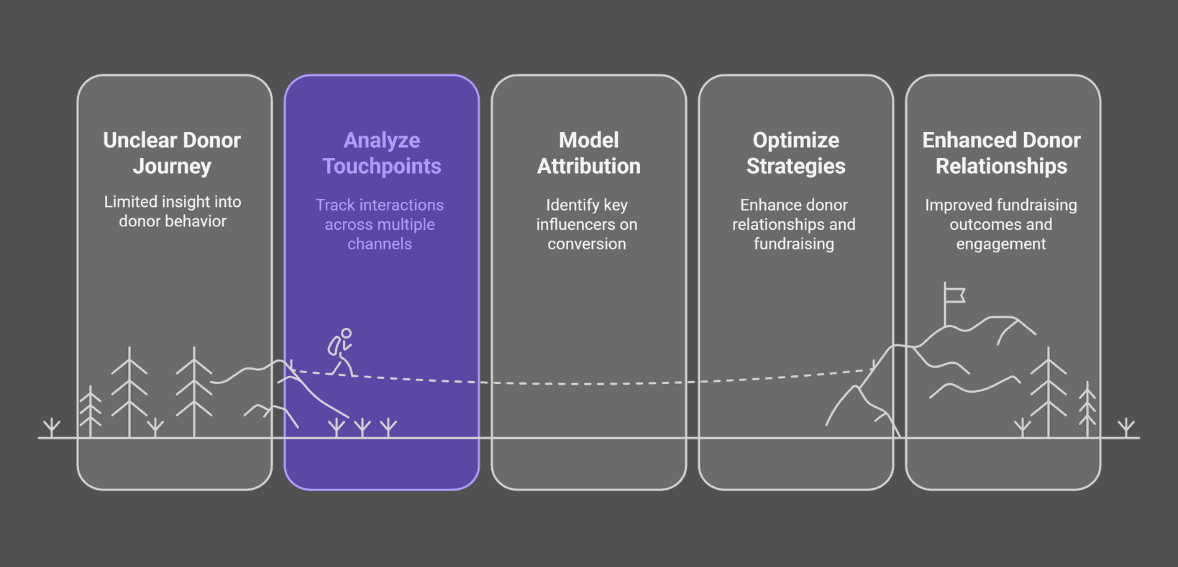
Multi-Touch Attribution Modeling for Complex Donor Journeys
Fundraising through nonprofit organizations is difficult today due to the many ways in which a donor interacts with a nonprofit organization: emails, social media, website visits, special events, and recommendations from friends, just to name a few. Nonprofits have trouble evaluating the effectiveness of their fundraising efforts and have a hard time communicating with their donors, making it impossible to come to a conclusion about the value of the donations.
More sophisticated marketing techniques are beyond the reach of single-touch attribution approaches such as first or last touch. Thus, the companies might end up wasting their budgets on the wrong things, not recognizing the strength of some channels, and eventually losing their contributions.
At this point, multi-touch attribution modeling becomes a necessity. By monitoring and evaluating each communication between the donor and the nonprofit, the organization can extract valuable insights not only about the whole journey but also about the engagement strategies and fundraising results. Moreover, the nonprofits will not only understand donor touchpoints but also be able to make decisions backed by data that enhance the relationships and, consequently, regular donations over time.
What is Multi-Touch Attribution Modeling?
Multi-touch attribution modeling is an advanced technique that distributes the credit for the donation across all the channels or touchpoints that the donor has interacted with before donating. While single-touch systems, for instance, the first-touch or last-touch models, attribute the whole influence and the credit solely to one interaction, the donor’s decision is being made by the set of interactions that occurred beforehand, which is the multi-touch model’s constructive understanding of the situation.
It discloses the previous contributor’s initial interaction for the charity sector, yet the whole distribution of the campaign techniques, which involved emails, social media, events, and website visits, led to the donation being made successfully. The multi-touch attribution empowers the institutions to assess the importance of each channel and alter their campaigns based on trustworthy data rather than hypotheses.
How It Differs from Single-Touch Models
Single-touch models usually break down the journey of the donor into very simple stages. They might assign the debit only to the first contact or only to the last contact before the donation. Although these models are straightforward, they do not take into consideration the subtle impact of the multitude of touchpoints that ultimately result in a contribution.
On the other hand, multi-touch models are very generous and share the credit among all the interactions, thus offering a complete picture of the donor’s actions. Such a strategy does allow charities to assess the real winners in terms of campaign donations and the ones that need more tweaking.
Benefits for Nonprofits
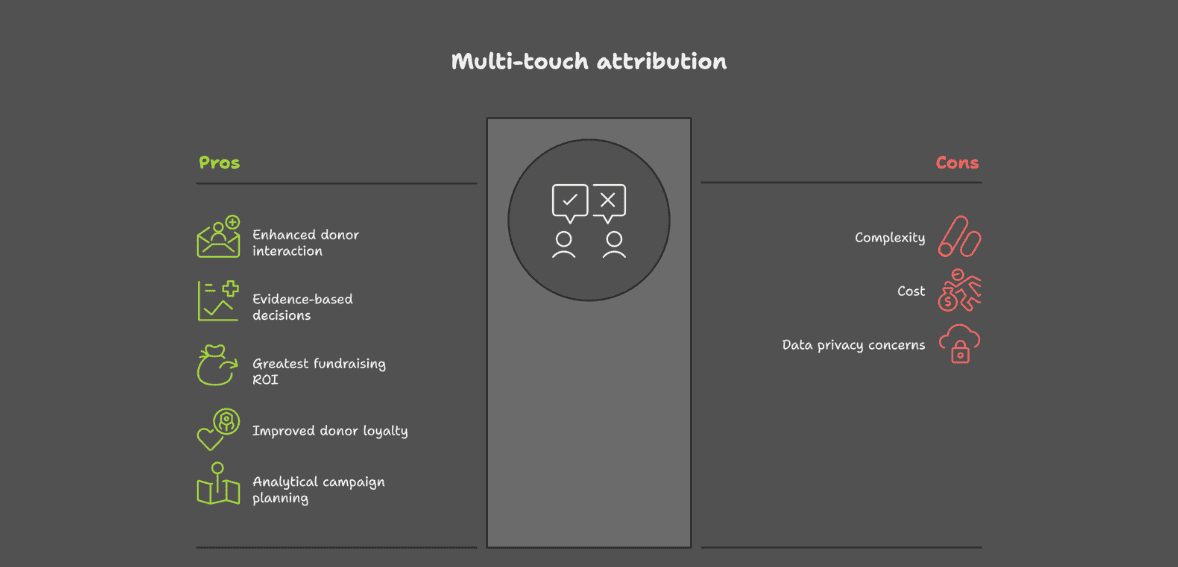
- Enhanced Donor Interaction: Not only can nonprofits identify the channels that are most effective in terms of donor interaction, but they can also communicate through the respective channels in an individualized way. For example, if email newsletters attract the most donors, the non-profit will most likely keep interacting through that channel.
- Evidence-based Decisions: The application of multi-touch attribution provides the positive insights that are essential for setting budgets, planning campaigns, and allocating resources, thereby assisting the non-profits in investing in those strategies that yield the best returns (ROI).
- Greatest Fundraising ROI: The non-profits can allocate the resources most effectively so that they get the highest return from their fundraising efforts, and are also careful not to spend money on the campaigns that perform poorly.
- Improved Donor Loyalty: Nonprofits can identify giving-supportive interactions, and thus, they can reinforce relationships with givers, attract sign-ups, and even cut off the churn rate of their key supporters.
- Analytical Campaign Planning: The attribution model reveals insights that enable the nonprofit to map the campaign around the key touchpoints, thus guaranteeing that every campaign will give something substantial to the fundraising goal — an approach strengthened further by multi-touch attribution modeling.
Key Types of Multi-Touch Attribution Models
Linear Attribution
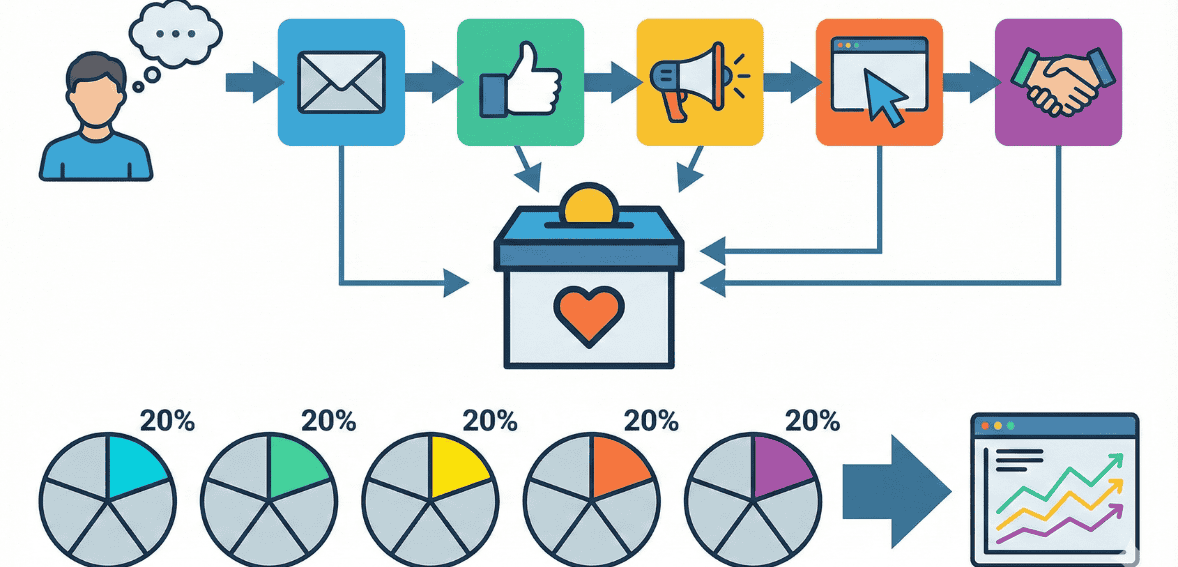
In linear attribution, every touchpoint throughout the donor journey receives the same amount of credit for a donation: If a donor encounters five different channels before donating, then each channel receives 20% of the donation credit. Linear attribution does not give preference to any one channel, and therefore, Nonprofits can see engagement trends for all channels in one place. Linear attribution works best for non-profits that run multiple fundraising campaigns concurrently.
Time-Decay Attribution
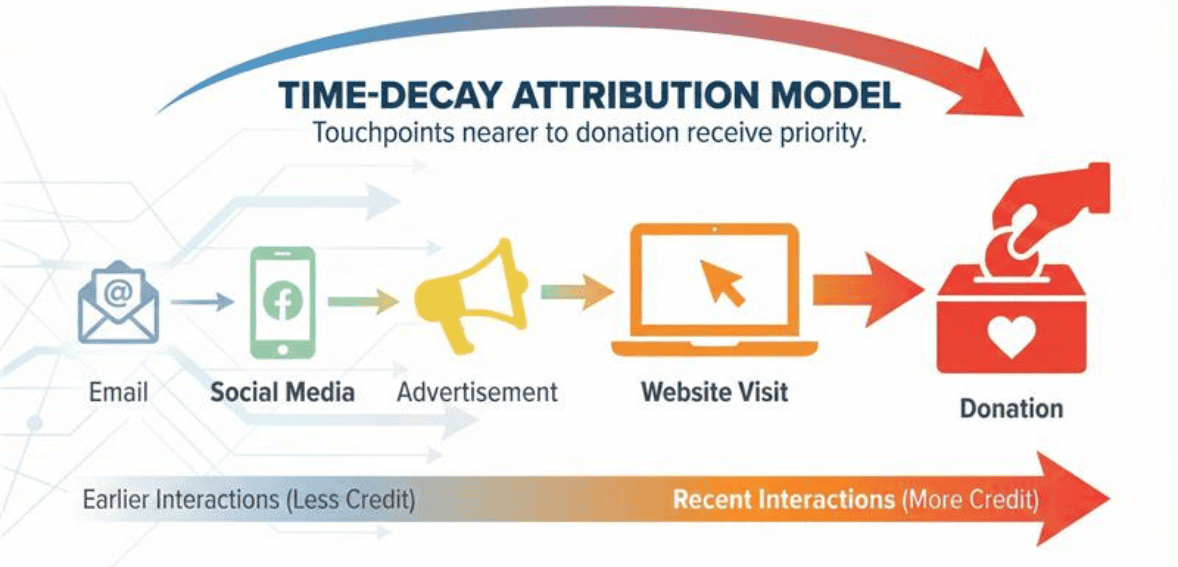
Time-decay attribution gives priority to touchpoints that are nearer to the last donation. Interactions that take place just before a contribution are said to have more influence than previous ones. This model is best suited for charities that want to analyze the factors that instantly drive donations and smoothen engagement strategies at the last moment.
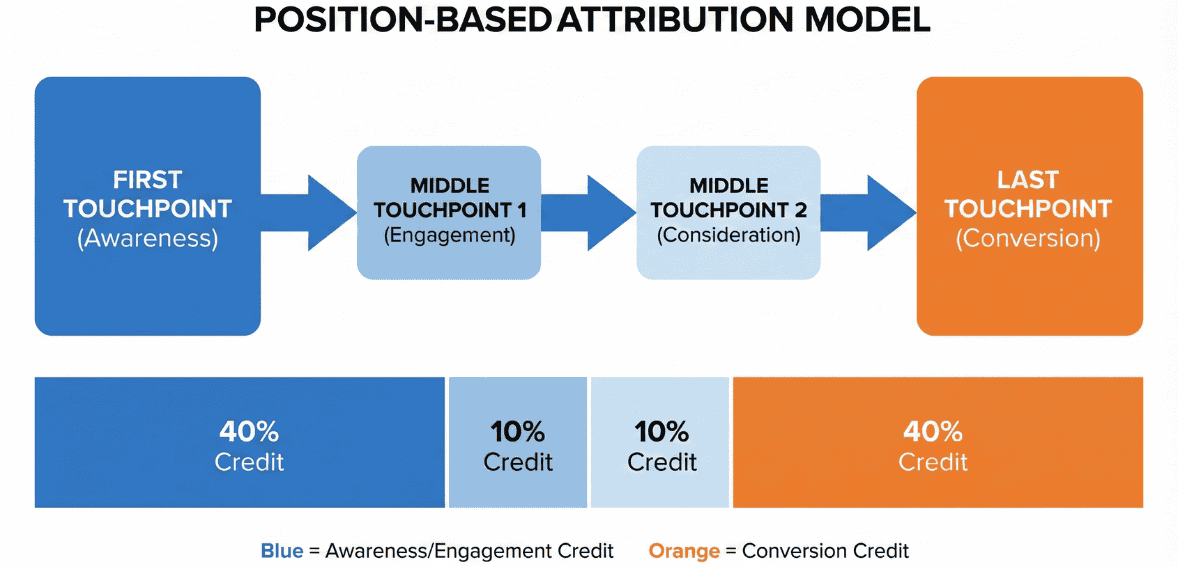
Position-Based Attribution
Position-based attribution assigns more credit to the first and the last touchpoints, while the remaining is distributed among the middle ones. It recognizes the early and easy donor education as well as the final moment of converting power. The model is very useful in balancing the awareness-building efforts with the conversion optimization.
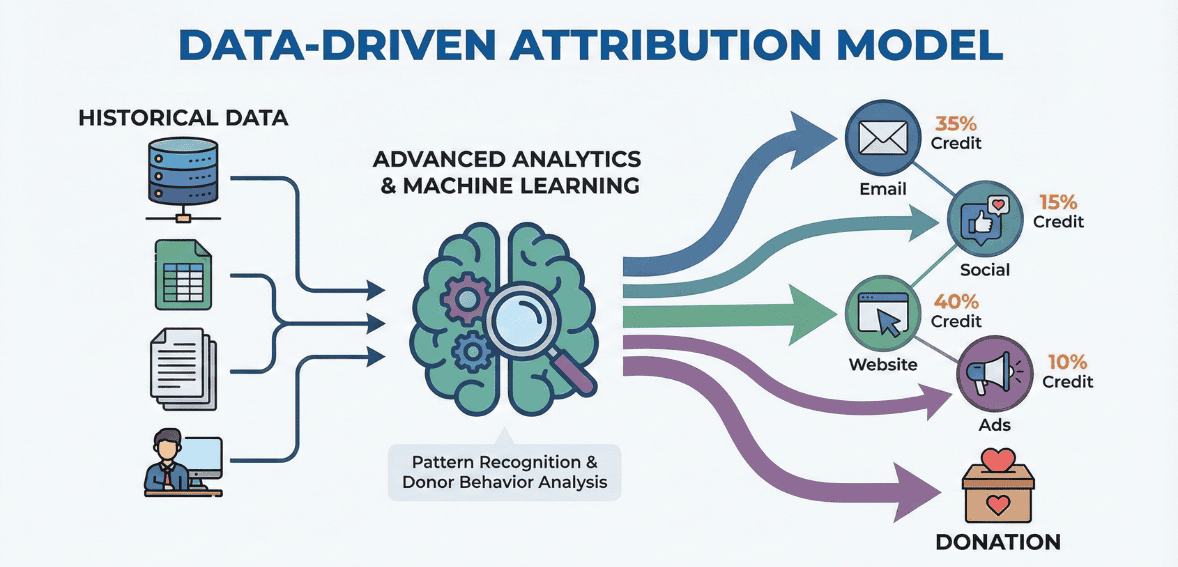
Data-Driven Attribution
Data-driven attribution gives credit to the touchpoints based on historical data. Through advanced analytics and machine learning, patterns in donor behavior are identified, and very accurate insights are provided. Although it is somewhat complex, this model is most suited for nonprofits with strong data systems and an analytical mindset.
Why Multi-Touch Attribution Matters for Complex Donor Journeys
Donor journeys are not simple at all. Donors might go over the website of a charity several times, participate in events, read newsletters, and communicate via social media before finally making a donation. Multi-touch attribution modeling ensures that no touchpoint is overlooked during analysis.
Tracking Multiple Touchpoints
The right tracking enables the charities to count the contributions made by each interaction. This implies that the charities will completely know which campaigns are good, which messages are catchy, and which media are driving the most engagement. Total tracking will make sure that the charities distribute the resources in the right way.
Understanding Donor Decision-Making
Examining donor actions at the different touchpoints reveals the trends and preferences of the donors. Some donors may find personalized emails more attractive, while people who dislike emails may go to webinars or social media for engagement. Including these preferences in their programming, nonprofits can make more precise and thus, higher output campaigns through engagement and conversion rates — a key advantage of multi-touch attribution modeling for donor journeys.
Preventing Lost Contributions
Organizations that do not use multi-touch attribution might misinterpret the data and, hence, they will be making efforts on the wrong channels, mistakenly believing they are effective, but in reality, the channels might have a negligible impact. This misconception can lead to rejection of donations, loss of precious marketing resources, and even worse, missing out on opportunities right from the start.
Enhancing Predictive Insights
With advanced attribution models, the organizations also get predictive insights into donor behavior that are quite precise. Say, for instance, that non-profits gain insight into the various touchpoints that persuade people to donate more than once; then, not only would they be able to forecast the donations coming in the future, but also to use the forecasts for planning their retention strategies. Predictive insights give power to organizations for focusing their activities on those donors who are most prone to repeat their contributions, thereby increasing the lifetime value of the donor.
Common Touch Points for Donors
Email Campaigns
The email links continue to be one of the most powerful means of communication. The tracking of the opens, clicks, and engagement gives a clear picture of the contribution the messages are making. Personalized email campaigns at the right moment can win over new donors and, even more so, they can increase the amount of money received from already converted donors.
Social Media Interactions
Activities such as liking, sharing, commenting, and so on in social media give great info about the donor’s interests and consciousness. The multi-touch attribution method can use these activities to show their strong impact. Besides, social media provides a means to monitor donor feelings, thus giving a reason to change the campaign’s tactics.
Website Visits and Engagement
The analysis of the website shows the donor patterns, indicating which pages they go to, the length of their stay, and the content that gets them to give. Changing the website’s look and making it more user-friendly based on these findings will not only increase the number of happy donors but also the conversion rates.
Events and Webinars
Whether it is a physical or virtual event, both kinds are necessary for donor engagement. Our model can be applied to measure the donations resulting from the events, thus guiding charities in building their event planning more engagingly. It is also advisable to do communication follow-ups and conduct post-event surveys, as they will add to the donor understanding already gained from the event.
Peer and Community Recommendations
The non-verbal communication and peer recommendations tend to account for a large part of donations coming in through recurring contribution giving schemes. Attribution across multiple touches is a method that lets organizations get a handle on the impact of such referrals, thus improving their fundraising based on community relationships.
Implementing Multi-Touch Attribution in Nonprofits
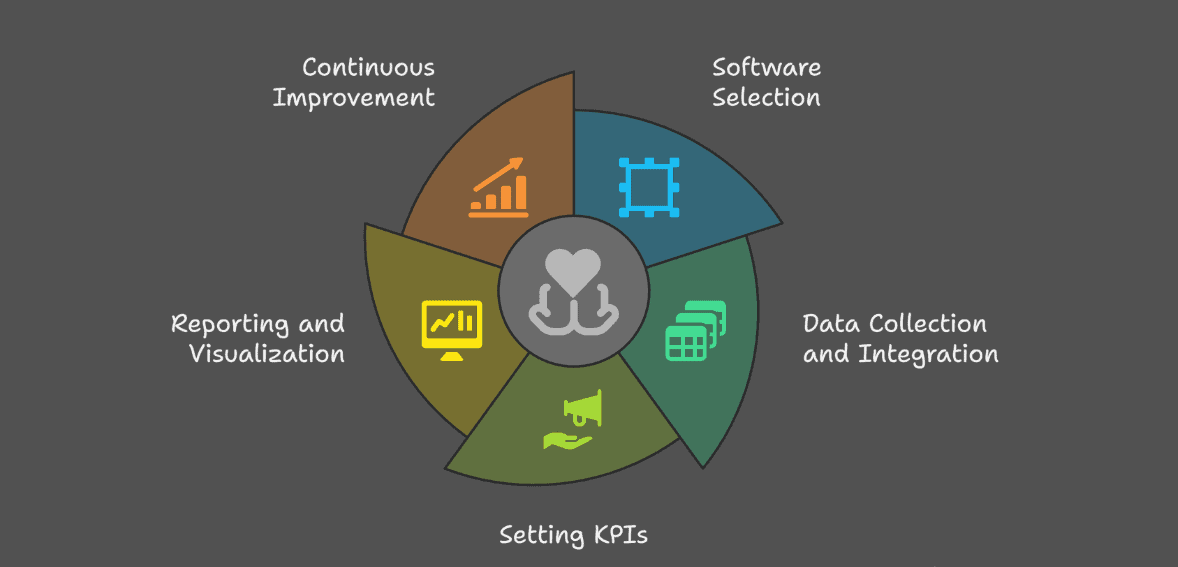
Choosing the Right Software
The software for tracking donor interactions across different channels should be selected by the nonprofit organization. The CRM systems, analytics tools, and marketing software that work together are very important in making sure that donor behavior is efficiently captured and analyzed.
Data Collection and Integration
Clean and comprehensive data is the foundation of good attribution. Integrating this data is crucial for nonprofits that want to apply multi-touch attribution modeling effectively across all donor engagement channels.
Setting KPIs
Key Performance Indicators (KPIs) direct the attribution efforts. Donor acquisition cost, average donation size, engagement rates, and repeat contributions are some of the metrics that provide benchmarks to measure the effectiveness of the campaigns.
Reporting and Visualization
Dashboards and charts are the visualization tools that huge numbers of stakeholders use to clearly see the results of attribution. All of these visualizations help tell a story for stakeholders and are open, which helps show data that will allow for making decisions based on the data. Additionally, there will be increased resource sharing and improved lines of communication between departments, donors, and teams.
Continuous Improvement
Attribution modeling is an ongoing process that can be improved over time by implementing an approach to regularly review campaigns, evaluate data sources, and analyze key touchpoints that will allow an organization to continually adapt to changes and improve response rates based on donor activity.
Overcoming Common Challenges
Data Silos
These are the separate systems in which information is stored. When data is kept in this manner, the analysis is likely to be inaccurate. Integrating data across all platforms gives a complete picture of donor behavior — especially important for nonprofits applying multi-touch attribution modeling on a large scale.
Inconsistent Tracking
Inaccurate or incomplete tracking is a problem for attribution efforts. Decision-makers can rely on trustworthy data through continuous audits, uniform tracking methods, and automatic monitoring.
Attribution Bias
Attribution models can introduce bias if they overemphasize certain channels. Choosing the appropriate model, validating results, and regularly reviewing performance ensures balanced insights that reflect real donor influence.
Tools and Technologies for Donor Attribution
- CRM Systems: Salesforce, Bloomerang, and NeonCRM are examples of platforms that gather all donors’ information and enable comprehensive tracking.
- Analytics Platforms: Google Analytics, HubSpot, as well as specific nonprofit software, measure and interpret the impact of the different channels.
- Artificial Intelligence and Machine Learning: Utilizing predictive analytics allows for spotting the most potential donors in the future, optimizing the supportive campaigns, and obtaining insights into the donation patterns.
Best Practices for Optimizing Donor Journeys
Personalization
When personalized communication is used to cultivate a relationship with a donor through an emotional connection and therefore cultivate the desire to donate, the donor will have a greater likelihood of participating, being satisfied with the service provided by the organization, and consequently will donate more, benefiting the non-profit organization overall. Personalized communications help to build a relationship through emotional ties, while providing the non-profit organization an opportunity to communicate its needs to donors regularly. This is easier to measure and optimize through multi-touch attribution modeling.
Testing and Optimization
Email campaigns, landing pages, social media campaigns, and events are all tested continuously to see if they are still effective. Besides, A/B testing helps to define and pinpoint the most effective strategies for every donor segment.
Cross-Channel Coordination
Unifying the messaging across all points of contact will not only make the brand stronger but also improve the donor’s engagement. The coordinated efforts, in turn, will lead to a more significant impact being created by every interaction.
Conclusion
Multi-touch attribution modeling provides nonprofits with the transparency necessary to track every movement of a donor before he or she gives money. Organizations can now finally see which activities matter, correlating insights from email newsletters, social media, and website visits. This change from guesswork to reliable data engages donors and boosts the overall efficiency of fundraising.
Indeed, it is a complex world of donor journeys, but nonprofits that use multi-touch attribution modeling gain a distinct advantage. They have better visibility, smarter resource allocation, and deeper personalization, allowing them to build stronger donor relationships and increase lifetime donor value.
FAQ
How is single-touch attribution different from multi-touch attribution?
The major difference between single-touch and multi-touch attribution is that single-touch attribution gives all of the credit to one engagement event, while multi-touch attribution splits the total credit across all of the donor’s touch points throughout the donor journey.
How would nonprofit organizations effectively track donor journeys that are more complicated than normal?
By connecting their CRM, analytics, and event tracking systems, nonprofits will be able to track interactions across all engagement channels.
What types of multi-touch attribution models should small nonprofit organizations use?
Small nonprofits are likely better off with linear and position-based models since they’re simpler to understand and still work well.
How often should attribution models be reviewed for accuracy?
Models should be evaluated for accuracy every quarter or immediately following a major campaign.
Will multi-touch attribution help nonprofits improve donor retention?
It is possible that by knowing what touch points lead to engagement, nonprofits will be able to develop greater long-term relationships more efficiently and effectively.