

Online Donation Platforms: How to Choose the Right One
Online giving isn’t “set it and forget it” anymore. Donors expect a fast, mobile-first checkout, multiple payment options, clear trust signals, and immediate receipts—while nonprofits and mission-driven teams need low friction, strong reporting, simple reconciliation, and airtight security.
That’s why choosing among online donation platforms has become a strategic decision, not a quick software pick.
The best online donation platforms do more than collect money. They shape your donor experience, determine your recurring revenue potential, influence how much you lose to fees, and affect how confidently supporters share your campaign with friends. They also impact risk: fraud disputes, chargebacks, data security obligations, and compliance with tax receipt rules.
This guide walks through how to choose online donation platforms based on practical, real-world criteria: what you’re fundraising for, how donors prefer to give, what tools you already use, and where hidden costs can surprise you.
You’ll also learn what “tip-driven” pricing really means, how to compare total cost (not just headline fees), and how to future-proof your fundraising stack for the next wave of donor expectations.
Throughout the article, you’ll see relevant terms used the way fundraisers and finance teams use them—payment processing, donor covered fees, recurring giving, CRM integrations, PCI compliance, data retention, and donor acknowledgments.
If your goal is to increase conversion, protect your donor relationships, and keep more of every gift, this is the exact mindset you want when evaluating online donation platforms.
Understand Your Fundraising Model Before Comparing Online Donation Platforms

Before you look at pricing pages and feature checklists, step back and define what you’re actually trying to accomplish. Online donation platforms are built around different fundraising models, and picking the wrong “type” can force you into workarounds that cost time, money, and donor trust.
The most common mistake is choosing a platform that’s great for one-off campaigns when your real growth lever is recurring giving—or choosing a slick peer-to-peer tool when your bottleneck is back-office reconciliation.
Start with your primary donation flows. Are you mainly collecting year-round gifts from your website? Running time-bound campaigns that need urgency and shareability? Hosting events that require tickets plus add-on donations? Building a peer-to-peer program where supporters fundraise on your behalf? Each of those workflows changes what “best” means for online donation platforms.
Also map your operational reality. Who will manage the platform day-to-day? Do you need role-based permissions, approval workflows, and audit trails? How critical is integration with your donor database or CRM? Do you require multiple sub-accounts, chapters, or locations?
These details determine whether a lightweight tool will stay lightweight—or become a patchwork of spreadsheets and manual exports.
Lastly, define your non-negotiables: payment methods you must support, branding requirements, receipt rules, reporting needs, and the acceptable donor experience at checkout. Once you know your fundraising model, comparing online donation platforms becomes much clearer—and you can filter out tools that look impressive but don’t match your reality.
Website Donations vs. Campaign Donations vs. Peer-to-Peer Fundraising
Online donation platforms typically shine in one of three lanes: embedded website giving, campaign-style giving pages, or peer-to-peer fundraising. Website donation flows prioritize consistency, brand control, and long-term recurring revenue.
Campaign donations emphasize storytelling, shareable links, progress meters, and flexible goals. Peer-to-peer is built for supporter-led pages, team fundraising, leaderboards, and social proof.
If your main goal is steady, year-round giving, focus on online donation platforms that offer clean embedded forms, high-speed checkout, recurring donation management, and strong donor account experiences. A tool that’s built mainly for viral campaigns can feel “noisy” or off-brand when embedded on a homepage.
If you run seasonal appeals or emergency drives, campaign tools matter: page templates, matching gifts, goal thermometers, impact blocks, and rapid duplication for new drives. Online donation platforms that support quick page creation and A/B testing can raise more simply because you can iterate faster.
Peer-to-peer is its own world. The platform has to make supporters feel like heroes, not assistants. Look for personal fundraising pages, team creation, coaching emails, milestone prompts, and easy social sharing. The best online donation platforms in this category reduce the admin load while increasing participant engagement, because that’s what ultimately multiplies donations.
One-Time Gifts vs. Recurring Giving and Membership-Style Support
Recurring giving is often the most predictable growth engine for modern fundraising, so your choice of online donation platforms should reflect how serious you are about monthly revenue. It’s not enough to have a “make this monthly” checkbox.
You want smart recurring features: failed-payment recovery (dunning), automatic card updater tools, donor self-service portals, upgrade prompts, and clear reporting on churn and retention.
Membership-style support adds another layer: donor tiers, benefits, renewal logic, and communications that feel like a community rather than a transaction. If your organization runs memberships, sponsorships, or subscription-like giving, verify that online donation platforms can handle tiered recurring plans and clean exports to your CRM or email system.
Also watch the donor experience. Recurring donors should feel confident they can update payment info and manage their commitment. If donors can’t easily adjust a monthly gift, your team ends up doing manual changes—an invisible cost that grows over time.
The best online donation platforms for recurring giving treat “monthly donor” as a first-class citizen: seamless signup, easy management, and retention-focused design. If recurring is a priority, weigh these features more heavily than flashy campaign widgets.
Key Features That Separate High-Performing Online Donation Platforms
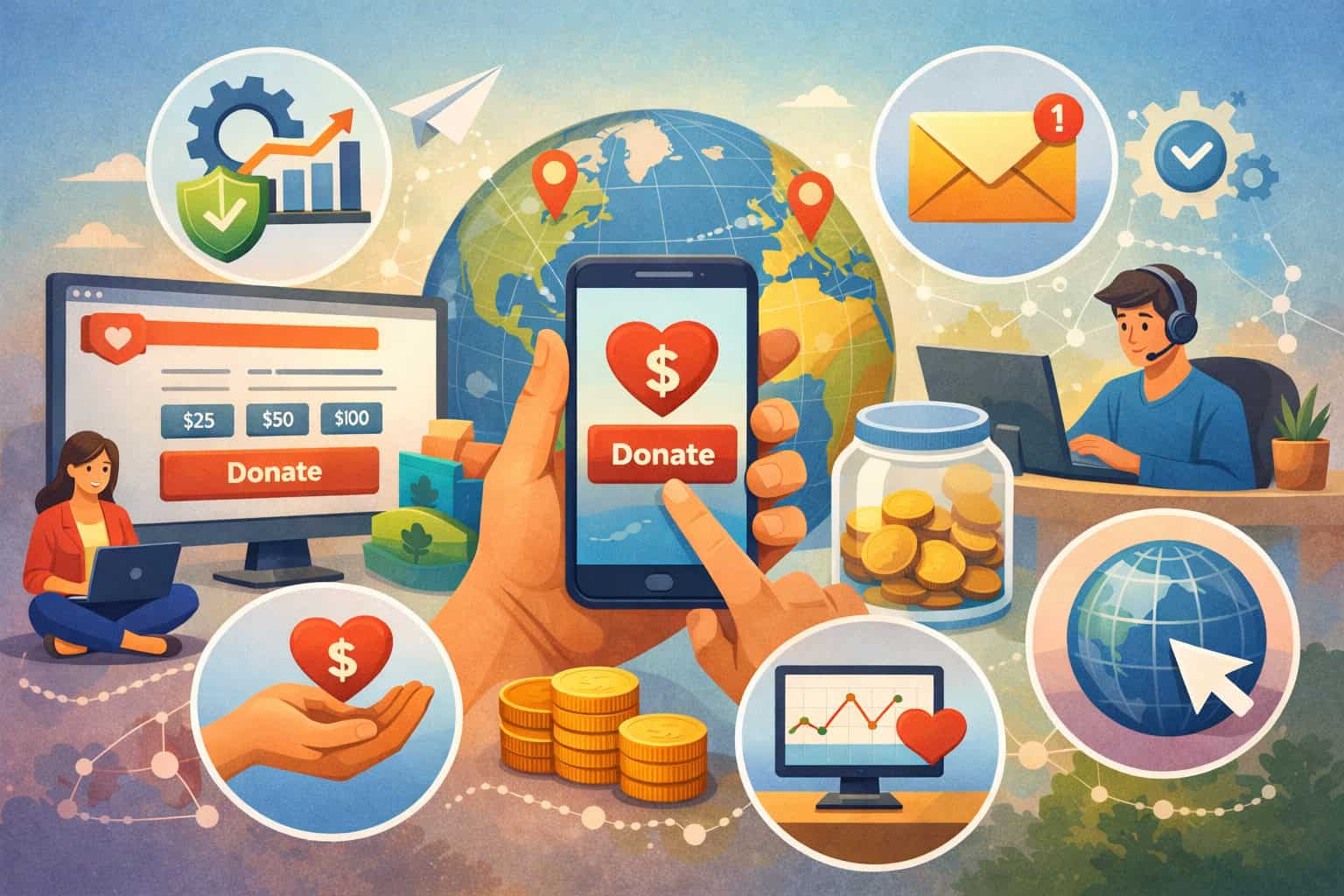
It’s tempting to compare online donation platforms by looking at the longest feature list. But the real difference is whether features improve conversion, increase average gift size, and reduce operational friction. “Nice-to-have” features don’t matter if the checkout flow is slow, the form isn’t mobile-friendly, or receipts create confusion for donors.
Start with conversion features: fast page load, minimal steps to donate, clear trust indicators, and flexible payment options. Donors abandon forms that ask for too much information too soon. A strong platform lets you collect the essentials, then enrich donor data later via follow-up journeys.
Next, evaluate donor experience after the gift. Automated receipts, thank-you pages, donor portals, and personalized confirmations have a direct impact on repeat giving. If online donation platforms make post-donation communication easy, you’re more likely to keep donors engaged.
Then consider internal needs: reporting, reconciliation, exports, and integrations. A platform can look perfect on the front end and still cause headaches for finance if payouts and fees aren’t transparent.
Finally, consider scalability. You might be fine today with basic donation pages, but if you plan to add peer-to-peer, events, or multi-campaign segmentation, choose online donation platforms that won’t force a migration in 12–18 months.
Checkout UX, Mobile Optimization, and Payment Methods That Boost Conversion
Checkout experience is the revenue engine. The best online donation platforms treat the donation form like an ecommerce checkout: optimized for speed, clarity, and trust. Mobile optimization is no longer optional—many donors discover campaigns on social media and give from their phone, so every extra second and every awkward input field reduces conversion.
Payment methods matter too. Cards are standard, but donors increasingly expect wallet options like Apple Pay and Google Pay because they reduce typing and feel more secure. Some online donation platforms also support PayPal and bank transfers, which can be important depending on donor preferences and average gift size.
Look for features that increase donation amounts without feeling pushy: suggested giving tiers, “cover fees” prompts that are transparent, recurring default toggles (when appropriate), and impact descriptions tied to amounts. These are not gimmicks—they’re proven UX patterns that help donors choose quickly and feel good about the gift.
Also verify accessibility basics: readable fonts, high contrast, keyboard navigation, and clear error messages. Accessibility isn’t just compliance—it’s conversion, because it reduces frustration for all users.
In short, the checkout flow is where online donation platforms either earn their keep or quietly leak revenue.
Receipts, Tax Acknowledgments, and Donor Communication Automation
Receipts aren’t just a courtesy; they’re a trust signal and, in many cases, documentation donors rely on. In the U.S., donors claiming deductions for contributions over $250 generally need a written acknowledgment containing specific information, and the IRS provides guidance on what that acknowledgment must include.
That means online donation platforms must support customizable receipts that include the required elements (like the amount, date, and whether goods/services were provided). It should be easy to tailor receipts for different campaign types (events, auctions, pure donations) and to include required disclaimers when benefits were provided.
Beyond compliance, automated communication drives retention. A strong platform lets you trigger immediate confirmation emails, send annual summaries, and segment messaging based on donor behavior. If your donor receives a fast, clear receipt and a warm thank-you, they’re more likely to give again and recommend you to others.
Also consider deliverability and branding. Are emails sent from your domain? Can you customize templates without breaking formatting on mobile? Do receipts land in spam? These practical details shape the donor experience far more than a shiny dashboard.
Online donation platforms that do receipts and acknowledgments well reduce risk, reduce support tickets, and create a smoother donor journey.
Reporting, Reconciliation, Payout Timing, and Finance-Friendly Controls
Fundraising teams often choose online donation platforms, but finance teams live with the consequences. Reporting and reconciliation are where “simple” platforms sometimes fall short. Your ideal platform should clearly show gross donations, processing fees, platform fees, chargebacks, refunds, and net payout—without requiring manual math.
Payout timing matters too. Some platforms pay out daily or on a rolling schedule; others batch payouts. Your cash-flow needs should influence your decision, especially if you run time-sensitive programs or emergency relief efforts.
Look for controls that reduce mistakes: role-based permissions, approval steps for refunds, audit logs, and export formats that match your accounting workflow. If you’re using QuickBooks or another accounting system, check whether the platform integrates directly or provides clean exports.
Also pay attention to how online donation platforms handle fee “coverage.” If donors can cover fees, the reporting should separate “donation” vs. “fee coverage” cleanly, so you don’t misstate revenue or confuse donors.
The best platforms make finance happy without slowing down fundraising—which is exactly what you want.
Pricing and Fees: How to Compare the True Cost of Online Donation Platforms
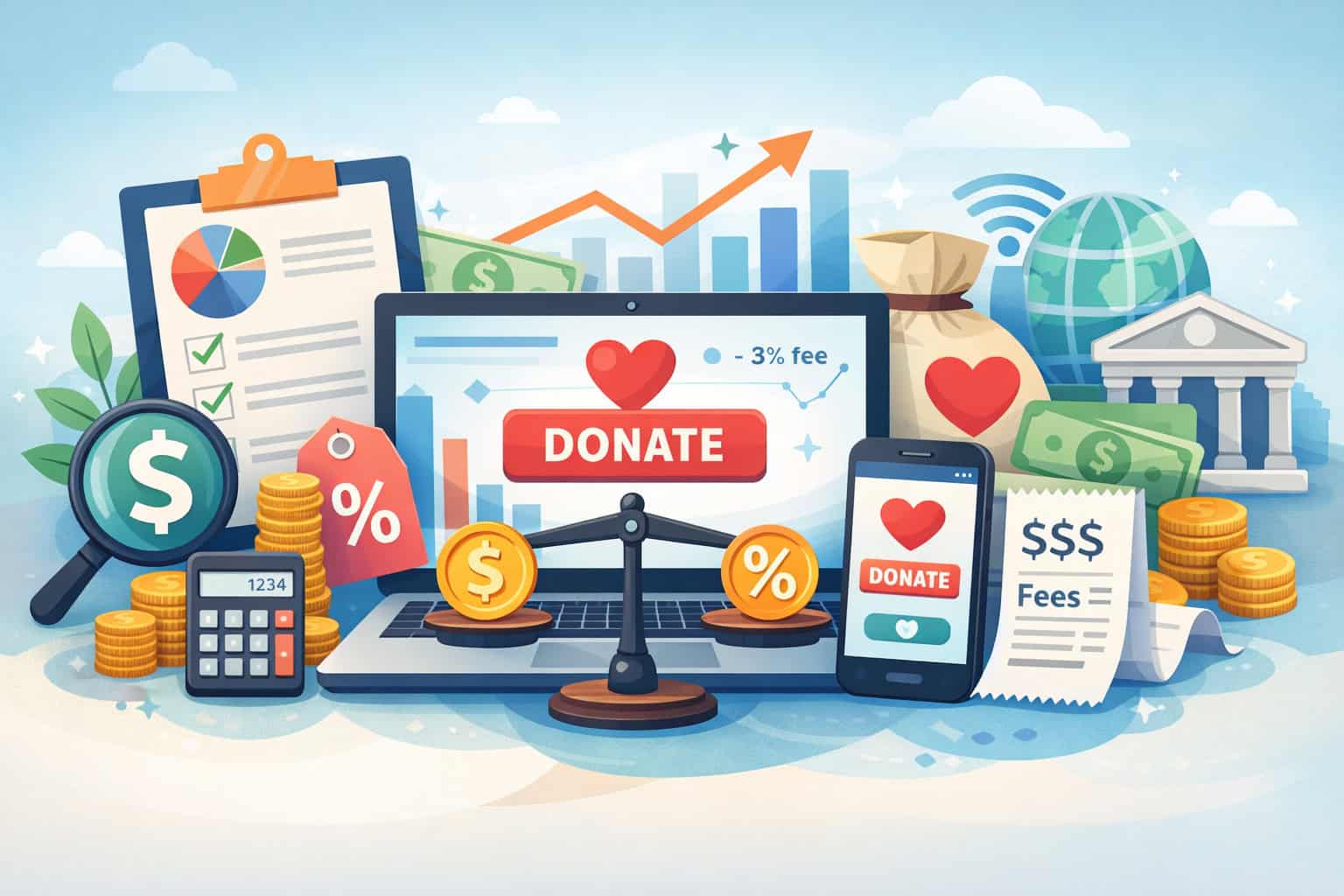
Pricing is where many organizations get surprised. Two online donation platforms can advertise “low fees” while producing very different net revenue. To compare fairly, you need to look at total cost: platform fees, processing fees, payout fees, add-on feature costs, chargeback handling, and the “soft costs” of staff time.
Start with the basics. Many platforms charge a platform fee (percentage or subscription) plus standard payment processing fees. Other platforms use donor tips as their primary revenue model, which can reduce direct costs for the organization but introduces donor experience questions.
Then consider what’s included. Some tools include basic donation pages but charge extra for recurring tools, text-to-give, events, peer-to-peer, or advanced integrations. A platform that looks affordable can become expensive once you turn on the features you truly need.
Also compare fees by donation size. A fixed fee per transaction impacts small gifts more than large gifts. If your average donation is $20–$40, small per-transaction costs add up quickly.
Finally, compare net payout in real scenarios. Run the math on 100 donations of your typical amount and see what you actually keep. That’s how you evaluate online donation platforms like a finance leader, not just a marketer.
Tip-Driven Pricing Models: Pros, Cons, and Donor Trust Considerations
Tip-driven models have grown because they can reduce platform fees for organizations while shifting cost to optional donor tips. For example, Givebutter describes a model where the platform can be free to use when optional tips are enabled, with alternative fees if tips are disabled.
The upside is clear: you may keep more of each donation and reduce budget pressure. Tip-driven online donation platforms can be especially attractive for small organizations that need modern tools without a large software subscription.
The trade-off is donor perception. If the tip prompt feels confusing, overly aggressive, or hard to decline, donors may feel manipulated—even if the underlying donation is legitimate. That can reduce trust, increase abandonment, and create complaints that your team has to manage.
The best tip-driven experiences are transparent: they clearly show what portion supports the platform, make it easy to set a tip to zero, and avoid “dark patterns.” When evaluating online donation platforms with tipping, test the donor flow on mobile and ask a few supporters to try it without guidance. Their reaction will tell you a lot.
If donor trust is central to your brand, prioritize transparency and control over pure cost savings.
Payment Processing Rates and Nonprofit Discounts You Should Know About
Processing fees can be the largest recurring cost in online donation platforms, so nonprofit discounts matter. Some payment providers offer discounted charity rates to eligible organizations, but the details vary and eligibility requirements can be strict.
Stripe, for instance, states it offers discounted processing fees for qualifying nonprofit organizations accepting donations, with conditions attached to how the account is used. PayPal also offers a process to apply for a charity rate for eligible organizations.
The key takeaway: don’t assume you’re automatically getting nonprofit pricing. Confirm eligibility, apply where required, and understand whether the discount applies only to donations or also to tickets, merchandise, and other payments.
Also consider the payment method mix. Wallet payments can have different fee structures in some setups, and international donations can add cross-border costs. Even if you mostly fundraise domestically, a “Donate” button can attract support from anywhere.
When comparing online donation platforms, document your likely payment mix (card, wallet, PayPal, ACH/bank transfer) and ask each vendor for an estimated effective rate based on your real pattern—not a generic example.
Hidden Costs: Add-Ons, Integrations, Chargebacks, and Support Tiers
Hidden costs often show up after you launch. You start with a basic plan, then realize you need an integration with your CRM, advanced reporting, event ticketing, peer-to-peer, or text-to-donate. Many online donation platforms charge separately for these, either as upgrades or as paid add-ons.
Chargebacks and disputes are another overlooked cost. Even if your organization rarely faces fraud, disputes can happen from donor confusion, subscription forgetfulness, or friendly fraud. A platform that provides clear donor descriptors, easy refund tools, and strong support reduces both chargebacks and staff time.
Support tiers matter as you scale. If you’re running major campaigns, you want responsive support—especially during the year-end giving season. Some platforms offer phone support only on higher plans. Others provide onboarding and implementation services at additional cost.
Also factor in the cost of staff time. If the platform forces manual exports, duplicate data entry, or messy reconciliation, you’re paying in labor even if the invoice looks small.
The most practical way to compare online donation platforms is to build a “real cost” worksheet: subscription + platform fee + expected processing + add-ons + estimated staff hours per month. The winner is often the platform that reduces friction, not the one with the lowest headline rate.
Security, Compliance, and Risk: What Online Donation Platforms Must Handle
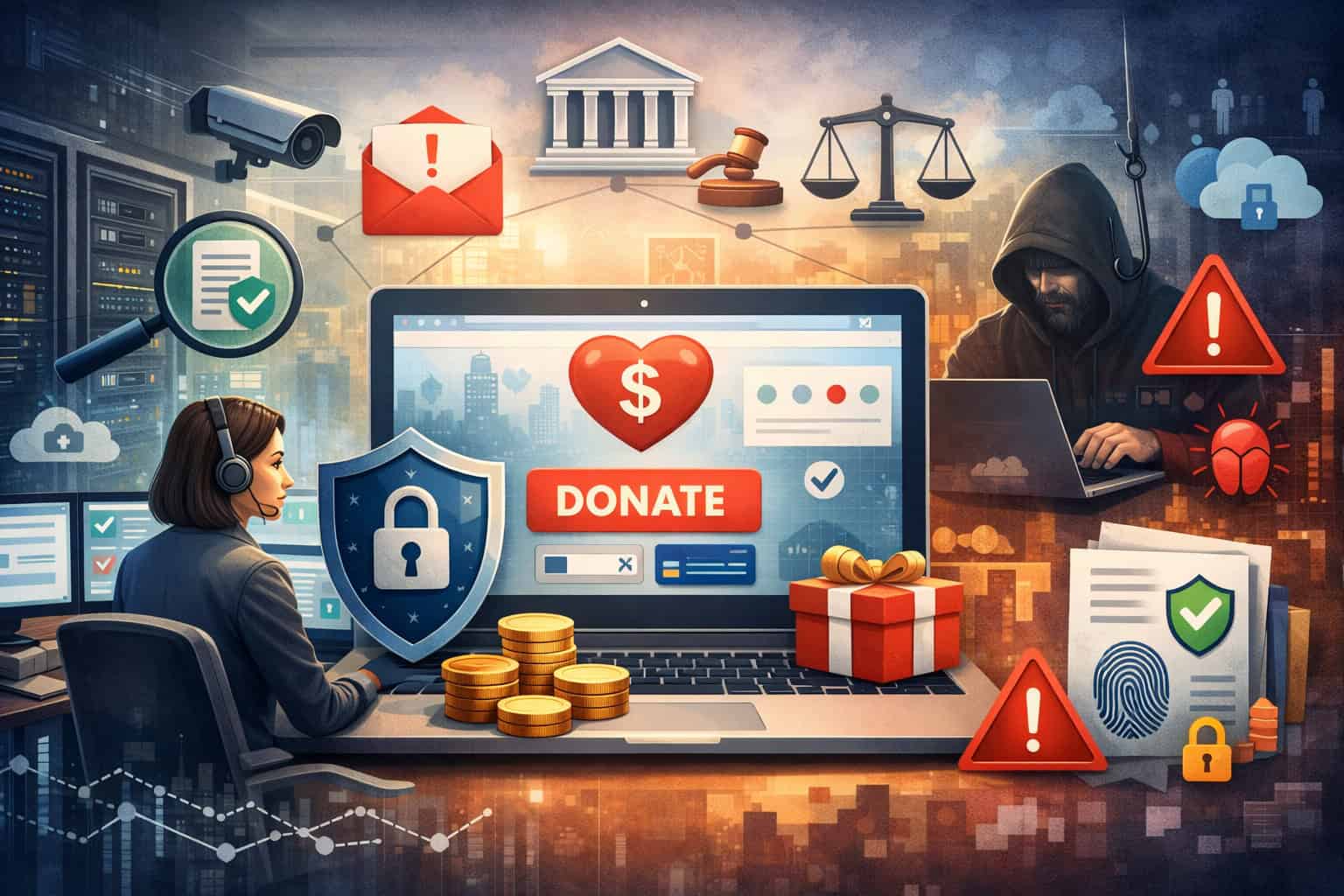
When donors give online, they’re trusting you with sensitive information—payment data, contact details, and often personal notes tied to emotional causes. That trust is fragile, and any security incident can damage donor confidence for years. So security isn’t a technical checkbox; it’s a fundraising asset.
Online donation platforms should minimize your exposure by using secure payment flows, tokenization, and compliance-friendly architecture. You should also look for fraud prevention tools, bot protection, and risk controls that reduce chargebacks without blocking legitimate donors.
Security standards evolve. For example, PCI DSS 4.0 introduced enhanced requirements and a timeline for future-dated requirements becoming effective, which impacts organizations that accept card payments online.
Even if your platform vendor handles most PCI scope, you still need to understand what responsibilities remain on your side—especially if you embed forms or use scripts on your website.
The right online donation platforms help you reduce risk through strong security posture, clear documentation, and practical tools that non-technical teams can manage confidently.
PCI Compliance, Data Handling, and What Changes After PCI DSS 4.0
PCI compliance can feel intimidating, but the core idea is simple: protect cardholder data. Many online donation platforms reduce your PCI scope by using hosted fields, secure payment pages, or tokenized checkout flows so sensitive data never touches your servers.
PCI DSS 4.0 brought updated security expectations and phased deadlines, including future-dated requirements and additional guidance for ecommerce payment flows. For nonprofits and fundraisers, this matters because donation pages behave like ecommerce checkouts, especially when embedded in websites.
When evaluating online donation platforms, ask how they handle PCI responsibilities: Do they provide SAQ guidance? Do they use a compliant payment processor? How do they secure embedded widgets? What is their approach to vulnerability management and incident response?
Also consider data retention. Your platform should give you control over donor data exports and deletion where appropriate, and should explain how long they store transaction logs and donor information.
If you’re not technical, that’s fine—your vendor should make security understandable. A trustworthy platform can explain what they handle, what you handle, and how they keep donors safe without burying you in jargon.
Fraud Prevention, Chargebacks, and Donor Verification Without Friction
Fraud prevention is a balancing act. Too much friction and real donors abandon the gift. Too little and you face chargebacks and payment holds. The best online donation platforms use layered protection: device fingerprinting, velocity checks, bot mitigation, and smart rules that flag suspicious behavior while letting legitimate donors donate quickly.
Recurring giving introduces a different risk: “subscription surprise.” Donors may forget they enrolled monthly and dispute charges later. A good platform reduces this by making recurring enrollment obvious, sending clear confirmations, offering easy donor self-service, and providing fast refunds when needed.
Also look at how disputes are handled. Do you get clear alerts? Are there templates for responding? Can you attach evidence easily? Chargeback processes vary by card network, but platform tooling makes a big difference in how much staff time you spend.
Online donation platforms should also support donor verification where appropriate—without forcing every donor through heavy verification steps. For example, you may want stronger checks for high-risk geographies or unusually large gifts, while keeping the standard checkout fast.
If you’ve ever dealt with a wave of disputes during year-end campaigns, you already know: risk controls are part of revenue, not separate from it.
Privacy Expectations, Donor Data Ownership, and Consent Management
Donors increasingly care about privacy—how their data is used, whether it’s shared, and how easily they can opt out. Online donation platforms should support consent management: email opt-in settings, SMS consent for text messaging, and clear donor preferences.
Data ownership matters too. You should be able to export donor data, campaign performance, and transaction history in usable formats. If you ever need to switch online donation platforms, portability protects you from being locked in.
Also confirm how the platform handles third-party sharing. Some platforms integrate with ad tools or analytics scripts. That can be valuable for optimization, but you need transparency so you can align with your privacy policy and donor expectations.
If you operate in multiple states or work with sensitive causes, privacy becomes even more important. Donors may want anonymity options, tribute gifts, and controls over public recognition lists.
A strong privacy posture is a trust builder. Online donation platforms that make privacy easy help you protect donors and reduce reputational risk—while supporting responsible fundraising growth.
Integrations and Your Fundraising Tech Stack: Choose Online Donation Platforms That Fit
Online donation platforms rarely live alone. They sit in the middle of your tech stack—website, email marketing, donor CRM, accounting, events, and sometimes volunteer systems. If the platform doesn’t integrate cleanly, your team ends up doing manual exports and imports, which creates errors and slows down donor follow-up.
Start by listing your “systems of record.” Where do you store donor profiles? Where do you track pledges and recurring commitments? Where do you send mass email and segmentation campaigns? Where does finance reconcile payouts?
Your online donation platforms should either integrate directly with these tools or provide reliable automation through connectors like Zapier-style workflows.
Also consider data quality. Many platforms collect donor data in slightly different structures. If you don’t control naming conventions, campaign IDs, and designation fields, you’ll create messy records that are hard to segment later.
The best platforms provide clean mapping, consistent identifiers, and the ability to pass metadata (like campaign source, donation designation, or event name) into your CRM.
In practice, integrations are where “good enough” platforms become great—or become a constant headache. Choose online donation platforms that reduce your administrative load and make your donor journeys faster and more personal.
CRM and Donor Database Sync: Prevent Duplicate Records and Lost Attribution
CRM syncing is the difference between “we raised money” and “we built relationships.” If your online donation platforms don’t sync reliably, donors may not get thanked properly, recurring donors may not be stewarded, and campaign attribution can disappear.
A strong sync should handle: new donor creation, matching existing donors, updating contact details, passing campaign metadata, and recording payment method and recurring status. Also look for logic that prevents duplicates—especially when donors use different emails or name variations.
Attribution is critical for growth. You want to know which email, social post, partner, or peer-to-peer fundraiser drove the gift. The best online donation platforms allow you to capture UTM parameters, source tags, and custom fields, then map them into your CRM. That data becomes your roadmap for scaling what works.
Also confirm how refunds and chargebacks sync. Finance accuracy matters, and donor records should reflect reality.
If CRM syncing feels like “just an admin detail,” treat it as a retention tool. Online donation platforms that keep your data clean help you build long-term donor value instead of running constant acquisition campaigns.
Accounting and Payout Workflows: Make Month-End Close Less Painful
Month-end close can be brutal when donation data is fragmented. Online donation platforms that support finance teams well will show net and gross clearly, separate fees, and provide exports designed for accounting workflows.
Look for payout reconciliation features: payout IDs, transaction grouping, deposit timing, and fee breakdowns by campaign or designation. Ideally, you can answer, “What did we receive in the bank, which donations made that up, and what fees were deducted?” without hours of manual work.
Also consider fund accounting needs. If you track restricted vs. unrestricted funds or multiple programs, your platform should support designations and reporting by fund. If you can tag gifts at checkout, you can avoid guesswork later.
If you run events, confirm whether ticket revenue and donations are separated in reports. Mixing them can create confusion and complicate acknowledgement language.
Online donation platforms that respect finance workflows don’t just save time—they reduce errors, improve transparency with leadership, and give you faster insight into campaign performance.
Marketing Tools: Email, SMS, Retargeting, and Personalization at Scale
Modern fundraising relies on timely, relevant communication. Online donation platforms that integrate with email and SMS tools help you build donor journeys: welcome series, impact updates, upgrade tasks, reactivation campaigns, and reminders for peer-to-peer fundraisers.
Look for segmentation capabilities. Can you tag donors by campaign, amount, recurrence, or interest area? Can you trigger automation when someone becomes a monthly donor or reaches a fundraising milestone?
Retargeting can also be powerful if used responsibly. If the platform supports tracking pixels and conversion events, you can retarget visitors who viewed a donation page but didn’t complete the gift. Just ensure your privacy policy aligns with your tracking approach.
Personalization matters. Donors respond to messages that reflect their actions: “Thanks for supporting the winter shelter fund,” not a generic blast. Online donation platforms that capture and pass meaningful metadata make personalization easier.
If growth is a priority, choose a platform that doesn’t just accept donations, but actively supports relationship-building at scale.
Step-by-Step Framework to Evaluate Online Donation Platforms Like a Pro
If you’re overwhelmed by options, you don’t need more opinions—you need a repeatable evaluation framework. The best way to choose online donation platforms is to run a structured process that compares real donor flows, real costs, and real operational impact.
First, define your primary use cases: website donations, campaigns, peer-to-peer, events, recurring giving, and major gifts. Assign a weight to each based on importance. For example, if recurring giving is your growth engine, it should carry more weight than event ticketing.
Second, build a scoring rubric. Include donor experience (mobile, payment methods, speed), fundraising tools (recurring, P2P, events), admin tools (reporting, roles), integrations (CRM, accounting), and pricing (total cost). Score each platform consistently.
Third, test the donor experience. Create a sandbox donation page and run through the checkout on mobile. Watch for friction: confusing fee prompts, too many fields, slow load, unclear recurring messaging, or awkward receipts.
Fourth, confirm support and implementation. If you’re migrating donors or recurring gifts, you need a clear plan. Online donation platforms should provide guidance for migration, data mapping, and launch.
This framework turns selection from a guess into a confident decision you can defend to leadership.
The Demo Checklist: Questions to Ask Vendors and What to Verify Yourself
Vendor demos can be polished, so your goal is to verify reality. Ask vendors to show—not tell—how specific workflows work. For online donation platforms, request live walkthroughs of:
- Creating a branded donation form and embedding it on a website
- Setting up recurring gifts and managing failed payments
- Creating a campaign page with goals and sharing tools
- Exporting reports and reconciling payouts
- Editing receipt templates and adding acknowledgment language
- Handling refunds, chargebacks, and donor support requests
- Mapping fields to your CRM and verifying attribution data
Then verify the donor experience yourself. Don’t rely on screenshots. Create a test donation, check how it appears on a bank statement, and review the email receipt. Test on multiple devices. If the platform uses optional tips or fee coverage, test how transparent the checkout feels.
Also verify admin permissions. Many teams learn too late that they can’t restrict sensitive actions or that audit logs are missing.
Online donation platforms should feel intuitive for both donors and staff. If a platform requires constant training, it will eventually become underused—no matter how powerful it is.
Pilot Testing: Run a Small Campaign Before You Fully Commit
A pilot campaign is the fastest way to see how online donation platforms behave under real conditions. Choose a small campaign with enough traffic to reveal issues but not so critical that problems damage your biggest appeal. Run it for 2–4 weeks, and measure:
- Conversion rate (visits to completed gifts)
- Average donation amount
- Recurring signup rate
- Donor support tickets or confusion points
- Refunds/chargebacks (even small signals matter)
- Staff time spent on setup, reporting, and reconciliation
Also review donor feedback. If donors mention confusion about fees, tipping, or receipts, take it seriously. Even small friction points can become bigger during peak season.
A pilot also tests your tech stack. Do integrations sync correctly? Do donor tags pass through? Does finance reconciliation work smoothly?
Online donation platforms that perform well in a pilot are far more likely to scale with you. Platforms that “almost work” in a pilot rarely get better when volume increases.
Migration Planning: Moving Recurring Donors Without Losing Revenue
Migration is where organizations lose money silently—especially recurring donors. If you’re switching online donation platforms, plan migration like a revenue protection project, not a technical task.
First, confirm whether recurring donations can be migrated and how. Some payment setups allow token migration under strict conditions; others require donors to re-enter payment details. If donors must re-enter details, you need a communication plan and a frictionless update flow.
Second, segment your recurring donors. Your highest-value monthly donors should receive white-glove communication. Provide clear steps, explain why you’re improving the donation experience, and emphasize security.
Third, align timing. Avoid migrating right before the year-end giving season. Choose a window when your team can monitor, troubleshoot, and respond quickly.
Fourth, test reporting continuity. Ensure you can compare year-over-year results even after the switch, using consistent campaign naming and data mapping.
Online donation platforms can be replaced, but donor trust is harder to rebuild. Treat migration as donor stewardship, and you’ll protect the revenue you’ve worked hard to earn.
Latest Trends Shaping Online Donation Platforms and Future Predictions
The fundraising landscape is moving quickly, and online donation platforms are evolving to match donor expectations. Several trends are becoming standard: mobile-first design, recurring-first strategies, personalization, and more transparency around fees and platform economics. Thought leadership and industry commentary in recent years has emphasized how digital fundraising continues to shift and how nonprofits are adapting strategies and tools accordingly.
One major direction is “frictionless giving.” Donors want fewer clicks, more wallet options, and faster confirmation. Platforms that behave like modern ecommerce checkouts will continue to outperform.
Another trend is transparency. Donors are more aware of fees, tipping prompts, and how platforms monetize. As scrutiny increases, platforms will likely compete on clarity and trust, not just features. (Recent debate around tipping prompts in fundraising checkouts has highlighted how interface design can influence donor perception.)
On the operations side, tighter security expectations and evolving PCI guidance will push platforms to invest more in secure ecommerce donation experiences.
Looking forward, expect more AI-driven personalization (suggested asks, donor journey timing), smarter fraud prevention, and deeper integrations that treat donor data as a single unified profile across channels.
AI, Personalization, and Smarter Donor Journeys
AI in fundraising doesn’t have to mean “robots writing emails.” In online donation platforms, AI is increasingly used to improve conversion and retention: suggesting optimal giving tiers, predicting which donors are likely to become recurring, and timing follow-ups based on engagement.
Personalization will also become more granular. Rather than one generic donation page, platforms will support dynamic content: impact statements that match a donor’s interest area, pre-filled information for returning donors, and tailored recurring upgrade prompts.
We’ll also see smarter retention tooling. Failed payments are a major cause of recurring donor churn, so platforms will improve automated retries, card updater integrations, and donor self-service flows.
For smaller organizations, AI may show up as better templates, smarter segment suggestions, and easier reporting—turning complex data into practical actions. For larger organizations, it will mean predictive modeling and multi-channel attribution that connects ads, email, and donor history into one view.
In the next few years, online donation platforms that help teams act on insights—not just view dashboards—will become the default choice for growth-minded fundraising.
More Payment Options, Faster Bank Transfers, and Real-Time Expectations
Donors increasingly expect to give the way they pay everywhere else: digital wallets, saved payment methods, and instant confirmation. That means online donation platforms will continue expanding wallet support and simplifying checkout.
Bank transfers and lower-cost payment methods will also become more important, especially for larger gifts and recurring giving. As payment infrastructure improves, donors and organizations will expect faster settlement and clearer payout visibility.
Another likely shift is more “donor control.” Donors will want to manage subscriptions, download year-end summaries, and control communication preferences without emailing support. Platforms that build a strong donor portal experience will win on retention and trust.
We’ll also see more cross-channel continuity. A donor might discover a campaign on social media, donate from mobile, then later receive an email impact update. Online donation platforms that connect these experiences—without data fragmentation—will drive higher lifetime value.
The future belongs to platforms that feel modern, fast, and respectful of the donor’s time.
Regulation, Transparency, and Trust as Competitive Advantages
Trust will become a bigger differentiator than flashy features. Donors are more sensitive to how fees are presented and where their money goes. Platforms that make fee coverage and optional tipping transparent—and easy to control—will reduce donor confusion and protect long-term relationships.
Compliance expectations will also continue rising. Payment security standards and ecommerce guidance evolve, and platforms will need to keep merchants and nonprofits aligned with best practices.
On the tax and receipt side, donors rely on proper acknowledgments, and organizations need systems that reliably generate correct documentation. IRS guidance on written acknowledgments remains a foundation for compliant receipt.
In the coming years, the most competitive online donation platforms will market trust: transparent economics, strong security posture, privacy-respecting design, and reliable documentation. That’s what donors will reward with repeat giving.
FAQs
Q.1: What are the most important factors when choosing online donation platforms?
Answer: The most important factors are donor experience, total cost, and operational fit. Donor experience covers mobile checkout speed, ease of giving, payment methods, and how trustworthy the form feels. If donors struggle, conversion drops—no matter how good your campaign story is.
Total cost means more than the headline fee. Compare platform fees, processing fees, add-ons, and “soft costs” like staff time for reconciliation. Two online donation platforms may both look affordable, but one may require paid upgrades for recurring tools, integrations, or event features.
Operational fit means the platform works with your team and your tech stack. If you use a donor CRM, the platform should sync cleanly and preserve attribution data. If finance needs clear payout breakdowns, reporting must support that. Also consider scalability: the platform you pick should support your next 2–3 years of growth, not just today’s campaign.
If you have to pick just one “north star,” choose the platform that creates the smoothest donor experience while keeping your internal workload manageable. That combination is what produces sustainable fundraising results with online donation platforms.
Q.2: Do “no platform fee” online donation platforms really cost nothing?
Answer: Not always. Some online donation platforms reduce platform fees by using optional donor tips, while payment processing fees may still apply. For example, Givebutter explains a model where the platform can be free when optional tips are enabled, with different fees if tips are hidden.
Even when platform fees are minimized, you still need to consider processing fees, payout timing, chargeback exposure, and any paid add-ons for advanced tools. Also consider donor perception. If donors feel pressured by tipping prompts or confused by checkout totals, they may abandon the donation or feel less positive afterward.
The best way to evaluate “free” is to run the math on your typical donation volume and size, then test the donor experience. If donors happily complete gifts and your organization keeps more net revenue without increasing support issues, a tip-driven model can be a strong fit.
If donor trust or brand tone is highly sensitive, you may prefer a straightforward pricing model where costs are clearly covered by your organization rather than the donor.
Q.3: How do online donation platforms handle tax receipts and acknowledgments?
Answer: Most online donation platforms can automatically email receipts, but you should confirm that receipts can be customized to include required information for donor documentation.
In the U.S., IRS guidance explains that donors claiming deductions for contributions over $250 generally need a written acknowledgment with specific elements.
That means your platform should let you include accurate language about whether goods or services were provided, the donation amount and date, and your organization’s identifying details. If you run events or provide benefits, receipt wording becomes even more important.
You should also confirm year-end summary tools, which help donors track their giving and reduce support requests during tax season. Another practical detail: deliverability. A “perfect receipt” doesn’t help if it lands in spam. Platforms that let you brand emails and use your domain generally create a more trustworthy donor experience.
When comparing online donation platforms, treat receiving as both compliance and stewardship—because it strengthens donor confidence and repeat giving.
Q.4: What security standards should online donation platforms meet?
Answer: At minimum, online donation platforms should follow strong payment security practices and support PCI compliance through secure payment flows. PCI standards evolve, and PCI DSS 4.0 introduced updated requirements and guidance that can impact ecommerce-style payment experiences, including donation checkouts.
From a practical standpoint, you want a platform that reduces your exposure: card data should not touch your servers, and the platform should provide documentation on how they handle security responsibilities. Look for fraud prevention tooling, secure account access, role-based permissions, and clear incident response practices.
Also evaluate data handling: how donor data is stored, exported, and protected. A trustworthy platform will be transparent about encryption, access controls, and retention policies.
Security isn’t just about avoiding breaches. It’s also about preventing fraud and chargebacks, protecting donor trust, and ensuring your fundraising doesn’t get disrupted by payment holds or disputes. Strong security is a revenue protector for online donation platforms.
Q.5: Which online donation platforms are best for growing recurring donations?
Answer: The “best” platforms for recurring donations are the ones that reduce churn and make recurring giving easy to manage for donors. Key features include: recurring-first checkout design, donor self-service portals, automated reminders for expiring cards, payment retry logic, and reporting that tracks retention over time.
Also look for clear messaging at checkout. Donors should understand when they’re signing up monthly, and they should have simple ways to adjust or cancel. Confusion leads to disputes, which hurts both revenue and donor trust.
If cost is a factor, also explore whether your payment provider offers nonprofit pricing or discounts for donation processing, and confirm your eligibility requirements. Stripe, for example, states it offers discounted fees for qualifying nonprofits accepting donations under specific conditions. PayPal offers a process for eligible organizations to apply for charity rates as well.
Ultimately, recurring growth is not just a feature—it’s a system. Choose online donation platforms that support the full lifecycle: acquisition, onboarding, retention, upgrades, and donor-controlled management.
Conclusion
Choosing online donation platforms is one of the highest-leverage decisions a fundraiser can make, because the platform shapes donor experience, trust, and long-term revenue. The right choice will increase conversion, grow recurring giving, reduce fee surprises, and make reporting and reconciliation easier for your team.
The decision becomes straightforward when you follow a structured approach. First, define your fundraising model—website giving, campaigns, peer-to-peer, events, and recurring. Second, prioritize the features that directly impact conversion and retention: mobile checkout speed, payment methods, receipts, and donor self-service.
Third, compare total cost, not just headline fees, and be honest about staff time and add-ons. Fourth, verify security and compliance posture, especially as payment security expectations evolve. Finally, test integrations and run a pilot so you’re choosing based on real performance, not marketing promises.
Online donation platforms will keep evolving—toward faster checkout, stronger transparency, smarter personalization, and deeper integrations. If you choose a platform that’s built for trust and scalability, you’ll not only raise more today—you’ll build a fundraising engine that keeps growing year after year.