
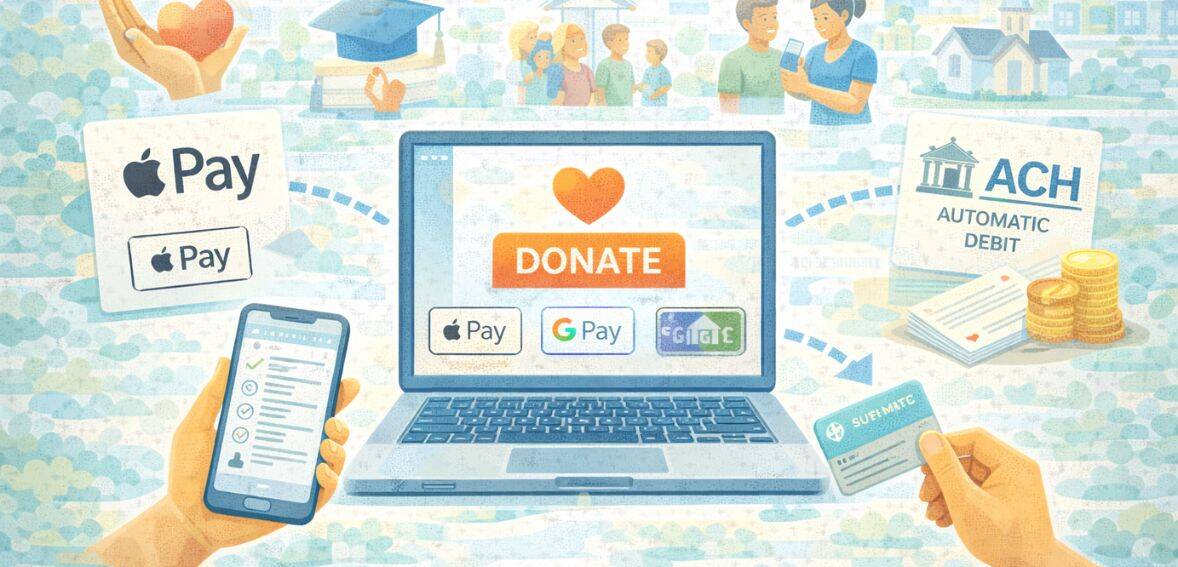
When to Offer Apple Pay, Google Pay, and ACH on Donation Pages
Convenience and trust have a significant impact on donation behavior. Friction at checkout can subtly halt donation, even in cases where donors are passionately driven. Nonprofits must carefully consider how and when to offer Apple Pay, Google Pay, and ACH as digital wallets and bank-based payment options become increasingly commonplace.
These choices influence donor confidence, completion rates, and long-term loyalty; they are more than just technical improvements. The proper payment mix eliminates reluctance and complements supporters’ current financial management style. Offering every choice without a purpose, however, may lead to misunderstandings or needless expenses.
The objective is intentional choosing rather than maximal choice. Nonprofits can create donation pages that feel simple, courteous, and in line with modern expectations by having a thorough understanding of donor intent, donation context, and operational realities.
Understanding Donor Payment Psychology
Payment decisions are made differently by donors than by consumers. They are looking for assurance rather than value exchange. At a crucial point, familiar payment methods strengthen trust and minimize cognitive strain.
Giving feels simple and secure when a donor sees a chosen method like Apple Pay or Google Pay. However, ACH conveys seriousness and sustained dedication. Every approach appeals to a certain donor attitude. While bank transfers appeal to planned or regular donors, wallet payments promote unplanned generosity.
Nonprofits can match payment alternatives to donor intent by acknowledging this psychological difference. Action can be slowed by choosing the incorrect course of action at the wrong time. In a matter of seconds, the correct choice can transform intention into impact.
Apple Pay as a Friction-Reduction Tool
When speed is crucial, Apple Pay performs very well. It does away with manual confirmation, card entry, and form completion. This ease of use can significantly boost completion rates, particularly for mobile donors.
Apple Pay is most effective for urgent appeals, impulse-driven campaigns, and social media-driven traffic where donors act fast. Donors are reassured by the trust ingrained in Apple’s ecosystem without further justification. But not everyone uses Apple Pay.
It caters to a particular group of people who are at ease using Apple products. Instead of using Apple Pay as the default for all giving situations, nonprofits should view it as a conversion accelerator. When there is a lot of emotion and little time, it excels at eliminating hesitation.
Google Pay and Cross-Device Accessibility
Google Pay serves a wider variety of devices and provides comparable convenience benefits. It is particularly useful for businesses with a variety of audiences because it functions flawlessly on Android phones, browsers, and even desktop computers.
Donors can donate without creating accounts or manually saving card information due to Google Pay, which minimizes complexity while preserving flexibility. It works well on email appeals, peer-to-peer donation links, and campaign landing pages.
Google Pay facilitates donors who switch between devices because it seamlessly connects with online experiences. In order to ensure accessibility across platforms, nonprofits should see Google Pay as a universal convenience option that enhances Apple Pay rather than replaces it.
ACH as a Signal of Trust and Commitment
ACH payments have a completely different function. They are more deliberate but slower. Larger gifts, recurring donations, or institutional contributions are frequently made by donors who select ACH. ACH communicates consistency, gravity, and long-term goals. By lowering processing costs and chargeback risk, it also helps organizations.
ACH works especially well for significant donor projects, yearly pledges, and monthly giving programs. For first-time donors who are not familiar with the organization, ACH should not be prominently displayed. First and foremost, trust. ACH becomes an effective instrument for sustainability rather than immediacy when it is implemented carefully.
Matching Payment Options to Donation Size
When choosing a payment, the magnitude of the donation is crucial. While larger offerings necessitate assurance and transparency, smaller donations benefit from wallet-based convenience.
For little to medium-sized donations where speed is more important than examination, Apple Pay and Google Pay function best. As gift volumes rise, ACH becomes increasingly alluring, particularly when contributors seek assurances regarding costs and long-term effects.
Decision fatigue is reduced by nonprofits that match suggested giving tiers with payment choices. Donors are subtly guided toward decisions that feel organic rather than coerced by this alignment. Payment reasoning should encourage giving rather than make it more difficult.
Mobile-First Donation Pages
Today’s fundraising is dominated by mobile traffic. Donation pages should be created with thumbs in mind rather than keyboards. Because Apple Pay and Google Pay eliminate typing and errors, they are successful in mobile situations. Despite its value, ACH frequently feels more complicated on mobile devices because of extra processes. While providing ACH in secondary roles, nonprofits should prioritize wallet payments on mobile pages.
This method accommodates mobile behavior without restricting the options available to donors. Donors are more inclined to finish contributions right away rather than putting them off and forgetting later when mobile experiences feel natural. In addition to choosing payment methods, donation form optimization helps nonprofits reduce friction and increase conversions by streamlining layout, fields, and flow.
Desktop Donors and Planned Giving
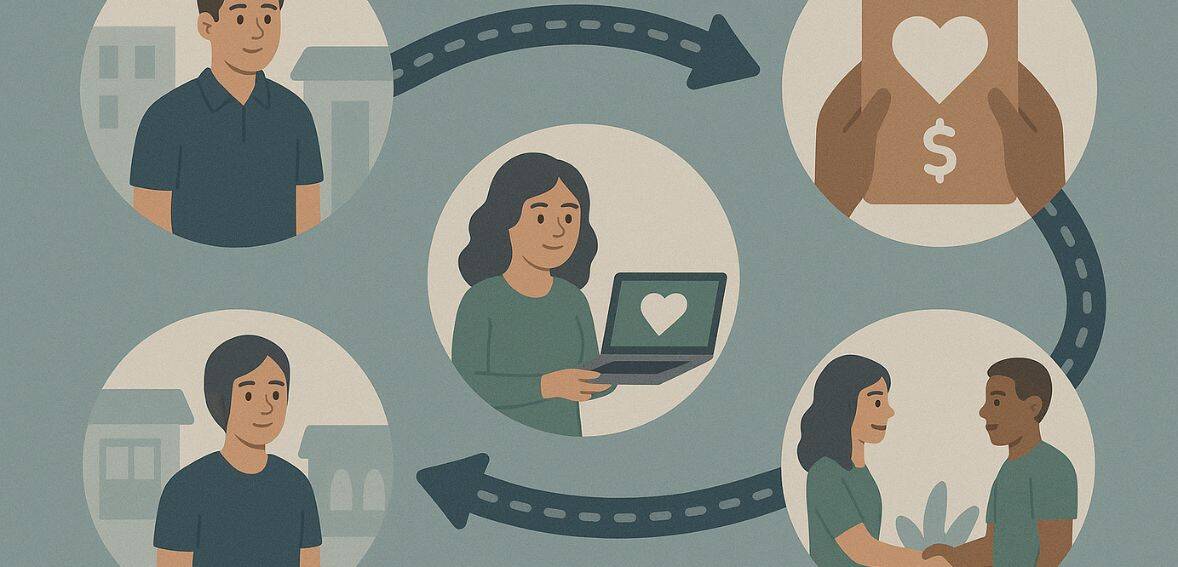
Desktop donors frequently show up with greater time and purpose. They can be reacting to official campaigns, reports, or publications. ACH becomes more essential in these situations. Impact statements, recurring commitments, and financial transfers can all be explained more clearly using desktop design.
Although they are less important than on mobile, Apple Pay and Google Pay nonetheless offer convenience. Payment hierarchy should be modified by nonprofits according to device context. While mobile pages should put speed and ease of use first, desktop contribution pages might encourage more considerate donations.
First-Time Donors Versus Returning Supporters
Above all, first-time donors require certainty. By utilizing preexisting confidence, well-known payment companies like Apple Pay and Google Pay reduce fear. Too soon, ACH could feel too intimate. On the other hand, returning donors are more receptive to effective or less expensive approaches.
Nonprofits can gradually make ACH the preferred choice for devoted supporters. Smart contribution pages adapt to the donor connection by providing several payment options based on past performance and familiarity. Instead of giving contributors too many options up front, this flexible approach builds confidence.
Recurring Giving and Payment Stability
Programs for recurring donations rely more on consistency than on speed. Although Google Pay and Apple Pay make it easy to join up, they rely on card credentials that can alter, expire, or malfunction at any time. By connecting directly to bank accounts, ACH reduces involuntary churn brought on by payment failures and provides a more robust basis for long-term giving.
ACH is frequently used as a retention technique and wallets as an access point by successful NGOs. Once trust grows, donors may switch from a quick wallet-based monthly gift to ACH. Instead of seeming transactional, this shift should feel beneficial.
Donors are better able to comprehend why ACH reinforces their commitment when dependability and impact are communicated clearly. In addition to being functional, payment stability strengthens the donor’s reputation as a consistent supporter as opposed to a one-time giver.
Fee Sensitivity and Financial Stewardship
Nonprofits must strike a balance between donor convenience and appropriate stewardship because each payment option has a cost. Higher processing costs are usually associated with wallet payments, which, over time, may subtly lower net revenue.
In comparison, ACH transactions are much more economical, particularly when it comes to big or frequent payments. Although many donors react favorably when provided with clear information, they may not actively consider fees. Donors frequently value transparency and choose to participate voluntarily when organizations explain that selecting ACH helps optimize program funding.
The key is tone. Messaging should empower, not guilt. Instead of being a secret trade-off, the payment decision becomes a shared obligation. Without sacrificing generosity, thoughtful fee awareness promotes donor confidence and mission viability.
Trust Signals and Visual Placement
Donor trust during checkout is significantly influenced by visual signals. The logos of Google Pay and Apple Pay serve as immediate indicators of confidence, particularly for new users. Without needing an explanation, they convey security, familiarity, and legitimacy.
On the other hand, context helps ACH. Comfort can be greatly increased with a brief explanation of the impact of efficiency or security measures. Placement is important. Wallet options work best when they are placed prominently for easy access.
When ACH is added next to recurrent giving portions or larger gift amounts, it performs better. Donors feel led rather than overwhelmed when payment alternatives are carefully planned. Visual hierarchy subtly conveys intention, assisting donors in selecting avenues that align with their giving objectives and comfort level.
Campaign Type and Payment Strategy

Payment strategies should take into account the fact that not all fundraising efforts are created equal. Apple Pay and Google Pay are crucial because emergency appeals require quickness and emotional immediacy. Donors who respond to urgency prefer to take immediate action over navigating complexity.
ACH integration is advantageous for longer-term projects like annual pledges, faith-based contributions, and capital campaigns. Instead of focusing on quick fixes, some contributors are considering long-term effects. Wallet simplicity is essential for peer-to-peer marketing, particularly when it is disseminated through social media.
Relevance is increased, and friction is decreased when payment options are in line with campaign objectives. Donation pages feel purpose-built rather than generic when payment logic adjusts to context.
International and Cross-Border Considerations
Organizations with a global reach must carefully consider localization; currency display, language, and regionally trusted payment methods all influence completion rates; wallet availability should match local adoption, and alternative bank transfer options may be necessary outside the U.S.
Trust increases when donors feel the experience reflects their location rather than the organization’s internal systems; respecting regional differences is not complexity for its own sake; it is an expression of inclusivity and professionalism. The adoption of Apple Pay and Google Pay varies significantly by country, while ACH is primarily focused on the United States.
Data, Testing, and Optimization
Evidence, not presumption, should guide a payment approach. Device, donor type, and campaign source all have a significant impact on conversion rates. Monitoring the most effective payment methods in each situation yields insightful trends.
Data reveals whether wallets perform better than cards over time, whether ACH improves retention, or whether placement changes have an impact on completion. Sweeping redesigns are not necessary for testing. Modest changes to default selection, labelling, or order frequently result in significant gains.
Because donor behavior changes over time, optimization is ongoing. Regularly reviewing payment data helps organizations remain responsive rather than reactive. Donation pages naturally improve without compromising simplicity when payment decisions are based on actual behavior.
Accessibility and Inclusivity in Payment Design

Inclusive donation pages acknowledge that there isn’t a single payment option that works for everyone. While some contributors distrust wallets, others favor them. While some people rely on bank transfers, others avoid them.
Respecting these distinctions without passing judgment is what accessibility entails. Just as important as the payment option itself are accessible design, easy flows, and clear wording. Clarity is preferable to novelty for donors with disabilities, elderly supporters, or those with little digital confidence.
Accessibility to payments is about respect. Donors donate more confidently and return more frequently when they feel welcomed rather than pushed into new processes. Reach and reputation are enhanced by inclusivity.
Operational Readiness and Internal Alignment
Internal workflows are impacted when payment choices are added. ACH deposits must be reconciled differently by finance teams than wallet or card transactions. Support staff must accurately respond to inquiries from donors.
Technology partners need to integrate safely. Nonprofits should make sure they are operational before adding more payment choices. Errors caused by misaligned systems erode donor confidence. Donor experiences are enhanced by efficient internal procedures. Payment plans should help employees just as much as they help supporters.
Donors see professionalism and dependability when teams are comfortable with several approaches. When done correctly, operational clarity is invisible, but when ignored, it can be harmful. Nonprofits should ensure their donor management systems are capable of handling diverse payment sources, reconciling gifts, and maintaining accurate donor records as payment options expand.
Conclusion
Providing ACH, Apple Pay, and Google Pay is not about following trends. It is about directing donors toward sustainable participation while meeting them where they are. Wallets facilitate immediacy and reduce friction. ACH encourages stewardship and longevity. When together, they form an entire ecology of giving. Donors are not overloaded with options on the best donation pages.
At the appropriate times, they provide trust, clarity, and relevance. Generosity comes more easily when payment options match donor purpose, device usage, and campaign context. The effectiveness of contemporary fundraising depends on intentional payment design, which is no longer optional.
FAQs
Should the default payment method on contribution pages be ACH?
Wallets convert well for first-time and impulsive contributors, but ACH works best as a default for high-value or recurring gifts.
Do Google Pay and Apple Pay genuinely boost donation conversion rates?
Yes. Wallets increase completion rates for one-time presents by lowering checkout friction, particularly on mobile devices.
At what point should charities aggressively urge donors to convert to ACH?
Reliability and reduced fees are especially important after trust has been built, usually after a donation or during recurrent gift onboarding.
Can providing an excessive number of payment alternatives reduce conversions? Indeed. Cognitive burden is increased by poorly presented options. Prioritizing payment alternatives is more important than just adding them.
How often should nonprofits review payment method performance?
At least quarterly, with ongoing monitoring during major campaigns to adapt placement and defaults based on donor behavior.