
Maintaining a Healthy Donor Database: Data Hygiene Best Practices
Good fundraising depends on good information. Every thank-you letter, campaign appeal, and stewardship report relies on the accuracy of your donor database. When that information is incomplete, duplicated, or outdated, even the most thoughtful outreach can fall short.
Donor data management is not just a back-office task. It directly affects how supporters experience your organization. A misspelled name, a duplicate mailing, or a message sent to an old address signals carelessness, even if the intent was positive. Over time, these small mistakes can erode trust and weaken donor relationships.
This explains why data hygiene matters for nonprofits, identifies common data problems, and outlines practical steps for nonprofit database maintenance. The goal is not perfection, but consistency and reliability—so your team can communicate confidently, analyze results accurately, and steward donors with respect.
Why Data Hygiene Matters in Donor Data Management

Data hygiene refers to the ongoing process of keeping your donor data accurate, consistent, and up to date. In practice, it means regularly reviewing your CRM data quality and correcting issues before they affect fundraising or reporting.
Messy data creates real-world problems. Consider a donor who receives two copies of the same appeal because the records are duplicates. Or a long-time supporter whose last name is misspelled in multiple emails. These are not just minor errors; they can feel personal to the recipient.
Inaccurate data also wastes resources. Printing and mailing costs add up quickly when appeals go to bad addresses or outdated contacts. Email campaigns suffer when bounce rates increase due to old or incorrect email addresses. Over time, this inefficiency drains staff time and budget.
Reporting accuracy is another primary concern. If duplicate records inflate your constituent count, leadership may believe your reach is larger than it truly is. If outdated records remain marked as active, campaign results may appear weaker or stronger than they are. Clean data supports sound decision-making.
Most importantly, data hygiene is part of donor stewardship. When supporters trust that you respect their information, they are more likely to stay engaged. Nonprofit database maintenance is not about software—it is about relationships.
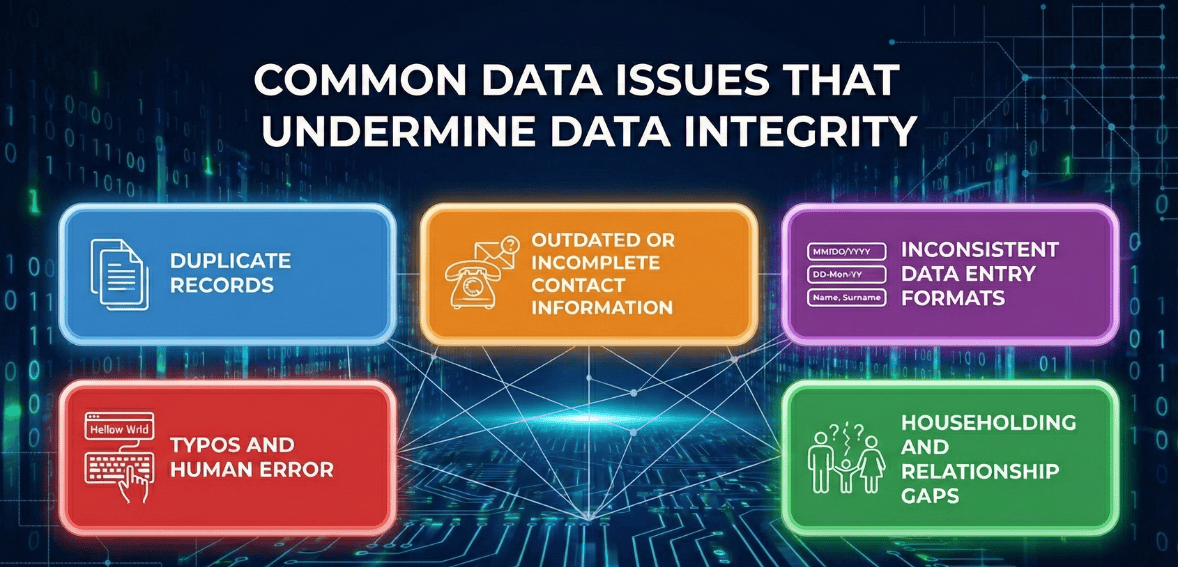
Common Data Issues That Undermine Data Integrity
Nearly every nonprofit encounters similar data challenges. Understanding these issues is the first step toward improving data integrity.
Duplicate Records
Duplicate records occur when the same person is entered into the system multiple times. This often happens due to minor variations, such as a nickname instead of a formal name or a personal email address instead of a work email address.
Duplicates confuse communications and reporting. One person may receive multiple messages, while giving history is split across records, making it harder to see their whole relationship with your organization.
The most effective solution is routine duplicate review. Most donor CRMs include tools that flag possible matches based on shared email addresses, phone numbers, or mailing addresses. These tools work best when used regularly, rather than waiting years between cleanups.
Outdated or Incomplete Contact Information
Addresses, phone numbers, and email addresses change frequently. When these updates go untracked, donors can quietly drop out of your communications.
Returned mail and bounced emails are warning signs of declining CRM data quality. Ignoring them allows errors to multiply. A healthier approach is to treat these signals as prompts to act—either by requesting updated information from the donor or by marking the record appropriately.
Some nonprofits use address update services tied to the U.S. Postal Service to refresh mailing data annually. Others include simple “update your contact information” links in email newsletters. Both approaches support better donor data management without overwhelming staff.
Inconsistent Data Entry Formats
Inconsistency is one of the most common and overlooked data hygiene problems. For example, one record may list “Street” while another uses “St.” States may appear spelled out in some documents and abbreviated in others. Company names might be entered in multiple variations.
These inconsistencies make segmentation difficult. If you plan to mail to donors in a specific state or city, inconsistent formatting can cause some recipients to be missed or miscategorized.
Clear data entry standards reduce this problem. When everyone follows the same rules, reports become more reliable, and cleanup becomes easier.
Typos and Human Error
Typos happen, especially during busy campaigns or events. An extra character in an email address can break communication entirely. A misplaced letter in a last name can follow a donor for years if never corrected.
Training and simple double-checks help reduce errors. Encouraging staff and volunteers to slow down slightly during data entry often saves time later by preventing follow-up fixes.
Householding and Relationship Gaps
Many donors are part of households, couples, or families. When these relationships are not linked correctly, your organization may miss opportunities for more thoughtful communication.
For example, sending separate letters to spouses who give jointly can feel impersonal. Regularly reviewing records with matching last names and addresses can help identify householding issues and improve the supporter experience with your outreach.
Practical Approaches to Data Cleanup

Improving data hygiene does not require shutting down operations for months. It works best when approached in manageable phases.
Start with high-impact fixes. Duplicate records are often the best first target because they affect both communication and reporting. Addressing them can immediately reduce confusion and improve data integrity.
Next, focus on invalid contact information. Review bounced emails and returned mail, and decide how to handle each case. Some records may be updated with minimal effort, while others may need to be marked inactive.
Consistency issues can then be handled gradually. Many nonprofits export data into spreadsheets to clean up formatting in batches before importing it back into the CRM. This approach works well for standardizing states, phone numbers, or capitalization.
If your database has not been reviewed in many years, a one-time cleanup project may be necessary. This should always begin with a full backup to protect historical data. Some organizations assign temporary help or dedicate a few hours each week over several months to make steady progress.
Establishing Routine Nonprofit Database Maintenance
One-time cleanup is helpful, but lasting CRM data quality depends on routine maintenance. Without ongoing attention, even the cleanest database will degrade.
A realistic data hygiene schedule might include:
- Quarterly reviews for duplicate records
- Annual address updates before major mail campaigns
- Post-import audits after events or online forms
These checkpoints keep minor issues from becoming overwhelming.
Clear policies also matter. A simple data entry guide can prevent many future problems. This guide explains how to enter names, addresses, and other common fields, and when to search for existing records before creating new ones.
Training is equally important. Anyone who enters data—staff or volunteers—should understand why accuracy matters. When people see the database as a shared asset rather than a task, quality improves.
Many nonprofits assign a staff member to oversee data integrity, even if it is only part of their role. This person runs regular checks, documents procedures, and serves as a point of contact for questions. Some modern systems, including platforms like Cloud Donor Manager, provide built-in alerts and validation tools that support this oversight without adding complexity.
Also read: Protecting Donor Data: Safeguarding Privacy & Trust
Using CRM Features to Support Data Hygiene

Most donor CRMs include tools designed to protect data integrity. These features work best when configured intentionally.
Required fields ensure that essential information, such as last name, is captured at entry. Picklists and dropdown menus reduce spelling differences by limiting free-text input. Validation rules can prevent incorrectly formatted email addresses from being saved.
Duplicate warnings are another valuable safeguard. When enabled, they prompt users to review existing records before creating new ones. This simple pause can prevent years of cleanup later.
Online donation and registration forms also play a role in donor data management. Forms that separate first and last names, use state dropdowns, and include basic validation reduce cleanup after data is entered into the system.
Data Hygiene as Part of Donor Stewardship

Clean data supports more than efficiency; it supports respect. When donors see that your organization remembers their preferences, uses the correct name, and communicates appropriately, trust grows.
Accurate data also allows for more relevant outreach. Segmentation by location, interest, or giving history depends on consistent information. When those segments work correctly, messages feel intentional rather than generic.
Over time, this reliability strengthens relationships. Donors are more likely to stay engaged when communication feels thoughtful and accurate. In this way, data hygiene becomes a quiet but powerful part of fundraising success.
Conclusion: Clean Data Is a Commitment to Your Donors
A healthy donor database does not happen by accident. It is the result of consistent care, clear standards, and an understanding that every record represents a real person who chose to support your mission. When donor data is accurate and well-maintained, your organization communicates with confidence, reports with clarity, and stewards relationships with respect.
Data hygiene is not about chasing perfection or fixing every historical flaw. It is about making intentional choices to reduce errors, prevent future problems, and treat donor information as a shared responsibility. Even minor improvements—merging duplicates, updating outdated addresses, standardizing entry practices—compound over time and create meaningful impact.
Nonprofits that invest in nonprofit database maintenance protect more than operational efficiency. They protect trust. Clean data ensures that donors feel recognized, not overlooked; valued, not inconvenienced. It allows your team to focus less on correcting mistakes and more on building lasting relationships that sustain your work.
Ultimately, good fundraising begins long before an appeal is sent. It starts with accurate information, maintained with care. By committing to ongoing data hygiene, your organization strengthens its foundation—and honors the people who make your mission possible.
FAQs
Our donor data is very messy. Where should we start?
Begin with issues that cause the most immediate problems. Duplicate records are usually the best starting point because they affect mailings, emails, and reports. Work in manageable segments rather than trying to fix everything at once. After removing duplicates, review bounced emails and returned mail, then address consistency issues such as formatting.
What tools can help with data cleanup and CRM data quality?
Start with the tools already available in your CRM, such as duplicate detection and validation rules. Address update services tied to the U.S. Postal Service can help refresh mailing data. Spreadsheet tools are helpful for bulk formatting fixes. Some systems, including Cloud Donor Manager, also offer built-in safeguards that reduce data entry errors.
How often should we clean or audit our donor database?
Some tasks should happen continuously, such as checking for duplicates as new records are added. Broader audits are often done annually or semi-annually. Many nonprofits choose a slower period of the year to conduct a deeper review, supported by periodic check-ins at smaller intervals.
How can we keep new data clean going forward?
Prevention is key. Train everyone who enters data to search before creating new records. Use standardized formats, required fields, and dropdown menus whenever possible. Review new records after events or imports to catch mistakes early, when they are easiest to fix.
Should we delete donor records that have been inactive for many years?
In most cases, no. Old records are part of your organization’s history and may still be helpful in reporting or future re-engagement. A better approach is to mark them inactive or archive them so they do not appear in current mailings, while preserving their information and giving history.