
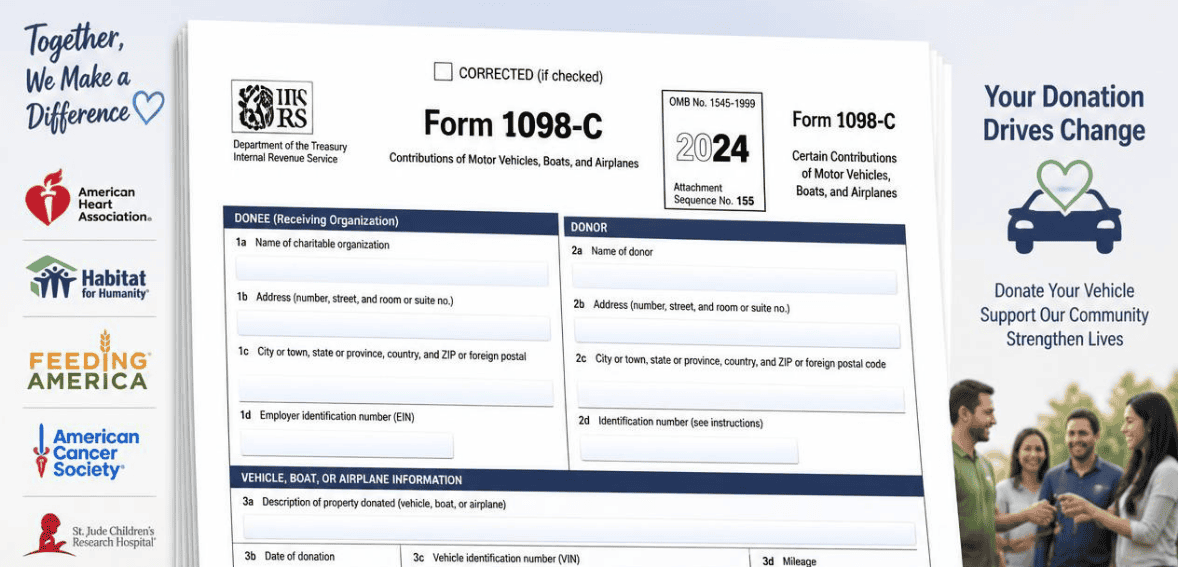
Form 1098-C Records for Vehicle Donations to Nonprofits
Donating a car to charity feels simple. You hand over the keys, and a good cause gets a boost. But the paperwork behind that gift is where things get serious. One small IRS document decides whether your donor claims a deduction or loses it entirely. That document is Form 1098-C.
Understand this form completely if your organization accepts car, boat, or airplane donations. A donor will lose their tax deduction if you file this form late or if you make any errors. This will also create IRS problems for your nonprofit. This guide will detail everything you need to know about nonprofit reporting for vehicle donations, including the filing thresholds, deadlines, and recordkeeping for Form 1098-C.
What Is Form 1098-C?
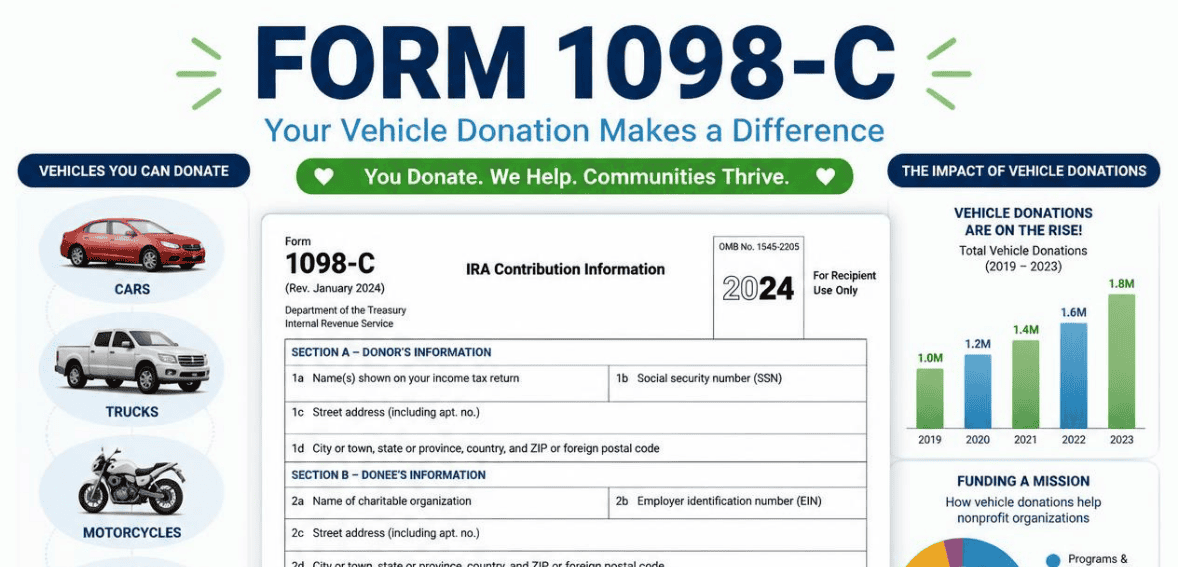
Form 1098-C is the IRS document titled “Contributions of Motor Vehicles, Boats, and Airplanes.” It does two jobs at once. First, it is an information return that a charity files with the IRS. Second, it acts as the written acknowledgment the donor needs to claim a charitable deduction.
Think of it as a vehicle donation gift receipt. The form is completed by the nonprofit. The donor keeps it for the tax return, and the IRS gets a copy. A donor can’t justify a deduction over $500 without the form. For that reason, accurate reporting of Form 1098-C is very important for any nonprofit that operates a vehicle donation program.
The IRS last revised the form in April 2025. The form carries OMB number 1545-1959. A separate form is required for each qualifying donation. Two vehicles from the same donor cannot be reported on the same form.
When Does a Nonprofit Need to File Form 1098-C?
The rule turns on one number: $500. A qualified 501(c)(3) organization must file Form 1098-C whenever it receives a donated vehicle, and the donor claims a deduction of more than $500. The filing duty belongs to the charity, not the donor.
A “qualified vehicle” covers more than just cars. It includes any motor vehicle built for use on public streets, roads, and highways. It also includes boats and airplanes. There is one key exception. A vehicle held as inventory for sale, such as a dealer’s stock, does not count as a qualified vehicle.
What about smaller gifts? If the claimed value is $500 or less, the nonprofit usually does not need to file Form 1098-C. That said, the charity must still give the donor a basic written acknowledgment. The reporting is lighter, but it never disappears completely.
How Much Can a Donor Deduct?
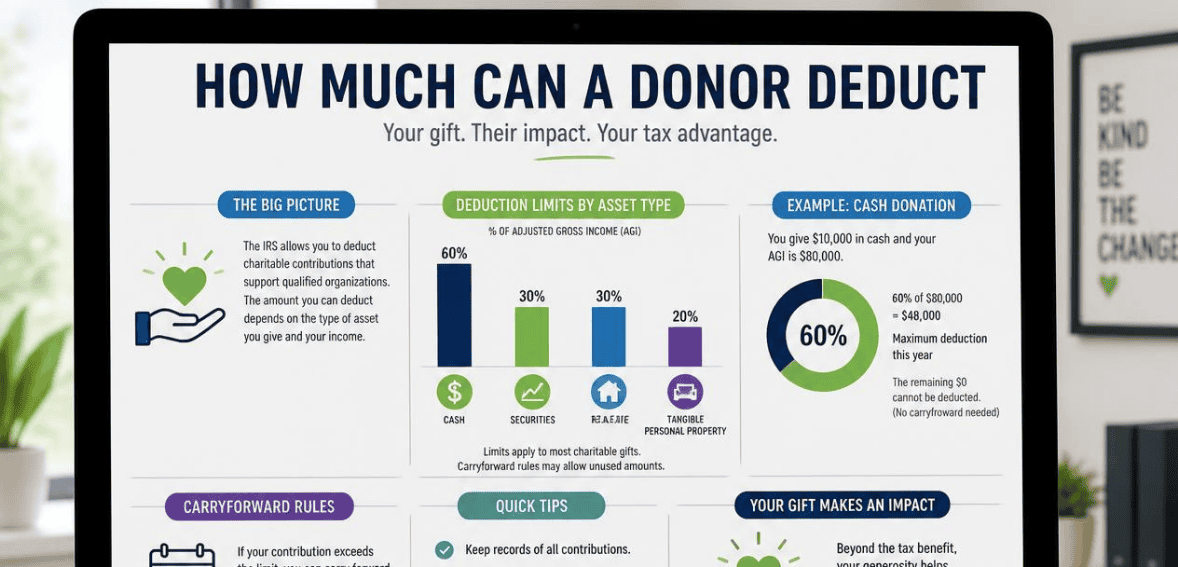
Many first-time givers get surprised at this part. It is not just the value of the car in a used-car guide. What the charity does with the vehicle after the donation determines what the tax deduction amount will be.
The Gross Proceeds Rule
Typically, donated cars are sold. Charities hold either an auction or a private sale, and the money goes toward the cause. In this situation, the donor’s tax deduction is limited to the gross proceeds of the sale.
Suppose a donor thinks their donated car has a fair market value of $3,000, but the charity sells the car for $1,800 in an auction. In this scenario, the donor is only able to deduct $1,800 from their taxes, as that is the gross proceeds of the sale. The gross proceeds of the sale are reported on Form 1098-C. Congress introduced this kind of law in 2005 to prevent the practice of over-inflated valuations of donated goods.
The Fair Market Value Exceptions
Sometimes a donor can claim the full fair market value even when it beats the sale price. The IRS allows three specific exceptions, and the charity must certify the right one on Form 1098-C:
- Significant intervening use. The charity uses the vehicle in its work before selling it, such as delivering meals through a Meals on Wheels-type program.
- Material improvement. The charity makes major repairs that meaningfully raise the vehicle’s value. Simple cleaning or a coat of paint does not count.
- Transfer to a needy individual. The charity gives or sells the vehicle to a person in need at a below-market price, and that transfer directly furthers its charitable purpose of helping the poor.
When one of these applies, the charity checks the matching box on the form and leaves the gross proceeds line blank. The donor then figures the fair market value themselves.
Form 1098-C Filing Deadlines Nonprofits Must Meet
Timing matters as much as accuracy. Form 1098-C actually has two different clocks running.
A donor copy is needed within a 30-day period. The charity is obligated to send Copy B to the donor within 30 days of the vehicle sale. The charity has to send the copy within 30 days after the date of the donation if the charity retains the vehicle for its use, makes improvements on it, or donates it to a needy person. If the charity fails to send in the copy, the donor will lose the right to the deduction.
The IRS copy is based on the information-return calendar. The paper filing deadline for donations made in tax year 2025 was in the last week of February 2026, and the e-filing deadline was March 31, 2026. A 30-day extension is automatic for nonprofits that request it by filing Form 8809 before the due date.
Many vehicle donation programs operated by charities are handled by third-party companies. This is fine and legal, but be advised that Form 1098-C must still be delivered by the charity, and selling the vehicle through a third party does not relieve the charity of this responsibility.
What Records Should Nonprofits Keep?
Solid recordkeeping protects both the donor and the organization. Your files should capture the donor’s name and taxpayer identification number, the vehicle identification number (VIN), and the date of the donation. If you sell the vehicle, log the sale date and the gross proceeds. If you use or improve it, document that use in detail.
You also want a copy of the signed title and proof of delivery. A vehicle donation is not truly complete until the charity holds a properly signed title. Keep these records organized by donor and by tax year. If the IRS ever asks questions, clean documentation is your best defense. It also makes preparing next year’s Form 1098-C filings far smoother.
Penalties for Late or Incorrect Form 1098-C Filing
Deadlines are important to the IRS, and for good reason. There are two distinct penalty regulations for Form 1098-C. The first regulation covers filing with the IRS. The second covers furnishing the copy to the donor.
The penalties are tiered based on what corrective measures are taken and when. Starting in 2026, an incorrect or late submission could cost up to $340 per form if the issue is not fixed by August 1 of that year. For large organizations with higher gross receipts, the penalties are capped in the millions. The IRS actually rewards you for correcting it soon after you have failed to comply, and the penalty will be lower. The main lesson to take from all of this is to file accurately and promptly, and correct the mistakes you make.
What Donors Need to Do With Form 1098-C
The donor has their own list after obtaining the form. First, the donor has to itemize deductions on Schedule A as part of Form 1040. If the donor decides to go with the standard deduction, the vehicle donated would essentially be worthless as a deduction. For 2026, the standard deduction is $16,100 for individual filers and $32,200 for married couples filing jointly. The donation provides a tax benefit only when the total itemized deductions exceed the thresholds mentioned.
Second, the donor should attach Copy B of Form 1098-C to the tax return. For any non-cash contribution over $500, Form 8283 is required to be filed. For donations with a value between $501 and $5,000, Section A is completed. For claims that exceed $5,000 and rely on fair market value, Section B is completed, which mandates a qualified appraisal. A nice exception that helps simplify the process is that a qualified appraisal is not required, even if the car sold for more than $5,000, in the event that the deduction is limited to gross proceeds.
Valuing Your Donated Vehicle
Kelley Blue Book and NADA Guides
Claiming a fair market value deduction means a donor likely has to figure the fair market value of a donated vehicle. The NADA Guides and Kelley Blue Book are the two most respected resources for fair market value. It is recommended to take the conservative approach when reporting value. A donor should consider the actual condition, mileage, and equipment of a vehicle when estimating the fair market value, and should not automatically report the top listed value.
It is unlikely the IRS would query the value of an auto donation, but, in the unlikely event that an audit occurs, the donor’s fair market value reporting will be much more defensible. Lastly, before scheduling a donation pickup, a donor should ensure a charity is tax-exempt using the IRS Tax Exempt Organization Search.
Conclusion
Form 1098-C sits at the center of every vehicle gift to a nonprofit. For charities, it is a compliance duty with real deadlines and real penalties. For donors, it is the key that unlocks a legitimate tax deduction. Get the $500 threshold, the deadlines, and the valuation rules right, and the whole process runs cleanly.
The safest approach is to build a simple system. Track each donation, note what happens to the vehicle, and send the form promptly. When a charity handles Form 1098-C reporting well, donors trust the program more and give more freely. That trust turns a pile of paperwork into a lasting source of support for your mission. When in doubt on a specific case, check the current IRS instructions or ask a qualified tax professional.
Frequently Asked Questions (FAQs)
- Who is responsible for filing Form 1098-C, the donor or the nonprofit?
The nonprofit is responsible. As the organization that receives the vehicle, the charity must file Form 1098-C with the IRS and send a copy to the donor. The donor’s only job is to attach that copy to their tax return and keep their own records.
- Do I need Form 1098-C if my donated car is worth less than $500?
Usually no. Form 1098-C is required when the claimed deduction is more than $500. For gifts of $500 or less, the charity typically does not file the form, but it must still give you a basic written acknowledgment of the donation.
- Why is my deduction lower than the value I found in a pricing guide?
Because the deduction is normally capped at the price the charity sold the vehicle for, known as the gross proceeds. You can only claim the higher fair market value if the charity used the car, materially improved it, or gave it to a needy person in furtherance of its mission.
- What happens if a nonprofit files Form 1098-C late?
The IRS can assess penalties of up to $340 per form for late or incorrect filings that are not fixed by August 1. Correcting the error within 30 days of the deadline greatly reduces the penalty, so charities should act quickly if a mistake occurs.