
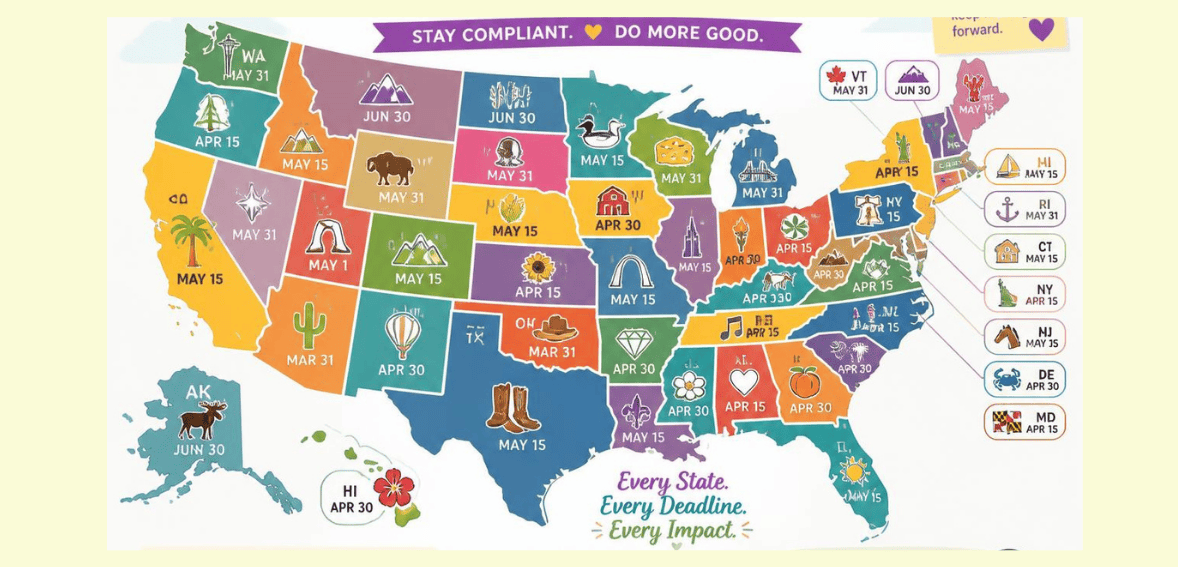
A Multi-State Charitable Solicitation Renewal Calendar
Picture this scenario. Your nonprofit hosts its first national giving day, resulting in donations from 30 of the 50 states. Everyone cheers the day’s success, and the donations and effort are recognized throughout the organization! Six months later, however, the party ends when you receive a certified letter from a state attorney general. While you were celebrating, your registration lapsed. Now you owe late fees, and your organization is legally barred from fundraising in that state until the situation is remedied.
This scenario is pretty common in the nonprofit fundraising world. Fortunately, the solution to this situation is simple. It just requires a good calendar.
The purpose of this guide is to help you create a calendar for charitable solicitation registration renewal that helps your organization remain in good standing for each year. We will keep the terminology as plain as possible, since the language varies from state to state.
What Is Charitable Solicitation Registration Renewal?
Let’s start with the basics. If your nonprofit asks the public for donations, most states require you to register first. This is called charitable solicitation registration. Currently, 36 states and Washington, DC broadly require this registration and renewal, unless a specific exemption applies.
Registration is an ongoing process. Most state registrations require renewal at least every year. For charitable solicitation registration renewal, you update your organization’s information, submit your financial report for the new reporting period, and pay the fee with supporting documents. You do this every year.
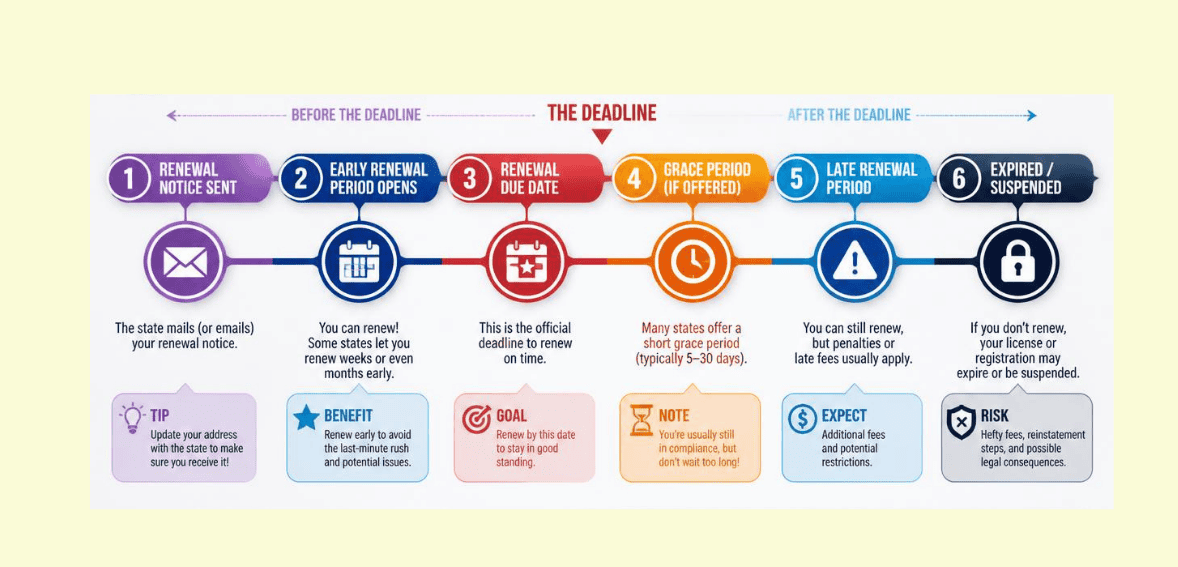
If you do not renew, your registration will lapse. A lapse will result in late penalties and fees and the loss of your right to solicit in that state. In some cases, registration will require full reinstatement. This is why tracking every renewal deadline is important.
Why a Multi-State Renewal Calendar Matters
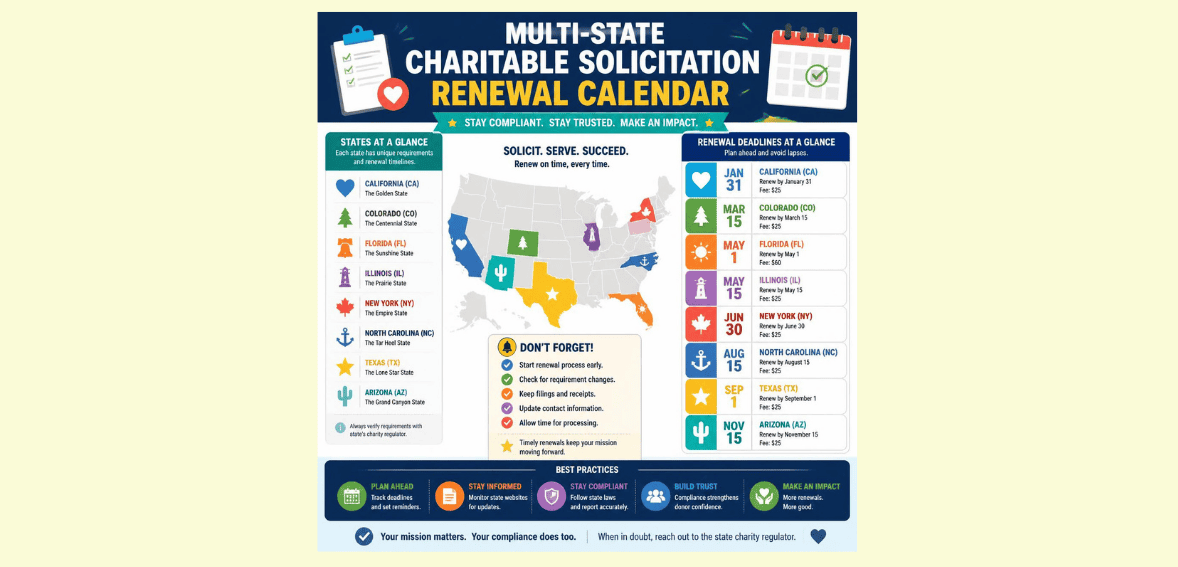
Here is the hard truth. State deadlines do not line up neatly. Each state runs its own charities program. Each sets its own rules, forms, fees, and due dates. What works in one state will not always work in the next.
One missed deadline can have a domino effect. Your federal filing runs late, then your state renewals run late, and multiple late fees get assessed in different states. You can avoid this effect with a shared calendar.
Our renewal calendar keeps your organization in good standing. Donors, grantmakers, and watchdog organizations will look up your registration status. A registration lapse can hurt your organization’s image and result in the loss of your fundraising registration, especially when you need it most. Finance and control managers who are dealing with a national donor base need a compliance calendar for state and federal requirements.
How State Renewal Deadlines Actually Work
Most charitable solicitation registration renewal deadlines fall into three patterns. Once you learn the patterns, the whole system gets easier to manage.
Fiscal-Year-End Deadlines
As is the case in most states, this is the standard model for when your renewal is due. Usually, it is the 15th day of the 5th month after the end of your fiscal year. For a nonprofit with a fiscal year end of December 31, the due date is mid-May.
Colorado is an example of this model and automatically grants a 3-month extension. South Carolina requires its annual financial report within four and a half months of the fiscal year-end. As a result, many organizations have a majority of their fiscal year-based renewals due between mid April and late June.
Anniversary-Date Deadlines
Some states ignore your fiscal year entirely. They tie renewal to the anniversary of your original registration. Florida is the classic example.
Florida Department of Agriculture and Consumer Services (FDACS)
Florida mandates that most charities soliciting within or into the state register with FDACS. Your renewal will occur on the anniversary of your original approval. It is not based on the end of your fiscal year. If it is not processed, Florida will apply a late fee of $25 for each month it is late, and a larger fine may also be applied. It will be tied to your first filing, and because of that, the month in which you first register will determine your compliance calendar for years to come. It is advised to think your first filing date through.
Fixed Calendar Deadlines
A few states set a hard calendar date that applies to everyone, regardless of fiscal year or anniversary. These are easy to forget precisely because they do not track your own numbers. Mark them boldly and treat them as immovable, since no extension of your fiscal year will move them.
Some states sit between these patterns. New Jersey, for example, generally sets charitable registration renewals within six months after the fiscal year ends, which gives a bit more breathing room than the four-and-a-half-month crowd. The lesson is to record each state’s actual rule rather than assuming it matches a pattern.
The Form 990 Domino Effect
Now for the piece that trips up even seasoned teams. Your federal return drives your state renewals.
The IRS requires Form 990 by the 15th day of the fifth month after your fiscal year ends. For calendar-year organizations, that means May 15. There is a 6-month extension available, making the due date November 15.
Here is the most significant issue with the IRS Form 990. Most states require a completed or draft Form 990 before granting a charitable organization a permit or license to operate in their jurisdiction. If the IRS Form 990 is not completed, most state renewals cannot proceed. A delay at the IRS quickly cascades to other states. You usually have to file Form 990 well in advance of the IRS due date if you want to remain compliant with state requirements.
Some states will grant you the IRS extension. For instance, the California Registry of Charities and Fundraisers will grant an IRS extension for the RRF-1. The CHAR500 in New York also gets an automatic 180-day extension. However, an extension only buys time; it does not remove the deadline. Plan the work around the extended date rather than treating the last possible day as your target.
Building Your Renewal Calendar Month by Month
An effective calendar begins with a master list of all the states where you need to create a filing. For each state, you need to have the agency name, form name, fee, due date, extension rules, the required documents, and the name of the signing officers. Some states have a requirement for multiple signatures, and the collection can be time-consuming.
This is an example of what a filer with a fiscal year ending December 31 might do to plan for the busy season. Feel free to customize it based on your needs.
- January to March: Close your books. Begin drafting Form 990. Confirm your list of registered states and check for any rule changes.
- April to May: File Form 990. Submit the wave of fiscal-year-based renewals due around the 15th of the fifth month.
- June to August: Handle later fiscal-year deadlines and any extension filings. Reconcile fees paid against fees owed.
- September to November: File under extended deadlines, including states like New York on its 180-day extension. Confirm every renewal was accepted, not just submitted.
- Rolling all year: Track anniversary-date renewals such as Florida on their own individual dates.
That last line is the one teams forget. Anniversary and fixed-date states do not wait for spring. Give each its own reminder set well in advance.
Tools That Simplify Multi-State Renewals
You do not have to build this from memory. A few resources can lighten the load.
Unified Registration Statement (URS)
The Unified Registration Statement (URS) was developed in 1997 by the National Association of State Charity Officials and the National Association of Attorneys General as a system to simplify multiple state charity registrations to a single form. Most states that require initial registration accept the URS.
Despite this convenience, there are limitations to using the URS. The URS has not been revised since 2014. States have developed different rules that the URS no longer accommodates. Several states do not accept the URS, and California, New York, and Florida require separate registration forms and processes. The URS has poor functionality for renewals since each state has different renewal requirements and timeframes.
National Council of Nonprofits
For comprehensive plain-English guidance on the entire landscape, the National Council of Nonprofits provides a great summary of registration and renewal obligations. Many organizations have found it helpful for understanding exemptions and disclosure statements and for explaining how new methods of fundraising, such as crowdfunding, can create registration obligations in a larger number of states than you might think. You can review their registration and renewal overview as background before making your first solicitation.
It has become common for organizations to hire a compliance service or nonprofit attorney to relieve them of the obligation of tracking their renewal deadlines. This expense is usually justified once an organization is registered in more than a few states.
Common Renewal Mistakes to Avoid
A handful of mistakes come up again and again, and they share the same fix. The biggest is relying solely on the federal calendar, since many state deadlines are not in sync with the IRS. Another is assuming every state accepts the URS, when several states require their own forms. Teams also lose track of anniversary-date states like Florida, because those renewals never appear in the spring cluster with everyone else. Confusion between submitted and accepted is common, surprising many when a state rejects a filing because of a lack of a signature or the incorrect fee.
All of these have the same solution. There should be one “living” calendar. This calendar should be reviewed monthly and should be confirmed for acceptance for renewals. Each renewal should be started early enough to avoid the “last minute” signature and document rush.
Conclusion
Multi-state fundraising is a gift and a responsibility. Every state where you solicit expects you to stay registered and current. The rules vary, the deadlines scatter across the year, and the penalties for missing them are real.
The good news is that this is a manageable problem. A well-built multi-state charitable solicitation renewal calendar turns a stressful guessing game into a routine. Map your states. Learn the three deadline patterns. Respect the Form 990 domino effect. Track anniversary and fixed dates separately. Review the whole thing every month.
Do that, and your renewals stop being fire drills. Your team stays focused on the mission instead of chasing paperwork. And when the next giving day sends donations flooding in from coast to coast, you can celebrate without worrying about that certified letter.
Frequently Asked Questions (FAQs)
How often do I need to renew my charitable solicitation registration?
In most states, you renew once a year. A handful use a two-year cycle, and a few require an annual financial report instead of a formal renewal. Because the timing differs by state, confirm each jurisdiction’s rule and record it on your calendar rather than assuming they all match.
Are charitable registration renewal deadlines the same as my Form 990 deadline?
Not always. Many states tie renewals to your fiscal year end, often around the 15th day of the fifth month, which mirrors the federal Form 990 date. But others use your registration anniversary or a fixed calendar date. Since many states also require your 990 before they will process a renewal, a late federal filing can delay your state renewals too.
What happens if my registration lapses in a state?
A lapse can bring late fees, monetary penalties, and the loss of your legal right to solicit donations there. Some states let you renew within a short grace period without penalty. After that, you may have to reinstate your registration, which can cost more and take longer than a simple on-time renewal.
Can I use one form to renew in every state?
No. The Unified Registration Statement helps with initial filings in many states, but it is outdated and does not cover renewals well. States including California, New York, and Florida require their own forms. Plan to complete state-specific renewal filings for each jurisdiction where you are registered.