

Florida Charitable Solicitation Renewal Records for Nonprofits
Running a nonprofit in the Sunshine State comes with a quiet deadline that sneaks up on many organizations every year. Miss it, and your right to ask for donations can disappear overnight. That deadline is your annual Florida charitable solicitation renewal. It sounds like paperwork, and it is. But it is also the line between a charity that can legally fundraise and one that cannot.
This guide explains the Florida charitable solicitation renewal process, who must file, fees, and how the state maintains public registries of all charities. If you are on a board, manage a nonprofit, or are responsible for compliance, this guide is for you.
What Is a Florida Charitable Solicitation Renewal?
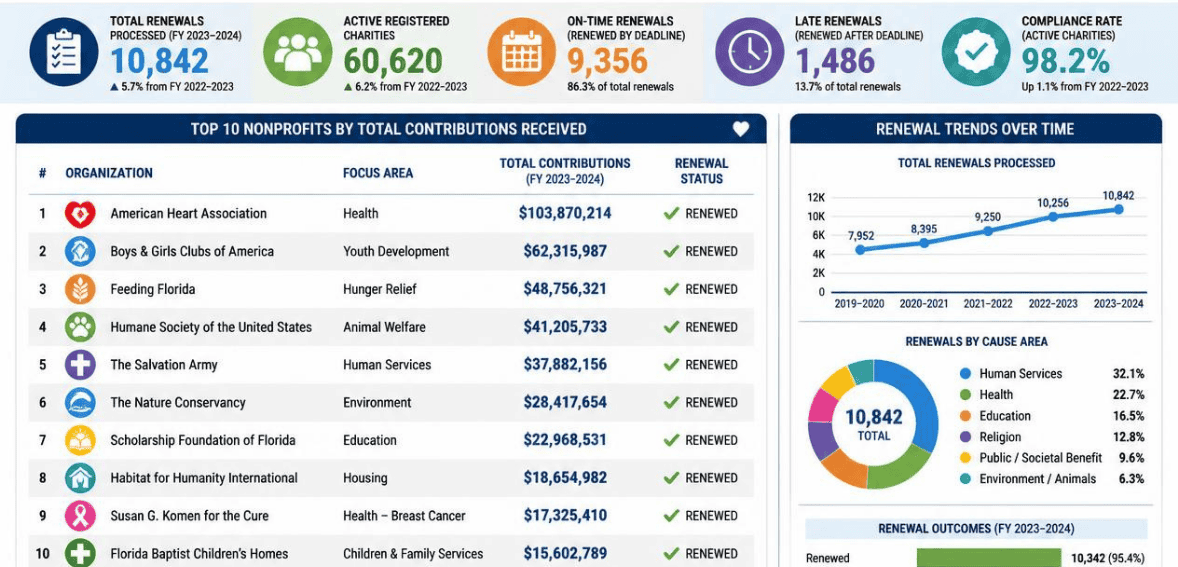
Florida law requires almost anyone who asks for donations in or from the state to register first. That rule comes from the Solicitation of Contributions Act, found in Chapter 496 of the Florida Statutes. The agency in charge is the Florida Department of Agriculture and Consumer Services, usually shortened to FDACS.
Florida Department of Agriculture and Consumer Services (FDACS)
The Division of Consumer Services at FDACS manages charitable fundraising. The division processes applications and fees, and maintains the public financial files of registered charities. The division can suspend registrations and assess civil penalties. You may visit the FDACS Solicitation of Contributions webpage for the official forms, fees, and rules.
The primary thing to note about charity registration is that it is not a one-time process. In Florida, every charity must apply for registration renewal on an annual basis in order to legally continue solicitation activities. This is known as the Florida charitable solicitation renewal process, and it is how your charity maintains compliance to solicit in the state of Florida.
Who Must Complete a Florida Charitable Solicitation Renewal?

Most nonprofits that solicit donations from Florida residents must register and renew. This holds even if your charity is based in another state. If you ask people in Florida for money, financial help, or anything of value for a charitable purpose, the law applies to you. Online fundraising counts too. A donation button on your website that reaches Florida donors triggers the same requirement.
Certain entities do not need to register. Typically, religious groups, schools, and some service organizations for veterans do not need to register. Oftentimes, charities that solicit only their members do not need to register, either. Additionally, starting July 1, 2024, smaller groups with no more than $50,000 in the prior year’s fundraising and with only unpaid volunteers can use a simpler application to register.
Before registering or renewing, your nonprofit must have Federal tax-exempt status verified by the IRS and a minimum of three board members. With that complete, the rest of the process can proceed with the state.
When Is Your Florida Charitable Solicitation Renewal Due?
Your renewal deadline is not a single date on the calendar for every charity. Instead, it falls on the anniversary of your initial registration. If you first registered on August 15, your renewal is due each August 15 after that.
FDACS has improved ways to keep you informed. They send registered charities a renewal notice via U.S. mail about 60 days prior to the renewal date. Consider it a courtesy notice. Even so, you cannot depend solely upon the post office. Be proactive about setting reminders to ensure you renew on time.
FDACS will not keep your renewal request for long after you submit. By Florida Statute, FDACS has 15 business days to approve or deny a request for renewal. If the department does not act on the request, it is deemed approved.
Florida Charitable Solicitation Renewal Fees
Renewals are based on how much money your organization raised in the last fiscal year. The state uses a sliding scale, meaning smaller organizations are charged less than larger organizations. Organizations that raised less than $5,000 are charged $10. Organizations that raised between $5,000 and $100,000 are charged $75. The fee increases to $125 for the $100,000 to $200,000 range, $200 for the $200,000 to $500,000 range, and $300 for the $500,000 to $1 million range. The fee for the $1 million to $10 million range is $350, and $400 for anything $10 million and over.
Generally, small all-volunteer charities that qualify for the simplified filing have no registration fee. Newly formed charities that have no financial history are allowed to submit a proposed budget instead of a prior-year report.
Now for the part that catches people off guard. If you miss your deadline, the late fee is $25 for each month, or part of a month, that your renewal is overdue. That charge adds up quickly. A renewal that is three months late costs an extra $75 on top of your normal fee.
Forms and Financial Reports You Will Need
The main form for most charities is the Solicitation of Contributions Registration Application, known as FDACS-10100. Small all-volunteer organizations use the shorter FDACS-10110 instead. Alongside the application, you file the Annual Financial Reporting Form, FDACS-10122, which reports your revenue and expenses for the year.
The financial information you provide must be what your organization actually reported to the IRS. The numbers are made public, so you must be accurate. Large charities are scrutinized more than others. Organizations that report more than $500,000 must have a financial statement review by an independent CPA. Organizations that report more than $1,000,000 must have an audit of their financial statements.
You have the option to file everything through your FDACS account online or send everything through the mail along with a check or a money order. The online option is the fastest, easiest and most reliable way to keep track of your renewal documents and your risk of losing your renewal documents is minimized.
Check-A-Charity: Florida’s Public Records Tool
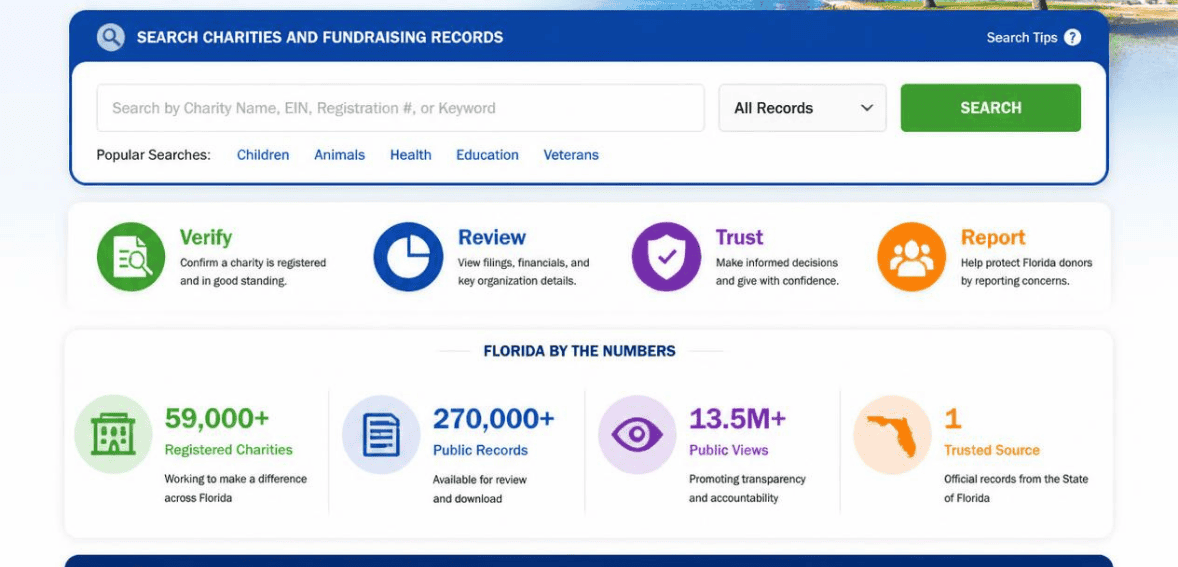
Every renewal you file feeds into a public database. FDACS runs a free online tool called Check-A-Charity, which lets donors, journalists, and the public verify any registered charity. Anyone can look up whether an organization is properly registered and see how it spends its money, including how much goes to programs versus fundraising and administration.
There is more to your renewal records than just compliance. The records you submit influence perceptions of your charity. If you submit zeros, zeros show up in the public charity records. You can access the tool on the FDACS Check-A-Charity page. More donors are looking up your records before making a donation, so consider your renewal records a public trust statement and not just a form.
Keeping Accurate Charitable Solicitation Records
Filing your renewal is only half the job. Florida law also requires you to keep solid internal records. Under Section 496.418, every charitable organization must keep true and accurate records of its activities in the state for at least three years. If FDACS requests them, you must provide those records within 10 working days, and no subpoena is needed.
There is another issue that messes with newer nonprofits. You cannot blend charitable and non-charitable funding. Donations have to go into their own accounts and must have documented use. Good record-keeping safeguards your organization in case the state inquires and makes each annual renewal much easier.
New Rules: Senate Bill 700 and the Honest Services Registry
Florida added a fresh layer to charitable registration in recent years. Senate Bill 700 took effect on July 1, 2025. It bars nonprofits and their fundraisers from soliciting or accepting contributions tied to certain “foreign countries of concern.” The named countries include China, Russia, Iran, North Korea, Cuba, Syria, and Venezuela.
The law also revised the registration process. Now, charities must provide a sworn attestation stating that they will not accept Foreign Prohibited Contributions. That sworn attestation will be filed with the public record, and the signers will be subject to the penalty of perjury for providing a false sworn attestation. Additionally, the state established a voluntary Honest Services Registry. This is a public registry of nonprofits that state they do not take funding from Foreign Prohibited Contributions. The listing on this Registry is voluntary, but it provides a mark of credibility for donor trust.
Due to the new law, many charitable nonprofits in Florida are reviewing and screening their donors, and revising their gift acceptance policies. If your charitable organization has transnational relationships, please review Florida Statutes Chapter 496 in its entirety, or speak to a compliance expert.
How to Stay Ahead of Your Renewal
Being compliant is all about calendar management. As soon as you register, mark the renewal date (usually referred to as an anniversary date) and set an alert for 90 days prior so you can begin to gather the necessary financial documents. If you do bookkeeping regularly, renewal season will be much easier, as you will just have to file everything. Always file online if possible. After filing, check your listing in Check-A-Charity and retain a copy of the filings for three years.
If your nonprofit exceeds the small-charity exemption’s $50,000 contribution limit or exceeds a fee threshold, you need to be alert. Once donations reach $50,000, you have a 30-day window to re-register at the new exemption level. The most common, and the most avoidable, compliance error is waiting too long to re-register.
Conclusion
The Florida charitable solicitation renewal is more than a yearly form. It is the legal foundation that lets your nonprofit ask for support, and it is a public record that donors can inspect at any time. Between the anniversary deadline, the sliding fee scale, the three-year recordkeeping rule, and the newer Senate Bill 700 requirements, there is a lot to track. But none of it is complicated once you build a simple routine around it.
Treat your renewal as an ongoing commitment rather than a last-minute chore. Keep clean records, file on time, and check your public listing each year. Do that, and your charity stays in good standing, keeps donor trust, and stays free to focus on the mission that matters most.
Frequently Asked Questions
How often do I need to file a Florida charitable solicitation renewal?
You must renew once a year. The deadline falls on the anniversary of your original registration date, not a fixed date shared by all charities. FDACS mails a renewal statement at least 60 days before the due date, but you should track the deadline yourself as well.
What happens if I miss my Florida charitable solicitation renewal deadline?
A late renewal costs $25 for each month, or part of a month, that it is overdue. Beyond the fee, your registration can be suspended, which means you lose the legal right to solicit donations in Florida until you fix it. Filing on time is always cheaper and safer.
Are my nonprofit’s renewal records public in Florida?
Yes. The financial information you submit becomes public through the FDACS Check-A-Charity tool. Donors can see whether you are registered and how your organization spends its money across programs, administration, and fundraising. Accurate reporting protects your public reputation.
Does Senate Bill 700 affect my renewal?
It can. Since July 1, 2025, charities registering or renewing in Florida must attest that they will not accept contributions from designated foreign countries of concern. If your organization has international donors or ties, review your donor sources carefully and confirm your attestation is accurate before you file.