
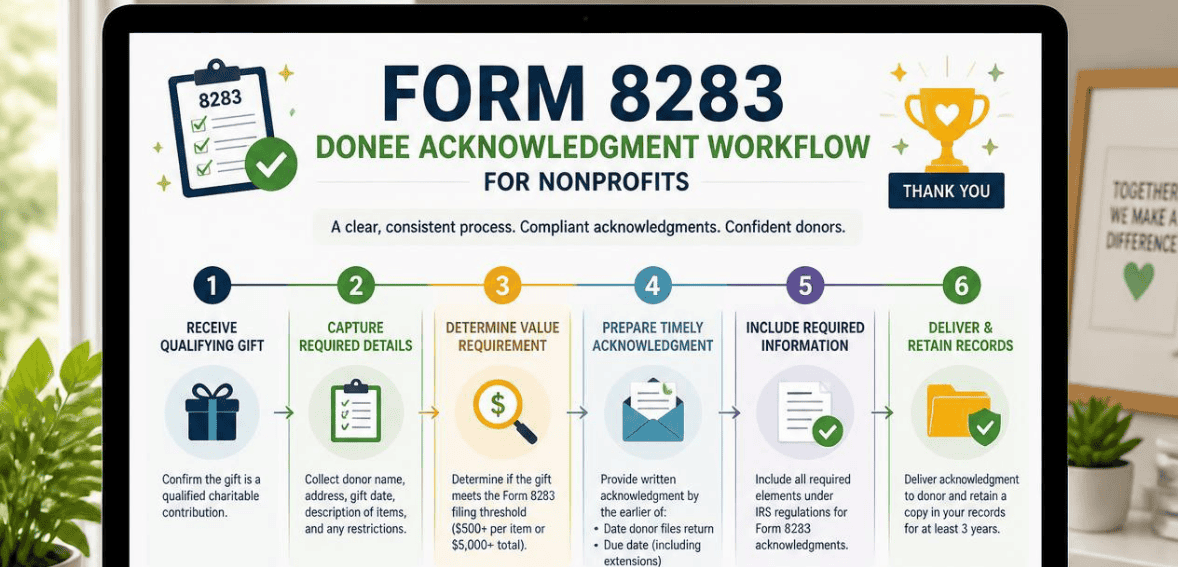
Form 8283 Donee Acknowledgment Workflow for Nonprofits
A donor walks in with a $12,000 painting and a bright smile. They hand you a tax form and ask for a quick signature. You sign it, thank them, and move on. Months later, that same donor calls in a panic. The IRS disallowed their deduction. The reason? A signature line on Form 8283 was completed the wrong way.
This happens very frequently. Non-cash gifts may be generous, but they are not without their administrative burdens. The Form 8283 donee acknowledgment is a big part of this. The signature of your nonprofit is what decides if a donor receives their deduction or not. So, it is to your advantage to organize this workflow properly.
This guide will explain the entire process of Form 8283 donee acknowledgement with very simple steps. You will find out the timing and the person responsible for signing, as well as how to safeguard your donor and your organization.
What Is the Form 8283 Donee Acknowledgment?
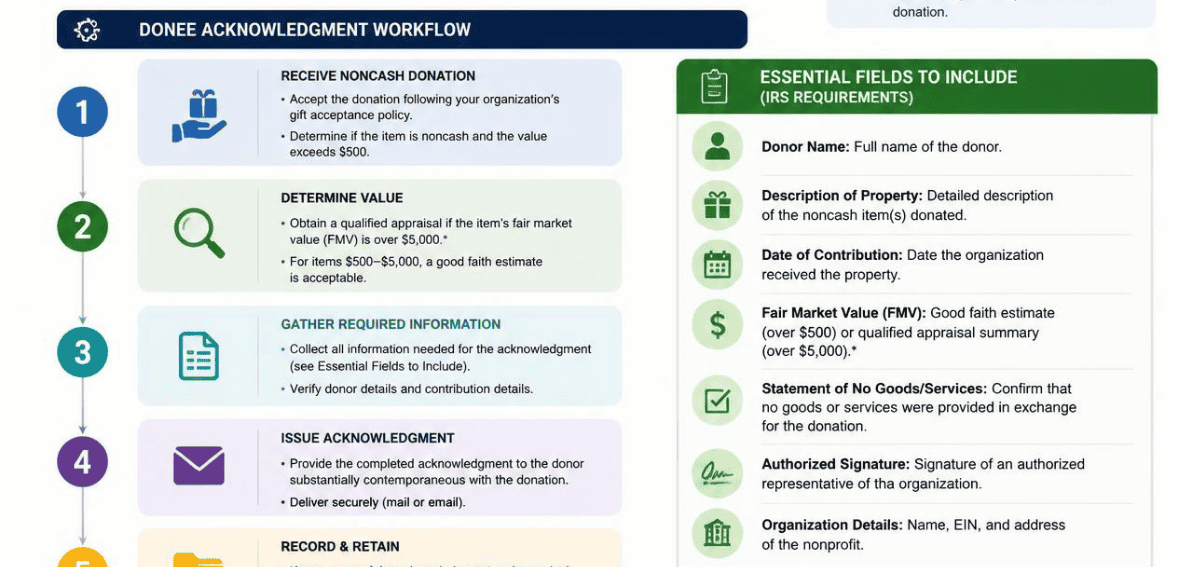
Form 8283 is the IRS form donors use to report noncash charitable contributions. Think donated art, vehicles, equipment, real estate, or stock. Cash gifts do not belong here. Only property does.
The Form 8283 donee acknowledgment is the part of that form where your nonprofit confirms it received the gift. It lives in Part V of Section B on the current version of the form. Your signature there certifies one simple thing. The organization received the described property on a certain date.
That is the key idea to hold onto. Your signature confirms receipt. It does not confirm value. The donor and their appraiser own the valuation. You just verify that the gift arrived.
When Does a Nonprofit Need to Sign Form 8283?
Not every noncash gift triggers a signature. The threshold matters. A lot.
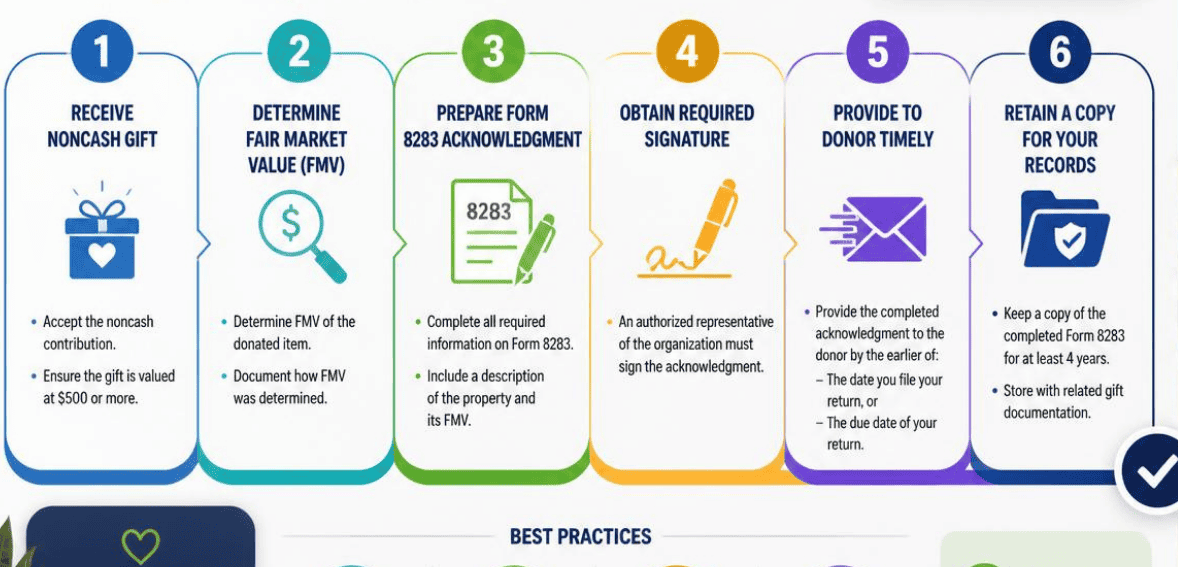
Form 8283 must be filed whenever total noncash deductions for the year exceed $500. The signature requirement is located in one of two sections of the form.
Section A pertains to gifts of $5,000 or less per item or per similar items group. It also pertains to gifts of publicly traded securities, regardless of their value. Typically, the nonprofit entity does not sign Section A of the form. It is, however, required to send a letter of thanks to the donor.
Section B pertains to items valued in excess of $5,000 or a group of similar items. Such gifts require a qualified appraisal and a donee acknowledgment in Part V of the form. It is pretty straightforward. A noncash gift valued at more than $5,000 always requires a signature.
The rule of similar items is what confuses many. The IRS considers all donated items of a similar nature to be a single group. Hence, all donated clothing is one group, all donated furniture is one group, etc. A group of donee items valued in excess of $5,000 also requires a signature, so even if a group of donee items is considered to be small, the items may still require a signature.
Who Can Sign the Form 8283 Donee Acknowledgment?
Not just anyone at your nonprofit can sign. The IRS is specific here.
Those who may sign Form 8283 on behalf of an organization include the tax return signatory or an employee specifically designated for this purpose. A random staff member or volunteer is not eligible.
This responsibility is typically assigned to the development director, chief financial officer, or executive director of a nonprofit organization. As a best practice, it is advised to designate backups. Donated gifts will not wait for the primary signatory to return from vacation. It is recommended to designate two to three signers to avoid the delay of a donation gift on account of a signature.
The Form 8283 Donee Acknowledgment Workflow, Step by Step
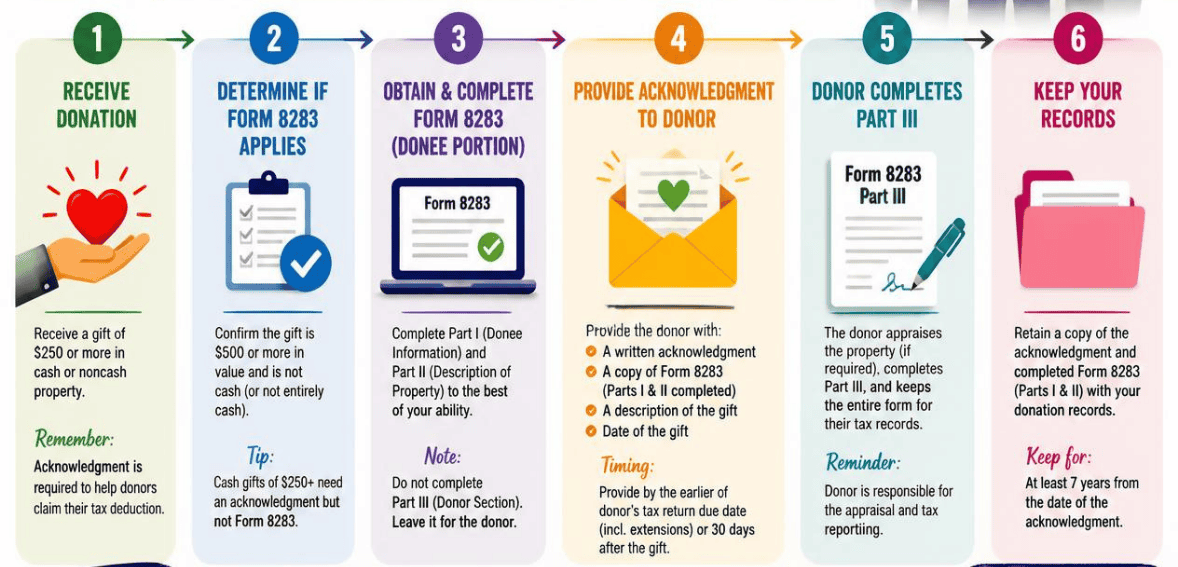
Here is where theory becomes practice. A clean workflow protects everyone. Walk through it the same way every time.
Step 1: Confirm the Donor Filled In Their Part First
A blank or incomplete form should never be signed. Prior to your organization signing Part V, the donor must fully complete their part and cannot leave any section blank. This specifically includes the name, the taxpayer identification number, the property description in Section B, Part I, and if the gift is tangible or real property, the condition of the property.
Step 2: Answer the “Unrelated Use” Question Honestly
Part V asks whether your organization intends to use the property for a purpose unrelated to your exempt mission. This question carries weight.
Imagine someone donates an expensive piece of art to your literacy nonprofit. Related use means if you display it to help promote your mission, you have related use. However, if you sell it immediately to make a profit, you may have unrelated use. Limiting the charitable deduction for the donor is a consequence of checking “Yes” here. So do it based on your actual intent. It’s the worst to have to guess.
Step 3: Sign, Date, and Return the Form
Once the donor’s sections are complete and the description checks out, your authorized signer completes Part V. They add their name, title, signature, and the date.
Then you return the form to the donor. The donor keeps the original for their tax return. You should also give the donor a copy of Section B for their records. Keep a copy for your own files as well. This return-and-retain habit saves headaches during an audit.
Step 4: Issue a Contemporaneous Written Acknowledgment
The Form 8283 signature is not a substitute for a donation receipt. The IRS recognizes these as two distinct forms. Both are required.
When you sign the Form 8283, you are also required to send the donor a written acknowledgment letter. This must state the name of your organization, the description of the property donated, and state if you provided any goods or services. Do not provide a value for the property; that is the responsibility of the donor. This letter must be sent prior to the donor sending in their tax return. That is what makes it “contemporaneous.”
Step 5: Log the Gift and Watch the Three-Year Clock
Record every signed Form 8283 in your gift tracking system. Note the donor, the date, the description, and the appraised value. Then set a reminder. The IRS watches what you do with the property for three years.
That reminder leads directly to the follow-up form most nonprofits forget.
Form 8282: The Follow-Up That Catches Nonprofits Off Guard
The Form 8283 donee acknowledgment is not the end of your obligation. It is often just the beginning.
Your organization generally must file Form 8282, Donee Information Return, if you sell, exchange, or otherwise dispose of donated property within three years of receipt. You must file this form within 125 days of the donation’s disposition, and you must give the donor a copy.
This is important because a donor’s tax deduction may be reduced or even eliminated if the property is disposed of too quickly (sale, exchange, or otherwise). For example, if you accept a $12,000 donation of a painting and, six months later, auction it for $3,000, that $3,000 tax deduction (the donor’s painting is probably worth more) will cost the donor $12,000. To avoid this, your organization must file Form 8282.
You do not generally have to file Form 8282 for donated property that the donor identified in Part III as worth $500 or less. You also do not have to file if the property is donated to a charity. It is better to file than to not file, because there can be penalties for failing to file.
What the Donee Acknowledgment Does Not Do
A little clarity here prevents a lot of donor frustration. Your signature does three things well and three things not at all.
Your signature confirms that the property was received. It identifies your organization as the recipient. And it captures the date of the gift. That is the full scope of what it certifies.
Your signature does not appraise the gift. It does not guarantee the donor’s deduction. And it does not replace a qualified appraisal or a formal receipt. If a donor asks you to “vouch for the value,” gently decline. Point them to their appraiser instead. Staying in your lane protects your nonprofit from liability.
Common Form 8283 Donee Acknowledgment Mistakes
Some mistakes tend to repeat. Anticipating them simplifies your process.
One is signing the form when the property description is vague or missing. Make sure the description is accurate to the gift. Letting someone outside the signer list sign is a second mistake. Part V should only be signed by your signers. A third mistake is using the signature as a receipt. An acknowledgment letter is still needed for gifts of $250 and above. A fourth is forgetting the three-year rule. A gift that is sold and that you don’t track can result in a Form 8282 obligation. The last mistake is timing. If a donor gift form is signed after the donor’s deadline, the deduction is lost.
Building a Repeatable Compliance Workflow
Consistency is the best strategy for responding to the IRS Section B Gift Defect Letter.
Develop a checklist for each Section 170 noncash contribution. Validate each contributor’s interest. Verify the contribution description. Provide an answer to the unrelated use question. Obtain the necessary approvals on the routing form. Sign and return the form, then issue the letter of acknowledgment. Log the contribution with a reminder for three years in the future.
Document the procedures one time. Teach your development team. Store the signed forms in a secure and permanently searchable electronic location. When nervous donors or auditors call, you will have the records in seconds. This preparation creates confidence with your donors, and confidence increases future contributions.
For the most current requirements for IRS Form 8283, review the IRS Instructions for Form 8283. As IRS Nonprofit Guidance on Substantiating Noncash Contributions explains the donee’s responsibilities, nonprofits should also read this document. Lastly, be sure to have a copy of Form 8282 for any property you plan on selling in the three years following its receipt.
Conclusion
The Form 8283 donee acknowledgment looks like a simple signature. In reality, it is a small step with big consequences. Sign it correctly, and you protect a donor’s hard-earned deduction. Handle it carelessly, and you risk a disallowed gift and a strained relationship.
The fix is not complicated. Know your thresholds. Name your authorized signers. Follow the same workflow every time. Pair the form with a proper acknowledgment letter. And never lose sight of the three-year disposal rule. Do these things, and your nonprofit turns a compliance chore into a mark of professionalism. Donors notice organizations that get the details right. That reputation pays off long after the gift is recorded.
Frequently Asked Questions
Does a nonprofit have to sign Form 8283 for every noncash donation?
No. Your nonprofit generally signs only for Section B gifts, meaning a single item or group of similar items valued over $5,000. Smaller gifts reported in Section A do not require your signature on the form. You should still send a written acknowledgment letter for any gift of $250 or more.
What does the nonprofit’s signature on Form 8283 actually confirm?
It confirms that your organization received the property described, and it records the date of receipt. It does not confirm or endorse the value of the gift. Valuation is the donor’s responsibility, supported by a qualified appraisal when the gift exceeds $5,000.
Who at our organization is allowed to sign the donee acknowledgment?
The signer must be an official authorized to sign your organization’s tax returns, or a person your organization has specifically designated to sign Form 8283. It is wise to name more than one authorized signer so a gift is never delayed by an absence.
What happens if we sell donated property soon after accepting it?
If you dispose of the property within three years of receiving it, you generally must file Form 8282 within 125 days and send the donor a copy. This can affect the donor’s original deduction. Limited exceptions exist, such as items valued at $500 or less identified by the donor, or property distributed for charitable purposes.