

Managing Form 990 Schedule B Contributor Records Without Exposing Donor Data
Every gift your nonprofit receives comes with a quiet promise. Donors trust you with their generosity, and often with their privacy too. Then tax season arrives, and that promise runs straight into a federal form. Schedule B asks for names, addresses, and dollar amounts. Handle it carelessly, and you risk exposing the very people who keep your mission alive.
This is the reassuring part. You can stay completely compliant and not put your supporters at risk. This guide shows you the best and smartest ways to manage Form 990 Schedule B donor records. You will discover the IRS requirements, which information will remain confidential, and the new and positive changes that recent court rulings have brought.
What Is Form 990 Schedule B?
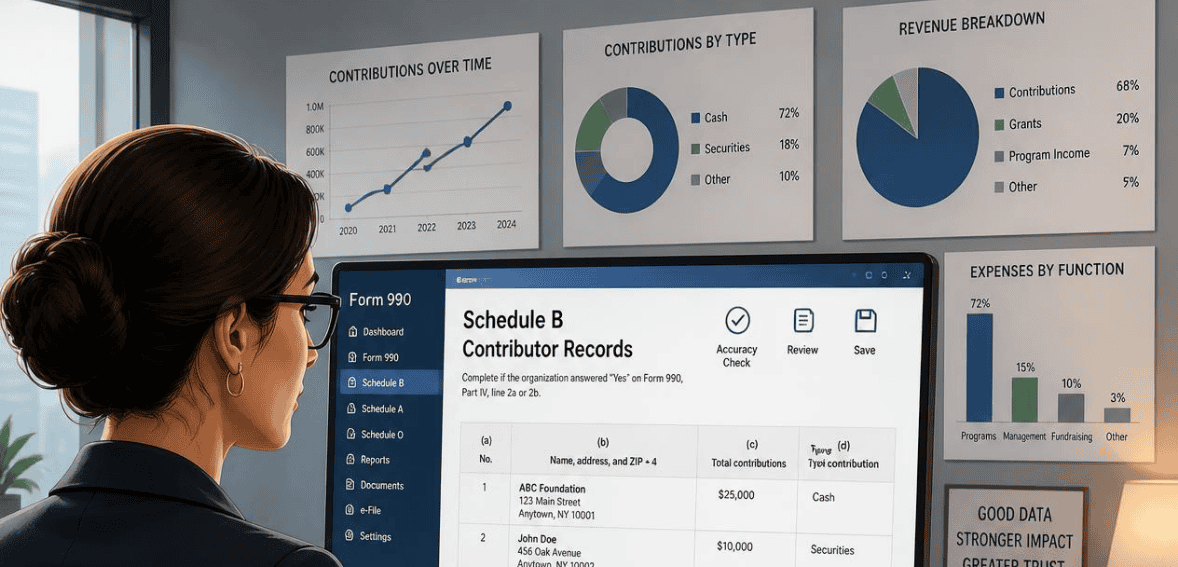
Schedule B is the Schedule of Contributors. It attaches to your annual Form 990, Form 990-EZ, or Form 990-PF. Think of it as the donor roster the IRS wants to see.
Most organizations need to complete Schedule B to report cash contributions of $5,000 or more from a single source during the reporting period. Some public charities will file Schedule B if the cash contribution exceeds the greater of $5,000 or 2% of the total cash contributions received. Schedule B generally reports your mid-level and major donors. It reports their names, addresses, and contribution amounts.
Why does the IRS care? The IRS uses Schedule B to cross-reference the charitable contribution deductions claimed by major donors. If a donor claims a substantial tax deduction, the reported gift lets the IRS confirm it against what the charity actually received. This helps prevent fraud involving the gift and the deduction. Because Schedule B serves this purpose, it supports public oversight. Even if it feels invasive to charities and their donors, it does serve a purpose.
Why Donor Privacy Matters More Than Ever
Donor data is sensitive. A published contributor list can invite unwanted solicitation, public scrutiny, or even harassment. Some donors give to causes that are personal, political, or controversial. They expect discretion. Break that expectation, and you can lose their trust in a single filing season.
Privacy is more than just social courtesy. It relates to the freedom to join and support groups without fear. That principle lies at the core of how these laws developed. Safeguarding your supporters is both a legal protection and a sound business strategy. Supporters who feel secure are more likely to give again, and to give more.
The Public Disclosure Rule That Protects Your Donors
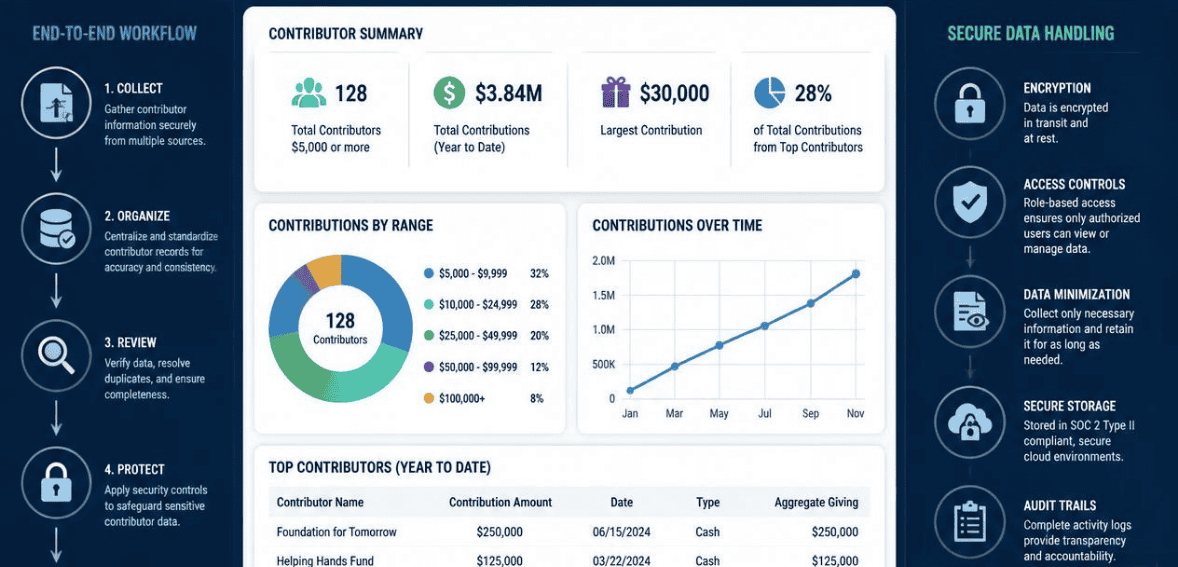
Here is the key insight that solves the whole puzzle. Your full Form 990 is a public document. Anyone can request it. But the donor details on Schedule B are treated differently, and that distinction is your best protection.
For most public charities, the names and addresses of contributors do not have to be shown to the public. The IRS itself redacts that information before releasing a return. And you are permitted to redact it too.
The Two-Copy Approach
The most organized approach is to maintain two versions of your return. One is your complete copy filed with the IRS, which includes full donor identities. The other is your public disclosure copy. In this version, you black out donor names, addresses, and other identifying details.
You provide the public, the grantors, and the state regulators with the redacted version of your Form 990 upon request. This is not a loophole. This is the correct course of action per IRS guidelines. Maintaining this approach will provide you with the confidence that you are in compliance with transparency regulations and that donor information is kept confidential.
When Redaction Is Not Allowed
The redaction privilege is not universal, so know where it stops. Private foundations that file Form 990-PF must disclose their Schedule B contributor information to the public. Section 527 political organizations face the same rule. For these two categories, donor details are part of the public record, and you cannot black them out. If your organization falls into either group, plan for full disclosure from the start.
The 2020 IRS Regulations: Who Still Reports Donor Names?
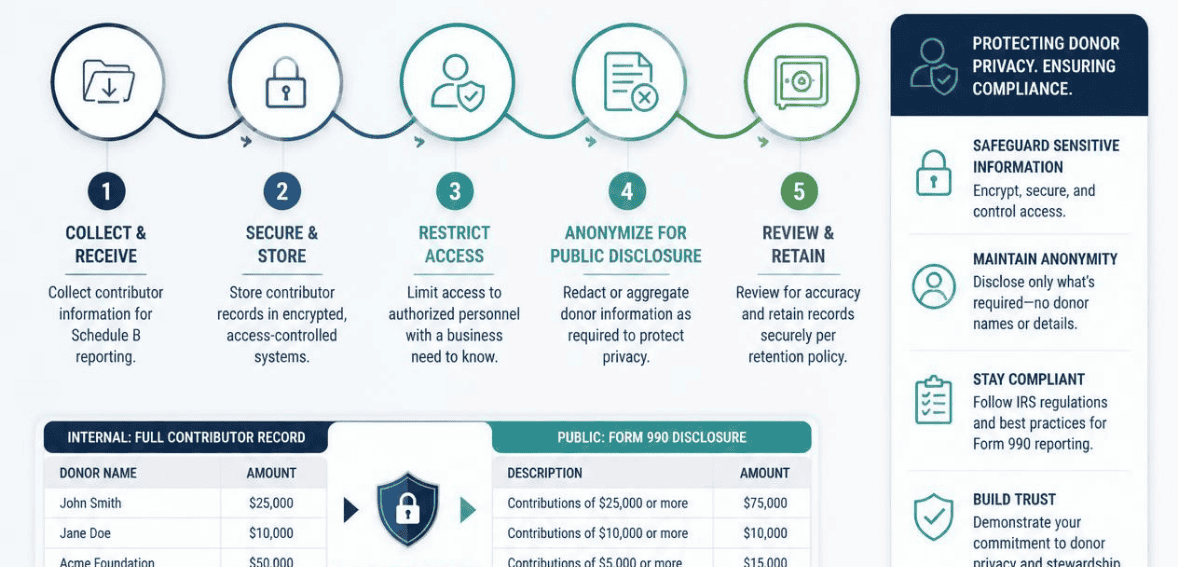
The rules about donor identity reporting to the IRS changed in 2020. On May 28, 2020, the Treasury published final regulations that limited which organizations must report donor identities.
With these regulations, only 501(c)(3) charities and 527 political organizations are required to disclose the names and addresses of their substantial contributors on Schedule B. Other exempt organizations, like 501(c)(4) social welfare organizations, 501(c)(5) labor unions, and 501(c)(6) trade associations, can report the contribution amounts without disclosing the identity of the contributors.
One requirement that did not change is that all filing organizations are required to maintain donor records. This means that the organizations must keep the names, addresses, and amounts of the donations, and must disclose this information to the IRS if the IRS requests it for an audit. This means that, for some organizations, the reporting burden was reduced, but the recordkeeping burden did not change. Whether or not the information is reported to the IRS, the organization is required to keep the information.
Americans for Prosperity Foundation vs Bonta: What Changed
The biggest shift in donor privacy came from the Supreme Court. On July 1, 2021, the Court decided Americans for Prosperity Foundation v. Bonta in a 6-3 ruling.
The case targeted a California rule requiring charities to submit a Schedule B donor list along with their fundraising petitions to the state Attorney General. California did (and does) promise to maintain confidentiality, but its records have leaked in the past. The charities’ position was that the rule creates a chilling effect on their donors’ First Amendment right to free association.
The Court agreed. California’s indiscriminate donor data collection was deemed facially unconstitutional. California’s desire to curb fraud in the charitable sector could not justify the collection of donor information from every organization.
The effect of the ruling was immediate. California, New York, New Jersey, and a few other states relied on Schedule B forms to create their donor collection systems. After the ruling, the collection requirements instituted by these states fell away. The ruling is especially important to nonprofits. In the aftermath of the ruling, states can no longer require donor lists (i.e., Schedule B) as a prerequisite for fundraising registration.
How to Keep Schedule B Contributor Records Secure
Knowing the rules is one thing. Building habits that protect donors is another. Strong internal practices turn compliance into a routine rather than a scramble.
Create a donor management policy and specify how donor records from Form 990 Schedule B will be managed, who in your organization will have access to these records, how the records will be stored, and when they will be released. Access control protects against unintentional leakage.
Then, be disciplined about preparing public disclosure copies. Prepare the redacted versions when you prepare the full disclosure returns. That way, no one sends out the full version by mistake when working under a deadline. Make sure to eliminate the names, street addresses, and even unusual gift descriptions, such as certain donated stock blocks, as these may identify a donor.
Retention of contributor records is also important. Keep your complete contributor records for the maximum time the IRS could request them, and store them in a secure location with backup. Remember, the public disclosure requirement normally doesn’t apply to returns older than three years. If someone requests donor information from a very old return, you may not be obligated to provide that information.
Finally, watch your filing software and any third parties who touch your return. Accountants, grant portals, and state agencies all receive copies. Make sure each one gets the redacted version unless the law clearly requires more. Educate your team so the habit sticks across staff changes.
Candid (Formerly GuideStar)
Many people use Candid to research nonprofits. Candid is the company that created the well-known GuideStar database. GuideStar is a good reputation tool, and many donors check it before donating. Here are the details that will provide peace of mind to privacy-conscious nonprofits. Copies of Form 990 from Candid and GuideStar do not contain Schedule B. Therefore, even if your Form 990 is widely disseminated, your contributor list is not included.
Staying Compliant With State Charitable Registration
Federal rules cover some ground, but not all of it. Most states obligate charities to register ahead of donation solicitations. Registration packages typically require your Form 990. Following the Bonta decision, states are mostly prohibited from demanding your unredacted Schedule B. However, some details differ, and certain states are slow to update their forms.
When registering and renewing with states, submitting your public disclosure copy is the safest option. If a state demands more, check current law before complying. The National Council of Nonprofits has helpful resources and state-aware guidance. If you need help with a filing and the stakes are high, a brief consultation with a nonprofit attorney is an expense you will not regret.
Conclusion
Protecting donor privacy and meeting IRS rules are not competing goals. They fit together neatly once you understand the system. File the complete return with the IRS, keep a redacted public disclosure copy for everyone else, and store your Form 990 Schedule B donor records under tight internal control.
The 2020 regulations eased reporting for many exempt groups. The Bonta ruling shut down aggressive state collection of donor lists. Together, they give nonprofits real breathing room to honor the trust their supporters place in them. Build the two-copy habit, tighten access, and stay alert to state quirks. Do that, and you can be fully transparent about your mission while keeping your donors’ identities exactly where they belong: private.
Frequently Asked Questions
Do all nonprofits have to file Schedule B?
No. You file Schedule B only when you meet the reporting threshold, usually a single contribution of $5,000 or more during the year. Certain public charities use a greater-of $5,000-or-2% test. If no contributor crosses the threshold, you can certify that Schedule B does not apply rather than filing it.
Can we hide donor names from the public?
Usually, yes. Public charities may redact contributor names and addresses from the public disclosure copy of Form 990. Private foundations filing Form 990-PF and 527 political organizations are the exceptions, since they must disclose that information publicly.
If we do not report donor names to the IRS, can we throw the records away?
No. Even organizations that no longer report donor identities under the 2020 rules must keep complete internal records. The IRS can request names, addresses, and amounts during an examination, so retain everything securely.
Can our state still require our Schedule B donor list?
Generally, no, following the 2021 Americans for Prosperity Foundation v. Bonta decision. Blanket state demands for donor lists were struck down as unconstitutional. Requirements still vary by state, so submit your redacted copy and confirm any broader request against current law.