

Reconciling Noncash Gifts for Form 990 Schedule M
Picture the last week before your filing deadline. Your cash gifts tie out cleanly. The bank statements agree with the books. Then a reviewer asks about the donated stock, the used van, and the pallet of canned food. Suddenly the numbers do not line up. That late scramble plays out at nonprofits across the country every year. It almost always points to one weak spot: a shaky reconciliation process for Form 990 Schedule M noncash contributions.
Here’s the comforting part. It’s simple to understand how to reconcile once you’ve seen the flow. This guide shows you how to do this using simple instructions. You will see how and when Schedule M applies, how to connect your figures to the main return, how to value your gifts, and how to avoid the blunders that cause the IRS to take an interest. All you need to do is understand the process, and Form 990 Schedule M will be evidence of your transparency instead of giving you sleepless nights.
What Is Form 990 Schedule M?
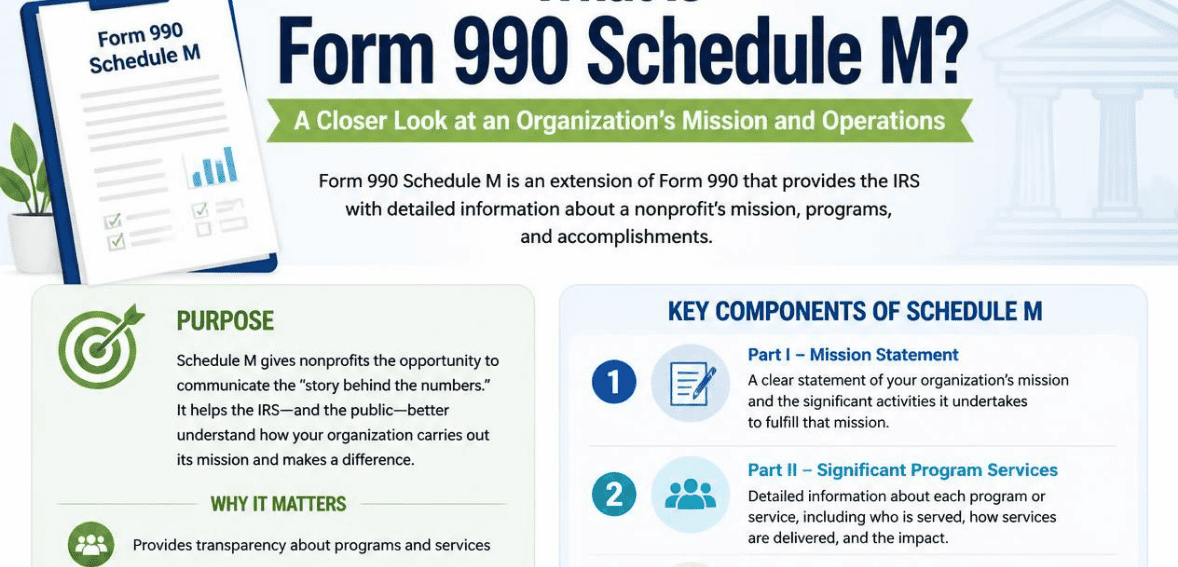
Schedule M is an attachment to Form 990. It reports the noncash gifts your organization received during the tax year. The key word is property, not money. That covers donated securities, vehicles, real estate, artwork, food, clothing, medical supplies, and equipment.
There are two primary functions of the schedule. It categorizes your gifts by type of property. It also provides the value for each gift by type. It also inquires about your gift acceptance policies and the use of third parties to facilitate donations.
Some gifts are not to be reported on this schedule at all. Donated services are never reported on Schedule M. Free use of a building, vehicle, or equipment is also not reported on Schedule M. This form is only for property. You still report a gift even if you sell it the same day you receive it. The gift counts because you received it, not because you retained it.
When Does Schedule M Apply?
You file Schedule M when you answer “Yes” to Form 990, Part IV, line 29 or line 30. Two separate triggers sit behind those lines.
The dollar test is on line 29. If your annual noncash contributions exceed $25,000, then you must file this schedule. You report this total on Form 990, Part VIII, line 1g.
Line 30 is for the special property test. Did you receive any works of art, historical artifacts, similar items, or a qualified conservation contribution? If yes, you must file Schedule M, regardless of the item’s value. You can be affected by this even if you received one low-value item. Many filers don’t realize this and think that the $25,000 rule is the only requirement to file Schedule M.
How Reconciliation Actually Works

Reconciliation means your Schedule M figures agree with the rest of your Form 990. This is the heart of clean reporting for Form 990 Schedule M noncash contributions. Skip it, and reviewers spot the gap fast.
Match Column (c) to Part VIII, Line 1g
Schedule M Part I offers four columns pertaining to each property type. Column (a) has a checkbox indicating if you received that type of gift. Column (b) captures the count of contributions or items. Revenue is captured in Column (c), and Column (d) describes the valuation method.
Column (c) actually holds the true reconciliation. The revenue you report for each type of property must be derived from and be consistent with Form 990, Part VIII, line 1g. The sum of the entries in column (c) from the entire schedule must equal the amount reported on line 1g. If the amounts do not match, it means either a gift was recorded outside the range of the schedule or was recorded on the wrong line. Be sure to correct this before you submit.
Value Gifts at Fair Market Value
You report noncash gifts at fair market value. That is the price a willing buyer and a willing seller would agree on. Neither party feels pressure to act. Both know the relevant facts.
You measure this value on the date you received the gift. That rule holds even if you sold the item minutes later. Apply the same standard to every property type so your return stays consistent.
Column (d) asks how you reached each value. Acceptable methods include the cost or selling price of the property, sales of comparable items, replacement cost, or the opinions of qualified experts. Pick the method that fits the asset and note it clearly.
Count Contributions the Right Way
Many filers go wrong in column (b). You may use the total count of contributions, the total count of individual items, or a combination of the two for the various categories of property. The only requirement is that you justify your choice in Part II.
Gifts of securities are treated differently. Each gift, even a block of shares, is treated as a single item. Thus a block of 100 shares gifted in a single transaction counts as one item. Books and publications, and clothing and other household articles, are also exempted. You need not fill in column (b) for these items.
Property Types You Must Track
Schedule M lists many categories of property. That structure forces you to sort your gifts before you file, which is exactly what makes reconciliation smoother.
Some typical examples are art pieces, historical artifacts, and memorabilia. There are also entire collections of automobiles, ships, aircraft, and other modes of transportation. There are also stocks and other financial instruments, reflecting varying degrees of ownership. There is also real estate, both residential and commercial. Also added are inventories of food, medical and other supply goods, research specimens, taxidermy, and other everyday items such as clothing and books. Place each gift on its appropriate line. An incorrect placement of a gift will distort your counts and your totals.
Key IRS Resources for Valuation
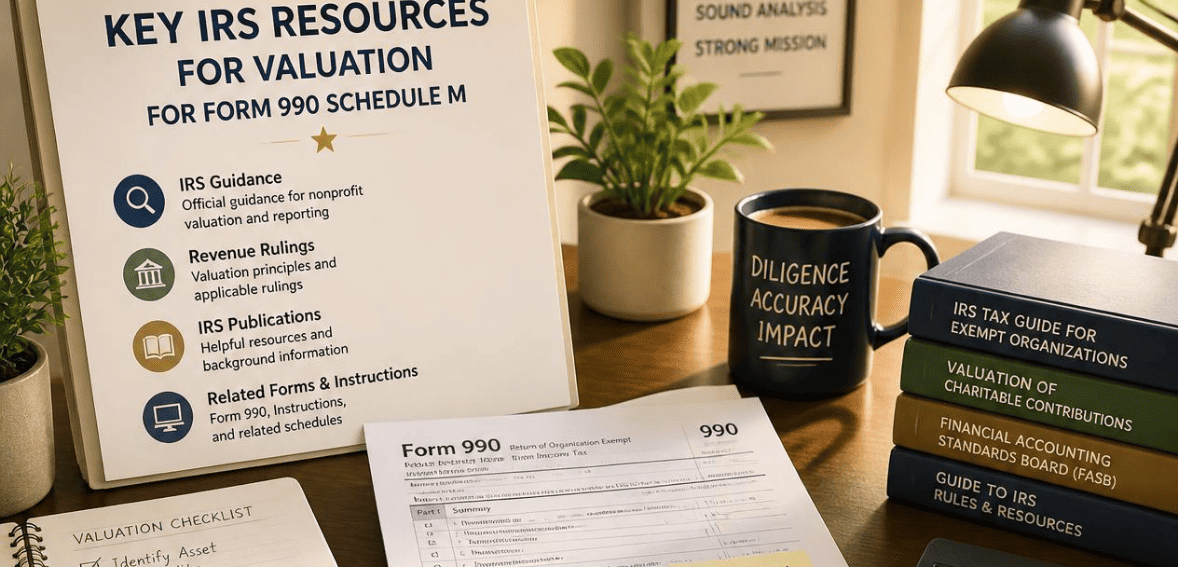
The IRS publishes the authoritative guidance behind Schedule M. Two resources matter most when you value and substantiate gifts, and both are worth bookmarking.
IRS Publication 561
Publication 561, Determining the Value of Donated Property, provides a baseline for fair market value of property. This publication describes valuing stock, real estate, art, vehicles, and virtually all types of property. It will help you defend your method when column (d) requires it. The IRS provides the current publication on its website.
IRS Form 8283
Form 8283, Noncash Charitable Contributions, is the donor’s form for larger gifts. Your donor generally files this form to claim a deduction in excess of $500. Schedule M asks how many Forms 8283 you received and acknowledged during the year. Generally, a donor needs a qualified appraisal to deduct more than $5,000 for most types of property. Publicly traded securities are the principal exception. You may review the Form 8283 page on the IRS site for the requirements. For the schedule itself, the official Schedule M PDF shows the layout.
Part II: Tell the Story Behind the Numbers
Part I holds the figures. Part II holds the explanation. Reviewers read this narrative section to understand your judgment calls.
Use Part II to explain how you counted gifts in column (b). If certain assets have a three-year holding period, mention that. Explain any donor restrictions, if applicable. Indicate whether you contracted a third-party service provider or a related organization to solicit gifts, to process gifts, or to sell gifts. Also, if you checked column (a) for a certain type of property but did not complete column (c), you are required to provide a brief explanation for line 33.
Narratives answer questions before they are asked and save time for both the organization and the IRS. Blank Part IIs invite questions and follow-up correspondence.
Common Reconciliation Mistakes to Avoid
A handful of errors show up again and again. Knowing them helps you dodge them.
The first mistake is a mismatch in column (c) totals that fail to sum to line 1g. The second mistake is including donated services as property, which have no business on the schedule. The third mistake is failing to flag the art or conservation trigger on line 30 because the organization focused only on the $25,000 threshold. The fourth is poor documentation—fair market values with no appraisal, receipt, or broker statement to support them. The fifth is failing to collect data throughout the year, which causes you to lose important records. All of these mistakes can be easily avoided with some organization.
Building a Year-Round Tracking Habit
The simplest fix involves logging every noncash gift immediately upon receipt. Note the type of property, the date of receipt, and the fair market value. Place the supporting document in a single shared folder.
This habit turns a stressful filing season into one where you only need to review, not locate. Because you already logged the fair market value of every noncash gift as it came in, you already have the values and counts you need. Reconciliation becomes checking rather than searching. A brief internal process is always better than a last-minute rush every year, and it makes every accountant happier too.
Conclusion
Reconciling Form 990 Schedule M noncash contributions comes down to one clear idea. Your property-by-property figures must agree with Form 990, Part VIII, line 1g. Value each gift at fair market value on the date you receive it. Count items with a consistent, documented method. Explain your choices in Part II. Keep your supporting records ready all year.
Do that, and Schedule M stops feeling like a threat. It becomes a clean statement of how your organization stewards the gifts it receives. Solid reconciliation protects your tax-exempt status and builds trust with donors and regulators alike. Set up your tracking system now, and your next filing season will feel far lighter.
Frequently Asked Questions
Do I report noncash gifts I sold right away?
Yes. You report the gift even if you sold it the same day you received it. Use the fair market value as of the receipt date. The later sale price does not replace that figure on Schedule M.
Are donated services reported on Schedule M?
No. Schedule M covers property only. Pro bono work, volunteer hours, and the free use of space or equipment do not go here. They are also not recognized as revenue on Form 990, Part VIII.
What if column (c) does not match Part VIII, line 1g?
That mismatch is a red flag. Recheck your books for gifts that were missed, double-counted, or classified under the wrong line. Every column (c) entry should trace to line 1g, and the totals should tie out exactly.
When does a donated gift need a qualified appraisal?
A donor generally needs a qualified appraisal to deduct more than $5,000 for most property. Publicly traded securities are the main exception. The appraisal supports the value your donor claims and strengthens your own records for Schedule M.