

What a Nonprofit CRM Tracks That a Sales CRM Never Will
The Fields a Sales CRM Doesn’t Have
A pipeline tool is built to move one opportunity toward a close and then archive it. Fundraising doesn’t work that way. That difference shows up as fields, not philosophy.
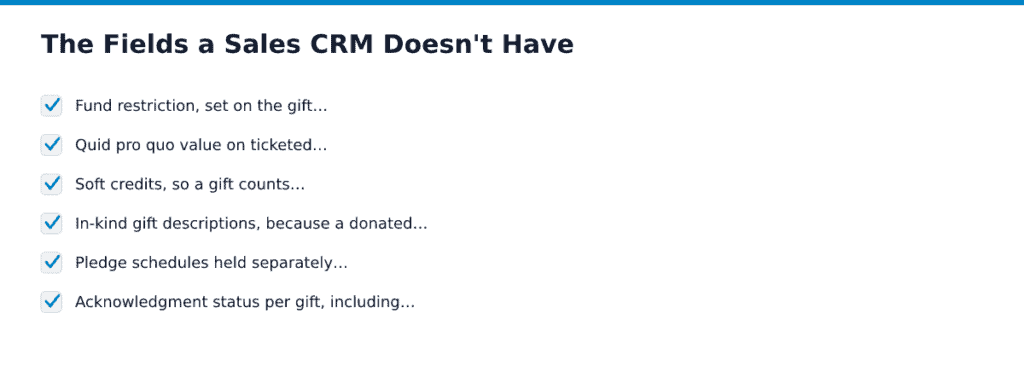
Six of them have no sales equivalent at all:
- Fund restriction, set on the gift record at entry, not derived later from a memo line.
- Quid pro quo value on ticketed and premium gifts, with the good-faith estimate of what the donor received in return (law.cornell.edu).
- Soft credits, so a gift counts toward a spouse, a board member or a foundation’s contact without double-counting the revenue.
- In-kind gift descriptions, because a donated van is a description and a substantiation trail, not a dollar amount you assign (law.cornell.edu).
- Pledge schedules held separately from the payments that satisfy them.
- Acknowledgment status per gift, including the date the contemporaneous written acknowledgment went out (law.cornell.edu).
Restriction deserves a second look, because it’s the one people try hardest to postpone. The fund a gift belongs to is a field you set when the gift is recorded. If it isn’t, you are reconstructing donor intent from bank deposits in June while your auditor waits, and the answer you produce is a guess with a signature on it.
Compare the shape of the data. A sales opportunity’s amount is one number. A donation is an amount, a deductible portion, a fund, a designation, a source code and a receipt reference, and every one of those can be queried independently.
This is why the Salesforce workaround breaks. Custom fields on Opportunities hold the data fine until you need a fiscal-year statement of activities split by restriction with pledges receivable separated from cash. Then you’re writing reports against fields nobody validated. Our Nonprofit Insights & Giving Tips coverage walks through where that line sits.
Field-by-Field: Sales CRM vs Nonprofit CRM
Take this into the demo and make the salesperson point at the screen. The decision you’re making is whether the fields you need exist natively, or whether you’ll be renaming custom fields and hoping your bookkeeper remembers what “Amount 2” meant in three years.
| Sales CRM field | Nonprofit CRM field | What breaks if you fake it |
|---|---|---|
| Opportunity amount | Contribution amount and deductible amount | Receipts overstate the deduction when the donor got a benefit |
| Account / company | Household, plus soft credit to the influencing donor | Spouses get two letters; the advisor who drove the gift shows $0 lifetime |
| Stage | Pledge schedule and installment status | Pledges receivable can’t be separated from cash received |
| Product / line item | Fund, appeal, campaign | Restriction is untracked from the first receipt, so the audit finds it |
| Close date | Gift date and receipt date | Year-end gifts land in the wrong fiscal year |
| No equivalent | Matching-gift eligibility and employer | Match revenue you were entitled to never gets claimed |
| No equivalent | Volunteer hours and board role | Non-cash engagement is invisible in segmentation |
| No equivalent | Grant report deadlines and payment tranches | A missed report holds up the next tranche |
Deductible amount isn’t cosmetic. It drives what the letter has to say, because a written acknowledgment for a contribution of $250 or more must state whether goods or services were provided and describe them with a good-faith estimate of value (law.cornell.edu). You need two.
Households, Soft Credits and the Constituent Who Is Never a Buyer
A sales CRM models a company, the contacts inside it, and the deals attached to both. Three levels, one direction. Fundraising needs a household that holds two spouses who give from a joint account, each spouse as an individual with separate email and separate volunteer history, and the employer that matches the gift. The same person sits in all three places at once, and the gift has to roll up to the household on a mailing list while staying attached to the individual on a stewardship report.
Soft credit is where a pipeline tool breaks outright. A check arrives from a donor-advised fund sponsor or a family foundation. The sponsor is the legal donor and gets the hard credit. The person who directed the grant gets the relationship credit, the thank-you call and the moves-management record. Your revenue total must count that money once while two constituent records each show it. A deal object can be split by percentage, which is a different thing and produces the wrong donor totals.
Roles compound the problem. One record is a donor, a Tuesday volunteer, a board member with fiduciary duties covered in our Nonprofit Insights & Giving Tips series, a program participant whose case notes most staff should never see, and the named contact on a foundation grant. Access rules differ by role on a single record.
Then there are flags a lead-status field can’t carry: anonymous, do not solicit, do not mail, deceased. Ignore one and you send a solicitation letter to a widow. The numbers that matter here, explained in Nonprofit Insights & Giving Tips, are lifetime giving, largest gift, first gift date and consecutive-year streak.
Money With Strings: Restricted Funds, Pledges and Grants
A sales CRM records what closed. A nonprofit CRM records what you owe. When a donor writes a check for the roof fund, that restriction is created at the moment the gift is recorded, and it has to survive all the way to a set of financial statements that report net assets with and without donor restrictions (law.cornell.edu). If the fund is a note in the memo line instead of a field on the gift, your auditor will find the gap and your general ledger won’t reconcile.
Pledges break the model further. Say a donor commits $30,000 over three years, paid twice a year. That’s one unconditional promise, recognized as a receivable when the promise is made, and six payments that hit cash on six different dates (law.cornell.edu). A deal record with a close date can’t hold both. You need the commitment, the schedule, the payments received and the balance outstanding, each queryable on its own.
Grants carry deliverables and report deadlines rather than close dates, and the reporting calendar differs by funder type, as covered in Nonprofit Insights & Giving Tips. Miss an interim report and you don’t lose a renewal conversation, you lose the next award. Budget lines from the application should map to the fund codes you actually track, which is the argument made in Nonprofit Insights & Giving Tips.
Recurring gifts need card-expiry handling, failed-payment retries and a cancel date. Lead with monthly giving on the page, then confirm the CRM can report retention for that cohort by month joined.
Receipts, Acknowledgments and the Audit Trail
The deadline isn’t yours, it’s the donor’s. A written acknowledgment counts only if the donor has it by the earlier of the date they file their return or the due date for that return (law.cornell.edu), and you have no way of knowing when someone files. So the automated receipt goes out the same day, and a specific human note follows within the week.
- Configure the automated receipt to carry your organization’s legal name, the gift date, the cash amount or a description of noncash property, and the goods-or-services statement required by the substantiation rules (law.cornell.edu). Test it against a real gift before launch, as covered in Nonprofit Insights & Giving Tips.
- Add the quid pro quo disclosure and a good-faith value estimate whenever a donor pays more than $75 and gets something back (law.cornell.edu).
- Store the sent PDF against the gift record and confirm a resend reproduces the original figures.
- Disclose the processing fee on the page as an unchecked option, then record the covered amount separately so the deductible figure stays right. Nonprofit Insights & Giving Tips walks through the fee math.
Done looks like this: Year-end summaries are a courtesy on top, not a substitute for the per-gift acknowledgment.
What to Ask a Vendor Before You Sign
Demos are staged. Hand the salesperson your list and make them drive in their own sandbox while you watch the clicks, because the number of screens it takes to do a thing is the real answer. Ask for each of these live:
- One gift record showing a fund restriction, a soft credit and a quid pro quo value together.
- A full export of constituents, gifts, pledges and notes to CSV, right now, unassisted.
- A pledge-receivable aging report reconciled against cash receipts for the same period.
- A recurring plan whose card failed last month, plus the message the donor got.
- A donation page completing a gift with no account creation.
If the export needs a support ticket or a professional-services quote, stop there. Then get the money questions answered in writing: who holds the merchant account, whether pricing is interchange-plus with a stated margin or a flat rate, and what happens to your data if you leave. Our comparisons of Nonprofit Insights & Giving Tips and of hosted versus installed systems in Nonprofit Insights & Giving Tips cover both.
Book two demos this week and run the same five requests in both. Score them on clicks, not on features.
Frequently Asked Questions
Is there a free nonprofit CRM, and what do you give up?
Free plans that cap constituents force you to delete lapsed donors, which is the exact history you need to prove a lapsed-donor reactivation worked. Read the export terms before you import anything: if you can pull constituents but not the gift table with fund designations and soft credits attached, you’re locked in, and a tool that makes a full export hard is a tool to leave. Watch, too, for free plans that only monetize through their own donation form at a flat processing rate you can’t negotiate.
What is the 33% rule for nonprofits?
It’s shorthand for the public support test, which A sales CRM tracks revenue by close date and owner, which produces none of the numbers this test needs. A nonprofit CRM that tags each gift with source, donor type and fiscal year lets your accountant run the test from the database instead of rebuilding it from bank statements.
Can Salesforce work as a nonprofit CRM?
The trade is administration: households, soft credits, recurring schedules, restricted funds and pledge write-offs all exist as configured objects, so someone has to own that configuration and keep it consistent as staff turn over. Budget for a consultant or an in-house admin, then check that the receipting flow produces a written acknowledgment containing the elements the substantiation rules require, including a statement of whether goods or services were provided in exchange for the gift (law.cornell.edu). For a two-person development shop with a few thousand donors, a purpose-built nonprofit CRM usually costs less over three years once you price the admin time.