

Free Church Tithe and Offering Software: What the Fees Underneath Actually Cost
Free means no monthly license fee. The platform earns its money on each gift instead, through the processing rate charged on every card and bank transaction.
What “free” really means in free church tithe and offering software
Nearly every free plan in free church tithe and offering software is free of a subscription and paid for out of per-transaction processing. The line item you stopped paying disappeared; the one you kept paying got bigger. Three funding models sit behind the word. The processor’s margin is baked into the quoted rate. A donor-facing prompt asks the giver to add a tip or cover the fee at checkout. Or the free tier caps something you’ll eventually need, like multiple funds or text giving, and the upgrade is the business model.
The mechanism has a name. Most of these platforms operate as a payment facilitator, meaning they hold the merchant relationship with the card networks and resell processing to your church under their own account. Their revenue is the spread between what they charge you and what the transaction actually costs, which is interchange, the fee the card networks set and pay to the cardholder’s bank, plus network assessments. Interchange is published, fixed, and the same for your church as for the church across town. Everything above it is somebody’s margin.
Suppose a plan quotes 2.9% plus 30 cents and your church takes $12,000 a month in card gifts across 200 transactions. That’s roughly $408 a month leaving before the money hits your account, or close to $5,000 a year. No subscription would have cost that. ACH, an electronic bank-to-bank transfer that pulls straight from a checking account, is priced as a smaller percentage and usually carries a per-transaction cap, so the cap is the number to ask for in writing.
Under roughly $10,000 a month in online giving, the free tier is often still the right call, because the flat rate’s premium over a negotiated one is smaller than a monthly license. Our Nonprofit Insights & Giving Tips coverage walks through where that math flips, and our primer on Nonprofit Insights & Giving Tips explains what the free tier typically withholds.
The fee stack, line by line
A single $100 tithe can be touched by six separate parties before it lands in the church’s account. A free plan doesn’t remove those parties. It bundles them into one blended percentage so you never see which one moved.
| Fee type | What sets the amount | Who charges it | Negotiable? |
|---|---|---|---|
| Card interchange | Card type and MCC; regulated debit is capped at 21 cents plus 0.05% of the transaction for covered issuers (ecfr.gov) | Card-issuing bank | No |
| Network assessment | Card network | No | |
| Processor markup | Your volume and average gift size | Processor | Yes, ask for it as one number |
| Platform/software fee | Plan tier, or a per-gift percentage on a free tier | Giving platform | Often |
| ACH fee | Flat per-item, sometimes with a per-gift cap | Processor | Yes |
| Chargeback fee | A flat per-dispute charge in your contract, billed win or lose | Processor | Sometimes |
| Monthly minimum or gateway fee | Contract terms, not volume | Processor or gateway | Yes, and often waivable |
| Payout/instant deposit | Settlement speed you choose | Processor | Avoidable by using standard payout |
| Refund handling | Whether original fees are returned | Processor and platform | Ask in writing |
Suppose a card gift loses roughly three dollars across the first four rows while an ACH gift loses a flat few cents. The gap compounds across a year of monthly givers, which is why Nonprofit Insights & Giving Tips pushes bank-draft recurring gifts first. On a free plan, rows one through four arrive as a single number, so ask the vendor to break out its own margin separately.
Why debit gifts are cheaper than the flat rate suggests
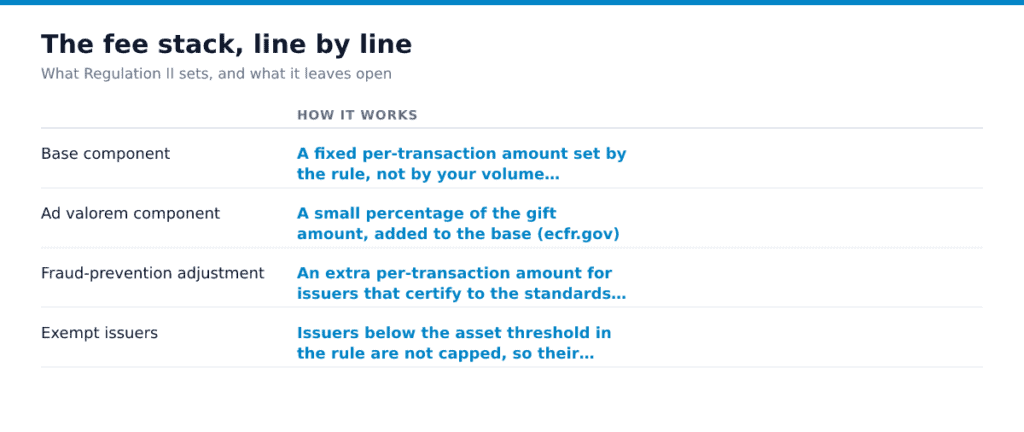
Debit is the cheapest card a giver can hand you, and federal rule keeps it that way. Regulation II governs debit interchange fees and routing for electronic debit transactions (ecfr.gov). For issuers above the asset threshold, the interchange fee an issuer may receive is capped at a fixed base component plus an ad valorem component of the transaction value (ecfr.gov), with a separate fraud-prevention adjustment available to issuers that meet the standards (ecfr.gov).
| Element | How it works |
|---|---|
| Base component | A fixed per-transaction amount set by the rule, not by your volume (ecfr.gov) |
| Ad valorem component | A small percentage of the gift amount, added to the base (ecfr.gov) |
| Fraud-prevention adjustment | An extra per-transaction amount for issuers that certify to the standards (ecfr.gov) |
| Exempt issuers | Issuers below the asset threshold in the rule are not capped, so their debit cards price like credit (ecfr.gov) |
Plenty of tithing runs on debit cards from small community banks and credit unions, which are exactly the issuers the cap doesn’t reach. So the mix matters. But on every capped debit gift, a flat 2.9% plus a dime hands your processor the whole gap between the capped interchange and the flat price, and the gap widens as the gift gets bigger.
Once online giving clears a few thousand dollars a month, ask for interchange-plus with the margin stated as one number in writing. Nonprofit pricing is real and worth requesting. A discounted flat rate is still a flat rate.
The contract clauses that cost more than the fees
Ask one question before you look at a rate sheet: can you log in tomorrow and download every donor record, every gift, every fund designation and every recurring schedule as CSV, without opening a support ticket and without paying an exit fee? If the answer is no, the platform owns your giving history and you’re renting it. Donor data belongs to the church.
Card tokens are the harder lock. A token is the stored stand-in for a card number, and it usually belongs to the processor, not to you, so moving platforms means asking every monthly giver to re-enter a card. Some drop off. Budget for that loss before you switch, and ask in writing whether tokens can be migrated to another gateway.
Then look at the giving page itself. If it demands an account before the gift, completion falls, and the fix is a guest path that takes a name, an amount and a card. The cover-the-fee prompt should be visible and unchecked, so covering it is a choice the donor makes. Fund designation belongs in a dropdown at the moment of the gift, building fund, missions or benevolence, not reconstructed later from memo lines by a volunteer treasurer.
Receipts are compliance, not courtesy. A donor needs written acknowledgment from the church for any single contribution of $250 or more (IRS Publication 557), and any payment over $75 that’s part gift and part goods requires a quid pro quo disclosure stating the deductible portion. Confirm the platform generates both automatically, as our Nonprofit Insights & Giving Tips walkthrough sets out., which our Nonprofit Insights & Giving Tips security notes explain.
From Cloud Donor Manager Before you sign anything, ask for the termination fee, the renewal window and the processor’s margin as three numbers in writing. Cloud Donor Manager publishes its giving fees and contract terms on one page, with no term commitment and no equipment lease. See the fees and contract terms in full
How to price and choose a platform in one afternoon
Do this before your next budget cycle, or the week a processor’s renewal window opens. You need one afternoon, your giving export, and two quotes.
- Pull the last 12 months of online giving and write down four numbers: total dollars, gift count, average gift, and the card-versus-ACH split. Your reporting screen should give you these in a few clicks, and our Nonprofit Insights & Giving Tips guide shows where they hide.
- Run each candidate’s published rates against those real numbers, not a $100 sample gift. Percentage rates and per-transaction fees rank differently once your average gift is in the math.
- Ask two processors for an interchange-plus quote in writing with the margin stated as one number, then compare effective rates on identical volume.
- Open each giving page on a phone as a stranger. Count taps to finish a gift, check whether monthly is preselected, and confirm no account is required.
- Request a sample full data export before you sign, and set the fund designation field and receipt template before the first live gift lands.
You’re done when one platform wins on effective rate and tap count together. Book the two quote calls today, and compare our Nonprofit Insights & Giving Tips platform rundown while you wait for them.
Frequently Asked Questions
Is Givelify free for churches?
That’s the same trade every “free” giving app makes, so the question worth asking isn’t the setup cost but what the effective rate works out to on your actual gift mix. Pull last quarter’s deposits, divide total fees by total gifts, and compare that single percentage against what an interchange-plus quote would cost you at the same volume.
Is there any free church accounting software available?
Yes, and it splits into two kinds: general-purpose free bookkeeping tools that know nothing about funds, and fund-accounting products with a free tier capped by transaction count, user seats or organization size. The cap is where the decision lives, because a church that outgrows the free tier mid-year pays migration effort on top of the new license. Before you commit, confirm you can export the full general ledger and the donor records as files you can open without the vendor.
What is the best app for church tithing?
The best app is the one that records the fund on the gift at the moment it’s given, lets a member set up a monthly gift without creating an account first, and hands you a complete export whenever you ask. Those three things matter more than the interface, because they determine whether your restricted-fund reporting is accurate and whether you can ever leave. We tell churches to test a platform by making a $5 designated gift on a phone and then trying to find that designation in a report.
Can a church pass credit card fees on to donors?
You can offer donors the option to cover the processing fee, and most giving platforms build that in as a checkbox on the gift form. Keep it unchecked by default and state the amount in dollars, not as a vague “help cover costs” line, so the donor sees what they’re agreeing to. Note that the tax-deductible portion of a fee-covered gift and any state rules on surcharging card payments are separate questions worth running past your accountant, since debit card interchange in particular sits under its own federal rule (ecfr.gov).
From Cloud Donor Manager Every gift is tagged to a fund at the moment it’s recorded, so a $5 gift designated to the building fund shows up in the building fund report before the deposit clears. Donors give without creating an account, the fee-cover box stays unchecked, and you can export your full donor list to CSV whenever you want it. See how fund designations and exports work